 ABC Bullion


Prices are fetched automatically and may not reflect current merchant prices. Currency conversions and tax treatment are approximate. Rankings are based solely on price. We are not a dealer and accept no responsibility for transactions with listed merchants. Past performance is not indicative of future results. This site does not provide investment advice. Full disclaimer
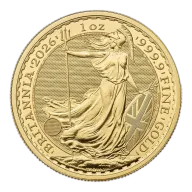
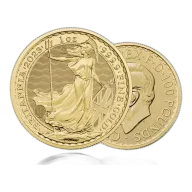
About the 1 oz Britannia Gold Coin
The UK's Most Tax-Efficient Gold Investment
The 1 oz Gold Britannia is the Royal Mint's flagship bullion coin and the most tax-efficient way for UK residents to hold physical gold. As UK legal tender with a GBP 100 face value, it is exempt from both VAT on purchase and Capital Gains Tax on disposal. No other major sovereign bullion coin offers this double exemption for UK taxpayers. The 1oz Krugerrand, 1oz Gold Eagle, and Canadian Maple Leaf are all VAT-free in the UK, but profits on sale are subject to CGT above the annual allowance (currently GBP 3,000).
The Britannia has been struck since 1987. The gold purity was upgraded from 22 carat (0.917) to 24 carat (0.9999) in 2013, matching the Maple Leaf, Philharmonic, and Kangaroo. Both the pre-2013 and post-2013 versions contain the same amount of pure gold per denomination; the older coins simply weigh more due to their copper alloy. The purity change was driven by international competition and the need to simplify export tax classification in markets with purity-based thresholds.
From the 2021 issue onwards, the Britannia carries four anti-counterfeiting features visible to the naked eye, earning the Royal Mint's description as "the world's most visually secure bullion coin." A latent image switches between a padlock and a trident depending on viewing angle. A surface animation creates a wave-like movement when the coin is tilted, produced using picosecond lasers working at submicron scale. Micro-text reading "DECUS ET TUTAMEN" (Latin: "an ornament and a safeguard") encircles Britannia. Tincture lines on Britannia's shield use the heraldic art of depicting colours through line patterns on metal.
The reverse design changes annually, a feature shared with only a handful of sovereign bullion coins (notably the Gold Kangaroo and the Chinese Panda). This adds collector interest to what is fundamentally a bullion product, though all years carry equal metal value. Mintage is unlimited, produced to meet market demand.
Britannia Denominations and Dimensions
The Gold Britannia is available in six denominations. All post-2013 coins are .9999 fine gold.
| Size | Face value | Gold content | Total weight | Diameter |
|---|---|---|---|---|
| 1 oz | GBP 100 | 31.104 g | 31.21 g | 32.69 mm |
| 1/2 oz | GBP 50 | 15.55 g | 15.60 g | 27 mm |
| 1/4 oz | GBP 25 | 7.78 g | 7.86 g | 22 mm |
| 1/10 oz | GBP 10 | 3.11 g | 3.13 g | 16.5 mm |
| 1/20 oz | GBP 5 | 1.555 g | 1.58 g | 12 mm |
| 5 oz | GBP 500 | 156.295 g | - | 65 mm |
Edge: Milled (reeded). Thickness (1 oz): 3 mm. Purity: .9999 fine gold (post-2013); .917 fine (1987-2012). Obverse: King Charles III (2023 onwards); Queen Elizabeth II (1987-2022, various portraits).
Pre-2013 vs Post-2013
The 2013 purity upgrade changed the gold from 22 carat to 24 carat, but the pure gold content per denomination remained identical. A pre-2013 1 oz Britannia contains 31.104g of gold in a 34.05g coin (the extra mass is copper alloy). A post-2013 coin contains the same 31.104g of gold in a 31.21g coin. The older coins are slightly more scratch-resistant due to the copper alloy, but they do not qualify for US IRA inclusion (the .917 purity falls below the .995 minimum). Post-2013 coins (.9999) are IRA-eligible.
Britannia Tax Advantages by Country
The Britannia's tax treatment is its single strongest selling point. The combination of VAT exemption, CGT exemption, and retirement account eligibility makes it exceptionally tax-efficient across multiple jurisdictions.
- UK (CGT): Exempt. All Britannia coins (gold, silver, platinum) are exempt from Capital Gains Tax because they are UK legal tender denominated in sterling. Sterling currency is not a chargeable asset for CGT purposes. This exemption has no annual limit; it applies regardless of the size of the gain. This is the principal reason Britannias and Sovereigns carry higher premiums than Krugerrands or Maple Leafs in the UK market.
- UK (VAT): Exempt. Gold Britannias are VAT-free as investment gold under the UK's implementation of the former EU Investment Gold Directive. Silver and platinum Britannias attract 20% VAT unless purchased under a VAT-free storage scheme (typically offshore, e.g. Zurich or Singapore).
- UK (SIPP): Gold Britannias are eligible for Self-Invested Personal Pensions. Tax relief at marginal rate (up to 45%). Gold held within a SIPP is also exempt from CGT. No ISA eligibility for physical bullion.
- US (IRA): Post-2013 gold Britannias (.9999 fine) meet the IRS minimum purity of .995 for gold IRAs. Must be held by an approved custodian. Pre-2013 Britannias (.917) do not qualify.
- US (capital gains): Taxed at the collectibles rate of up to 28%.
- Canada: GST/HST-exempt at .9999 purity. RRSP and TFSA eligible through approved dealers with allocated storage.
- Australia: GST-free as investment-grade gold (.9999 exceeds the 99.5% threshold). CGT applies with a 50% discount for holdings over 12 months.
- EU: Gold Britannias qualify as investment gold under the EU Gold Directive, even post-Brexit (the coins meet the objective criteria). VAT-exempt across all member states.
- Singapore: GST-exempt under the Investment Precious Metals scheme. No capital gains tax.
- Hong Kong: No sales tax, no import duty, no capital gains tax.
- New Zealand: GST-exempt as fine gold at 99.5%+ purity. No formal capital gains tax.
- Germany: Capital gains are completely tax-free if the coin is held for over 12 months, regardless of the size of the gain.
From Apartheid-Era Rival to Britain's Premier Bullion Coin
The Gold Britannia was launched in 1987, the same year as the Austrian Philharmonic and one year after the American Gold Eagle. Its creation was a direct response to international demand for sovereign gold bullion coins, a market that had been dominated by the South African Krugerrand since 1967. With anti-apartheid sanctions restricting Krugerrand imports in many Western countries during the 1980s, there was a gap in the market that the Royal Mint moved to fill.
The original 22-carat (0.917) purity matched the traditional British gold coinage standard used for Sovereigns since 1817. This remained the standard for 26 years until the 2013 upgrade to .9999, which brought the Britannia into line with the Maple Leaf (which had offered .9999 gold since 1982) and the Philharmonic. The purity change also changed the coin's colour: 22-carat Britannias have a warmer, slightly reddish tone from the copper alloy; 24-carat coins are a purer yellow.
The reverse design has been refreshed regularly, with Philip Nathan's original standing Britannia (1987-1996) serving as the template that later designers have reworked. Nathan's designs have returned multiple times across the series. The 2014 issue produced an unexpected collector item: approximately 17,000 "Mule Britannia" coins were struck with an incorrect Lunar Year obverse die, and these now command significant premiums on the secondary market.
The 2021 redesign was the most significant in the coin's history, introducing the four-layer security system (latent image, surface animation, micro-text, tincture lines). The Royal Mint was one of the first mints worldwide to use picosecond laser technology for coin production, creating surface detail at scales 200 times narrower than a human hair. The Britannia silver standard (.958) used from 1997-2012 was also historically notable, being a revival of an alloy first mandated in England in 1697 to prevent coin clipping of sterling silver.
Britannia vs Krugerrand: The UK Buyer's Core Decision
For UK gold buyers, the choice between the 1oz Krugerrand and the 1oz Britannia is the most consequential decision in the market. Both are VAT-free. Both contain exactly one troy ounce of gold. The Krugerrand typically carries lower premiums at purchase, sometimes meaningfully so. But the Britannia is CGT-exempt and the Krugerrand is not.
The maths on CGT exemption depends on the size of the gain and the investor's tax rate. For small purchases held within the annual CGT allowance (GBP 3,000 for 2025/26), the Krugerrand's lower premium wins. For larger holdings where gains would exceed the allowance, the Britannia's CGT exemption can save thousands of pounds on disposal. The breakeven point depends on the holding period, the gold price movement, and the investor's marginal tax rate, but for any holding above a few coins, the Britannia's tax advantage compounds over time.
Britannia vs Maple Leaf and Kangaroo
The Canadian Maple Leaf and the 1oz Gold Kangaroo are both .9999 fine, matching the post-2013 Britannia on purity. The Maple Leaf has Bullion DNA digital authentication and MintShield anti-fingerprint coating; the Kangaroo has micro-laser engraving and annually changing designs. The Britannia counters with its four-layer visual security system and, for UK buyers, the decisive CGT exemption. Both the Maple Leaf and Kangaroo are subject to UK CGT. In non-UK markets where CGT exemption is irrelevant, the three coins compete primarily on premium, availability, and security features.
Britannia vs American Gold Eagle
The 1oz Gold Eagle is 22-karat (.9167), making it physically larger and more scratch-resistant than the Britannia but less pure. The Eagle is IRA-eligible in the US by statutory name; the post-2013 Britannia qualifies on purity. The Britannia's advanced security features significantly outperform the Eagle's simpler reeded edge (though the Type II Eagle added a variable reed from 2021). For US buyers, the Eagle's domestic liquidity advantage is substantial. For UK buyers, the Britannia's CGT exemption makes it categorically superior.
1 oz Britannia Gold Coin: frequently asked questions
-
The cheapest 1 oz gold Britannia tracked today is A$6,239.30 from ABC Bullion, with prices across tracked dealers ranging from A$6,239.30 to A$6,282.70. Comparing dealers on this page takes seconds and can save a meaningful amount on a single coin.
-
The lowest-priced listing currently sits at about 4.9% over the A$5,971.17 gold spot price. Premiums vary between dealers and shift with market demand, so checking the live comparison table gives the most accurate picture of what you would actually pay today.
-
Yes. Gold Britannia coins struck from 2013 onwards are 999.9 fine gold (24 carat). Earlier Britannias minted between 1987 and 2012 were 22 carat (0.917 fine) and alloyed with copper, though they contained the same amount of pure gold per coin. The 2013 upgrade to 24 carat brought Britannias in line with rivals such as the Canadian Maple Leaf.
-
Yes. The 1 oz gold Britannia is issued by The Royal Mint and is UK legal tender with a face value of £100, though its gold content makes it far more valuable than its nominal face value. Legal-tender status is the basis for the coin's Capital Gains Tax exemption for UK investors.
-
In the UK, gold Britannia coins are exempt from Capital Gains Tax because they are UK legal-tender coins denominated in sterling. UK legal-tender coins like Britannias fall outside the chargeable-asset definition for CGT purposes. Investment-grade gold itself is also free of UK VAT. For US investors, gold coins are taxed as collectibles at up to 28%; in Canada, 50% of any gain is included in taxable income.