7 products · 61 deals
Filters
| Product | /oz | Premium | Price | |
|---|---|---|---|---|

11 deals
|
$4,912.98 | +13.07% |
$245.65
£184
|
Compare |

24 deals
|
$4,994.72 | +13.31% | $249.74 | Compare |

4 deals
|
$5,107.81 | +17.55% |
$255.39
£191
|
Compare |
| $5,196.68 | +19.59% |
$259.84
£195
|
View Deal | |
| $5,627.51 | +27.66% | $281.38 | View Deal | |
| $5,865.61 | +34.99% |
$292.30
£219
|
View Deal | |

19 deals
|
$5,882.82 | +35.39% |
$294.15
£220
|
Compare |



Prices are fetched automatically and may not reflect current merchant prices. Currency conversions and tax treatment are approximate. Rankings are based solely on price. We are not a dealer and accept no responsibility for transactions with listed merchants. Past performance is not indicative of future results. This site does not provide investment advice. Full disclaimer
About 1/20 oz Gold Coins
The Smallest Government-Minted Gold Coin Denomination
A 1/20 oz gold coin contains 1.5552 grams of gold, making it the smallest fractional troy-ounce denomination produced by government mints. At a gold price around $3,300 per ounce, each coin holds roughly $165 of metal. That low entry price defines who buys at this weight: gift buyers, collectors building date runs, and stackers who want sovereign-mint gold without committing the cash a 1oz gold coin demands.
The denomination is exclusively a gold phenomenon. No government mint produces 1/20 oz silver or platinum coins, because the metal value at that size would be trivial. It is also exclusively a coin format; the 1/20 oz weight exists only as government-minted legal tender, not as bars. Buyers shopping at this budget who prefer bars typically look at 1g or 2.5g gold bars instead, which is the common choice among European buyers in this price range.
The economic tradeoff is straightforward and unflattering. Spreading the fixed costs of striking, finishing, and packaging a coin across just 1.555 grams of gold produces the highest premiums of any government-mint gold product. For pure accumulation, 1/4oz gold coins and 1/2 oz coins deliver significantly better value per gram. The 1/20 oz earns its place for different reasons: it makes sovereign gold giftable at a modest price point, it lets collectors complete fractional sets, and it offers maximum divisibility for anyone who wants to be able to sell gold in very small increments.
Worth knowing before comparing products: not every major series comes this small. The American Gold Eagle and the Britannia both bottom out at 1/10 oz. The 1/20 oz is primarily a Canadian and Australian denomination, led by the Royal Canadian Mint's Maple Leaf and the Perth Mint's Kangaroo, with Mexico's Libertad as the low-mintage outsider. A common point of confusion is the difference between 1/20 oz and 1g products: a 1/20 oz coin contains 1.555g, so it holds 56% more gold than a 1g piece, and it carries legal tender status where the 1g format is typically a bar in an assay card. If you are comparing listings across both sizes, that gap matters more than the similar-looking prices suggest.
Why 1/20 oz Premiums Are the Steepest on the Gold Coin Scale
Premiums on 1/20 oz gold coins typically run 15-25% over spot, and sometimes higher. The cause is structural rather than a matter of dealer pricing: minting a coin carries fixed costs for striking, finishing, and packaging that are the same whether the blank weighs 31 grams or 1.5 grams. Spread across just 1.5552 grams of gold, those costs translate into the most expensive per-ounce gold a government mint sells. At $3,300 gold, a 1/20 oz coin has a melt value of about $165, yet retail prices commonly land at $190-210 or more.
The premium curve up the weight scale shows what you give up by buying small. Fractional gold coin premiums step down as weight rises: 1/10oz gold coins typically carry 8-15%, 1/4 oz coins around 7-10%, 1/2 oz around 5-8%, and full 1 oz government coins usually 3-8% in normal market conditions. Doubling up from 1/20 oz to 1/10 oz is the single most effective premium reduction available to a small-budget gold buyer, which is one reason the 1/10 oz is the more common "smallest fractional" choice in most markets.
The second half of the premium problem appears at resale. Dealer buyback on recognised government coins at this size is typically at or near spot value, which means the 15-25% paid above spot at purchase is largely lost when the coin is sold back. A buyer who pays a 20% premium and sells at spot needs the gold price itself to rise by roughly that much just to break even. That round-trip cost is acceptable for a gift or a collectible, and painful for an investment position.
Two practical notes for comparison shopping. First, because the absolute prices are low, a few dollars of difference between dealers translates into multiple percentage points of premium, so comparing across many dealers matters more at this weight than almost any other. Second, the Mexican 1/20 oz Libertad can behave differently from the rest of the category: its low mintages mean it may command a slight numismatic premium on the secondary market, which partially offsets the usual buyback loss for that specific coin.
1/20 oz Gold Coins by Mint
The category is dominated by a handful of government mints, and the line-up differs from what you see at larger weights because several flagship series never went this small.
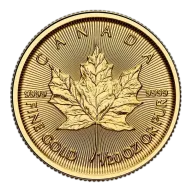
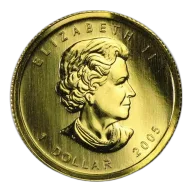
The Canadian Gold Maple Leaf 1/20 oz is the most widely available coin at this denomination. Struck in .9999 fine gold with a $1 CAD face value, it carries the same security features as the full-size Maple Leaf, including radial lines and a micro-engraved privy mark. At approximately 14mm in diameter it is slightly smaller than a shirt button. The 1/20 oz gold Maple Leaf is the default choice for buyers who want maximum dealer recognition at this size.
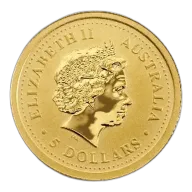
The Australian Gold Kangaroo 1/20 oz from the Perth Mint is also .9999 fine, with a $5 AUD face value and a kangaroo design that changes annually. Perth Mint additionally strikes 1/20 oz coins in its Lunar series, which our dealer data shows is one of the most widely stocked products at this weight alongside the Maple Leaf.
The Mexican Gold Libertad 1/20 oz is the collector's pick. Struck in .999 fine gold, it is one of the lowest-mintage government bullion coins at this size, and unusually it carries no face value denomination. Those low mintages give it a following beyond pure bullion buyers.
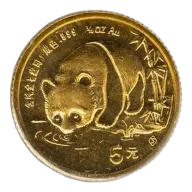
The Chinese Gold Panda existed at 1/20 oz only before 2016, when China switched its coin programme from troy-ounce to gram denominations. Historic 1/20 oz Pandas still circulate on the secondary market and have a collector following, particularly in Asia; the modern equivalent is the 1g Panda.
Just as important is what you will not find. The American Gold Eagle and the Britannia do not come in 1/20 oz; the smallest denomination in both series is the 1/10oz gold coin. The US Mint's fractional Eagles run 1/10, 1/4, and 1/2 oz only, so American buyers at this weight are necessarily buying Canadian, Australian, or Mexican coins. Purity is consistent across the main options, with the Maple Leaf and Kangaroo at .9999 fine and the Libertad at .999 fine, so the choice between them comes down to premium, availability, and any collector interest in the Libertad's mintage figures.
Selling and Storing Coins the Size of a Shirt Button
Liquidity at 1/20 oz is moderate by gold coin standards. Government-minted coins from recognised mints, the Royal Canadian Mint, the Perth Mint, and Mexico's mint among them, are accepted by all major dealers, so finding a buyer is not the problem. The denomination is nonetheless less liquid than 1/10oz gold coins, which serve as the standard "smallest fractional" gold coin in most markets and trade in larger volumes.
The practical friction comes from the low absolute value. With roughly $165 of gold in each coin, the cost of shipping and insuring a sale is disproportionate to what the coin is worth. Posting a single 1/20 oz coin to a dealer can consume a meaningful slice of the proceeds. These coins are best sold in person at a local dealer, or in quantity so the fixed selling costs spread across more metal. Anyone planning to accumulate at this weight should factor that into the exit plan from the start.
One resale bright spot is the Mexican Libertad: its low mintages mean 1/20 oz Libertads may command a slight numismatic premium on the secondary market, something the higher-mintage Maple Leaf and Kangaroo do not offer.
Storage conventions also differ from larger gold coins. There is no standard tube packaging at this size; coins are typically sold in individual flip holders or capsules rather than the mint tubes used for 1 oz coins. That suits the way they are usually bought, a few at a time, but it means a growing stack stays loose unless you organise it yourself.
Physically, these are tiny objects. The 1/20 oz Maple Leaf measures approximately 14mm across, slightly smaller than a shirt button, and a coin that small is genuinely easy to lose or damage if it is left out of protective housing. Dedicated numismatic storage, meaning capsules or album pages, is the sensible default. The compensation is that space requirements are negligible: dozens of 1/20 oz coins fit in a small coin box, so even a substantial holding at this weight occupies almost no room in a safe or deposit box.
1/20 oz Gold Coins: frequently asked questions
-
The metal in a 1/20 oz gold coin is worth one-twentieth of the current troy ounce spot price ($4,408.10). Retail prices include a dealer premium on top of that, and fractional coins like these typically carry higher premiums per ounce than full-size coins. The table above shows live offers from 21 dealers tracking 65 listings at this weight.
-
A 1/20 oz gold coin weighs 1/20 oz (1.5552 g). This is measured in troy ounces, where one troy ounce equals 31.1035 grams, so a twentieth is approximately 1.5552 grams of gold.
-
It means the coin contains one-twentieth of a troy ounce of gold, or about 1.5552 grams. Several sovereign mints produce coins at this size. Because the fixed costs of minting and distributing are spread over very little metal, premiums per troy ounce are higher at this size than for larger fractional or full-ounce coins.
-
Several sovereign mints produce gold coins at the 1/20 oz size. The page above tracks 65 listings from 21 dealers, so you can see exactly which coins are available and compare prices across them.
-
Investment gold coins meeting minimum purity thresholds are VAT-free in the UK (99.5% fineness or above) and throughout the EU. In Canada, qualifying gold coins are also exempt from GST (0%). Australian GST (0%) does not apply to investment gold. In the US there is no federal VAT, though some states levy sales tax on gold coin purchases.
- 1/20 oz American Eagle Gold Coin
- 1/20 oz Britannia Gold Coin
- 1/20 oz Gold Coin
- 1/20 oz Gold Lion Gold Coin
- 1/20 oz Libertad Gold Coin
- 1/20 oz Maple Leaf Gold Coin
- 1/20 oz Panda Gold Coin
- 1/20 oz Perth Mint Kangaroo Gold Coin
- 1/20 oz Perth Mint Lunar Gold Coin
- 1/20 oz Tower Mint Angel Gold Coin
- Pre-Owned 1/20 oz China Mint Gold Coin
- Pre-Owned 1/20 oz Libertad Gold Coin
- Pre-Owned 1/20 oz Maple Leaf Gold Coin
- Pre-Owned 1/20 oz Perth Mint Lunar Gold Coin