10 products · 162 deals Prices & premiums exclude tax to compare across countries
Filters
| Product | /oz | Premium | Price (ex. tax) | |
|---|---|---|---|---|

110 deals
|
$67.91 |
+1.87%
+22% inc.VAT
|
$67.91
£61 inc.VAT
|
Compare |

3 deals
|
$72.18 | +6.73% | $721.81 | Compare |

3 deals
|
$74.01 |
+11.02%
+33% inc.VAT
|
$2,379.48
£2,140 inc.VAT
|
Compare |

20 deals
|
$79.18 | +18.78% |
$79.18
£59
|
Compare |

2 deals
|
$79.42 |
+19.14%
+43% inc.VAT
|
$39.71
£36 inc.VAT
|
Compare |

3 deals
|
$82.31 |
+23.47%
+48% inc.VAT
|
$8,230.69
£7,402 inc.VAT
|
Compare |
| $89.21 |
+33.82%
+61% inc.VAT
|
$892.09
£802 inc.VAT
|
View Deal | |
| $95.22 | +42.83% |
$952.15
£714
|
View Deal | |

9 deals
|
$104.78 |
+57.18%
+89% inc.VAT
|
$26.19
£24 inc.VAT
|
Compare |

10 deals
|
$109.42 |
+64.14%
+97% inc.VAT
|
$10.94
£10 inc.VAT
|
Compare |


Prices are fetched automatically and may not reflect current merchant prices. Currency conversions and tax treatment are approximate. Rankings are based solely on price. We are not a dealer and accept no responsibility for transactions with listed merchants. Past performance is not indicative of future results. This site does not provide investment advice. Full disclaimer
About the Britannia Silver
The Royal Mint's Silver Flagship
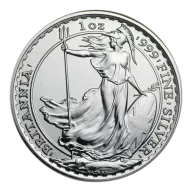
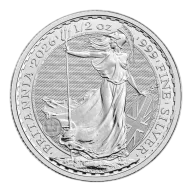
The Silver Britannia is the Royal Mint's primary silver bullion coin, first struck in 1997 and upgraded to .999 fine silver from 2013 onwards. For UK buyers, it occupies a unique position: it is one of the only silver coins exempt from Capital Gains Tax at the point of sale, because its status as UK legal tender (carrying a £2 face value) means it is not a chargeable asset for CGT purposes. That exemption does not apply to any foreign silver coin or to silver bars, making the Britannia the most tax-efficient way to hold physical silver in the UK.
From the 2021 issue onwards, the Britannia carries four anti-counterfeiting features that the Royal Mint describes as making it "the world's most visually secure bullion coin." These include a latent image that shifts between a padlock and a trident, a surface animation created with picosecond lasers, micro-text reading DECUS ET TUTAMEN ("an ornament and a safeguard"), and tincture lines on Britannia's shield. All four are visible to the naked eye when the coin is rotated in light, requiring no special equipment to verify. This level of built-in security exceeds what most competing sovereign mints offer on their silver coins.
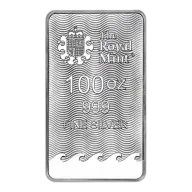
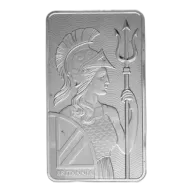
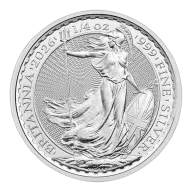
The series is available in a wide range of sizes. The 1 oz Silver Britannia is the core bullion product, with fractional sizes at 1/2 oz, 1/4 oz, and 1/10 oz, plus larger denominations at 2 oz, 5 oz, 10 oz, and 1 kilo in both coin and bar formats. The 10 oz Britannia Silver Bar and 100 oz Britannia Silver Bar extend the range for buyers looking to accumulate larger positions at lower premiums per ounce. Unlike most sovereign bullion coins that keep a fixed reverse design, the Britannia's reverse changes annually, adding a layer of year-over-year collectibility that most bullion series lack.
Silver Britannias are subject to 20% VAT on purchase in the UK, the same rate applied to all silver bullion regardless of origin. The VAT exemption that makes Gold Britannias so attractive does not extend to silver. The CGT exemption at the point of sale partially compensates for this, particularly for buyers expecting significant capital appreciation.
Silver Britannia Denominations and Dimensions
Current Production (2013 onwards, .999 fine)
| Size | Face Value | Silver Content | Diameter | Thickness |
|---|---|---|---|---|
| 1/10 oz | 20p | 3.11g | -- | -- |
| 1/4 oz | 50p | 7.78g | -- | -- |
| 1/2 oz | £1 | 15.55g | -- | -- |
| 1 oz | £2 | 31.10g | 38.61 mm | 3 mm |
| 2 oz | -- | 62.2g | -- | -- |
| 5 oz | £10 | 155.5g | -- | -- |
| 10 oz | -- | 311g | -- | -- |
| 1 Kilo | -- | 1,000g | -- | -- |
All coins have a reeded (milled) edge. Bars are also available in 10 oz, 100g, and 100 oz sizes in .999 fine silver.
Historical Production (1997-2012, Britannia Silver .958)
The original silver Britannia was struck in Britannia silver, a historic alloy of .958 fineness first defined in England in 1697 to prevent the clipping of sterling silver coins. At this purity, the 1 oz coin weighed 32.45g total (heavier than the post-2013 version) with a 40 mm diameter. The 2013 upgrade to .999 brought the Silver Britannia in line with international bullion standards and reduced the total weight to 31.21g while maintaining the same 31.10g of pure silver content.
Security Features (2021 onwards)
- Latent image: A circular area switching between padlock and trident at different viewing angles
- Surface animation: Wave-like pattern behind Britannia, created by picosecond laser at submicron scale
- Micro-text: DECUS ET TUTAMEN encircling Britannia, visible only under magnification
- Tincture lines: Heraldic pattern on the shield using centuries-old metalwork techniques
Silver Britannia Tax Treatment by Country
United Kingdom: Silver Britannias are subject to 20% VAT on purchase, the same treatment as all silver bullion in the UK. There is no VAT exemption for silver (only investment gold qualifies). On disposal, Britannias are exempt from Capital Gains Tax because they are UK legal tender denominated in sterling. Sterling currency is not a chargeable asset under HMRC rules. This CGT exemption applies to all Britannia coins across gold, silver, and platinum, and is the primary tax advantage that distinguishes Britannias from foreign silver coins and silver bars. The annual CGT allowance is currently £3,000. Silver Britannias are eligible for inclusion in a Self-Invested Personal Pension (SIPP), with tax relief at the buyer's marginal rate.
United States: Post-2013 Silver Britannias at .999 purity meet the IRS fineness requirement for precious metals IRAs (silver must be .999+). Pre-2013 coins at .958 purity do not qualify. Silver gains are taxed as collectibles at a maximum 28% federal rate. Sales tax varies by state, with approximately 35 states exempting bullion.
Canada: Silver bullion at .999 purity is exempt from GST/HST under the Excise Tax Act. Capital gains are taxed at a 50% inclusion rate. Silver Britannias are not eligible for RRSP or TFSA accounts through most custodial arrangements.
Australia: Silver at 99.9% purity qualifies as investment-grade and is GST-free. The .999 Britannia meets this threshold. CGT applies on disposal with a 50% discount for assets held longer than 12 months.
European Union: Silver Britannias are subject to the standard VAT rate in each EU country, ranging from 17% (Luxembourg) to 27% (Hungary). Germany offers a margin scheme (Differenzbesteuerung) on pre-owned silver coins, and the Netherlands applies a similar scheme. These margin-scheme rates result in effective VAT well below the headline rate.
New Zealand: Fine silver at 99.9% purity is GST-exempt. No formal capital gains tax exists, though gains may be taxable as income if the IRD determines the silver was acquired for resale.
Singapore: Investment Precious Metal silver at 99.9% purity is exempt from the 9% GST. No capital gains tax applies in Singapore.
Hong Kong: No sales tax, import duty, or capital gains tax on silver bullion of any kind.
South Africa: Silver bullion is subject to 15% VAT. The zero-rating that applies to Gold Krugerrands does not extend to silver products, including imported Silver Britannias.
From Britannia Silver to Four Security Features
The Royal Mint introduced the Silver Britannia in 1997, a decade after the gold version launched in 1987. The initial silver coin was struck in Britannia silver at .958 fineness, a historic alloy that had a direct connection to British coinage history. The Britannia silver standard was first mandated in England in 1697, requiring silversmiths to work to a higher purity than sterling (.925) to prevent the clipping of circulating silver coins. The Royal Mint revived this standard specifically for its silver bullion coin, giving the early Britannias a unique purity not shared by any other modern bullion coin.
In 2013, the silver purity was upgraded to .999, matching the international standard used by the American Silver Eagle, Austrian Philharmonic, and other major sovereign coins. The upgrade brought several practical benefits: it aligned the Britannia with IRA fineness requirements in the United States (.999 for silver), it simplified cross-border trade, and it removed the need to explain the unusual .958 purity to international buyers. Pre-2013 coins contain the same weight of pure silver per denomination as post-2013 coins; the older coins simply weigh more overall because the alloy includes more copper.
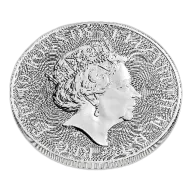
The reverse design of the Britannia changes regularly, unlike most sovereign bullion coins that maintain a fixed design. Philip Nathan created the original 1987 standing Britannia with trident and shield, and his work has been revisited several times. Other designers who have contributed reverse designs include Christopher Le Brun, Suzie Zamit, Robert Hunt, Jody Clark, Antony Dufort, Jonathan Olliffe, and Marie-Alice Harel. The obverse carried portraits of Queen Elizabeth II from 1987 through 2022, with the King Charles III portrait appearing from 2023 onwards.
The most significant recent development was the introduction of four anti-counterfeiting features from the 2021 issue. The Royal Mint developed the surface animation technology using picosecond lasers that create indentations 200 times narrower than a human hair, producing a wave-like pattern that appears to move when the coin is tilted. Combined with the latent image, micro-text, and tincture lines, this made the Britannia one of the most technically advanced coins in production. The Royal Mint was among the first sovereign mints to apply this level of laser technology to coin manufacturing.
A notable production anomaly occurred in 2014, when approximately 17,000 coins were struck with an incorrect Lunar Year obverse die, creating the "Mule Britannia." These error coins now command substantial premiums above the standard bullion price.
Silver Britannia vs Maple Leaf, Eagle, and Kookaburra
The Silver Britannia's most direct competitor in the UK market is the Silver Maple Leaf from the Royal Canadian Mint. Both are sovereign-mint coins with strong global recognition, but they differ in purity and security approach. The Maple Leaf is .9999 fine silver (four nines), the highest purity of any standard bullion coin, and uses the Bullion DNA digital authentication system that allows individual coin-level verification through a dedicated reader device. The Britannia at .999 fine uses visual security features that require no equipment beyond the human eye. For UK buyers, the Britannia's CGT exemption makes it the more tax-efficient choice on disposal. The Maple Leaf is not UK legal tender and therefore subject to capital gains tax. Both carry 20% VAT on purchase in the UK.
Against the American Silver Eagle from the US Mint, the Britannia competes well on premiums. The Eagle carries the highest premiums of any sovereign silver coin, typically 20-30% over spot, driven by domestic US demand and the US Mint's pricing to authorised purchasers. The Britannia trades at lower premiums in most markets. The Eagle was redesigned in 2021 (Type II) and uses .999 fine silver, the same purity as the Britannia. Neither coin matches the Maple Leaf's .9999 purity. For US buyers, the Eagle's widespread recognition gives it a liquidity advantage, but the Britannia's security features are more advanced.
The Perth Mint Kookaburra shares the Britannia's practice of changing its reverse design annually. The Kookaburra was first minted in 1990 and was upgraded to .9999 purity from 2018. It has a maximum annual mintage of 500,000 coins (since 2013), lower than the Britannia's unlimited mintage. The mintage cap gives the Kookaburra stronger year-over-year collectibility, with early vintage years (especially the 2000 issue at 84,000 coins) commanding significant premiums. The Britannia's unlimited production keeps premiums lower and availability broader, making it the better choice for pure bullion accumulation rather than date-specific collecting.
The Austrian Silver Philharmonic from the Austrian Mint consistently carries some of the lowest premiums among sovereign silver coins. At .999 purity with a fixed design and EUR 1.50 face value, the Philharmonic is a straightforward value play. It lacks the Britannia's security features and design variety, and it offers no tax advantages for UK buyers. For investors outside the UK who are not concerned with CGT exemption, the Philharmonic's lower premium makes it a strong competitor.