15 products · 248 deals
Filters
| Product | /oz | Premium | Price | |
|---|---|---|---|---|

2 deals
|
$4,470.99 | +2.89% |
$4,471.00
£3,351
|
Compare |

19 deals
|
$4,477.08 | +3.03% |
$4,318.25
£3,236
|
Compare |

47 deals
|
$4,479.51 | +3.09% |
$4,479.51
£3,357
|
Compare |

3 deals
|
$4,669.65 | +7.47% |
$1,167.42
£875
|
Compare |

24 deals
|
$4,702.72 | +8.23% |
$2,267.94
£1,700
|
Compare |

34 deals
|
$4,707.69 | +8.34% |
$2,353.83
£1,764
|
Compare |

20 deals
|
$4,826.78 | +11.08% |
$1,241.48
£930
|
Compare |

16 deals
|
$4,861.43 | +11.88% |
$1,215.36
£911
|
Compare |
| $4,963.60 | +12.60% | $24,817.99 | View Deal | |

3 deals
|
$4,904.51 | +12.87% |
$2,452.26
£1,838
|
Compare |

24 deals
|
$5,007.92 | +13.61% | $250.40 | Compare |
| $5,059.32 | +14.77% | $505.94 | Compare | |

14 deals
|
$5,145.52 | +18.42% |
$496.30
£372
|
Compare |

29 deals
|
$5,186.84 | +19.37% |
$518.68
£389
|
Compare |

10 deals
|
$5,889.21 | +35.51% |
$189.34
€165
|
Compare |






Prices are fetched automatically and may not reflect current merchant prices. Currency conversions and tax treatment are approximate. Rankings are based solely on price. We are not a dealer and accept no responsibility for transactions with listed merchants. Past performance is not indicative of future results. This site does not provide investment advice. Full disclaimer
About the Panda Gold
The Gold Panda: China's Annual Collector-Bullion Hybrid
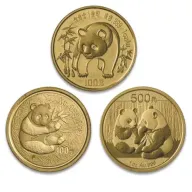
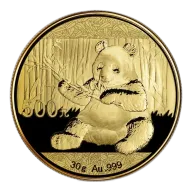
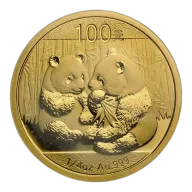
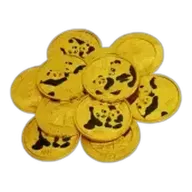
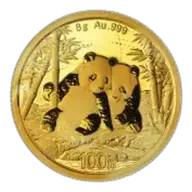
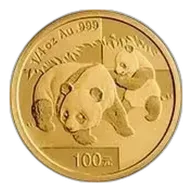
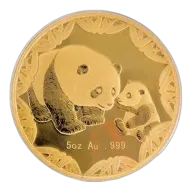
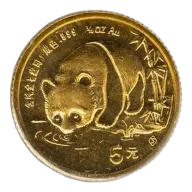
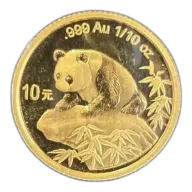
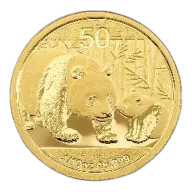
The Gold Panda, produced by the China Gold Coin Corporation (CGCC) under the People's Bank of China, occupies a unique position in the bullion market. Introduced in 1982, it is one of only two major government coin series (alongside the Australian Kangaroo) that changes its reverse design every year. Each annual edition features a new illustration of a giant panda, creating collector demand that sits on top of the coin's metal value. This dual appeal means Gold Pandas consistently trade at higher premiums than comparably sized coins from other sovereign mints.
The standard Gold Panda is struck in 999 fine gold (three nines), a step below the 999.9 purity of the Britannia, Kangaroo, and Philharmonic. The coin is legal tender of the People's Republic of China with face values denominated in yuan. The obverse carries an unchanging depiction of the Hall of Prayer for Good Harvests (Qinian Dian) at the Temple of Heaven in Beijing, a design element that has remained constant since the series began.
A significant change occurred in 2016 when China switched the Panda from troy ounce denominations to metric grams. The standard coin went from containing exactly 1 troy ounce (31.103 grams) to containing 30 grams (0.9645 troy ounces), a reduction of roughly 3.5% in gold content. Physical dimensions remained unchanged. Pre-2016 Pandas in troy ounce weights and post-2016 Pandas in metric grams are both actively traded, but buyers should be clear about which weight standard they are purchasing.
Counterfeiting is a more significant concern for Pandas than for most other major bullion series. The combination of annually changing designs (making comparison harder), higher collector premiums (making counterfeiting more profitable), and historically less sophisticated anti-counterfeiting features has created what numismatic authentication services describe as an alarming rate of skilled fakes. Purchasing from established dealers or buying coins certified by NGC or PCGS is the standard mitigation. Recent Pandas have added security enhancements including radial line backgrounds and micro-engraved marks, but the series still lacks a digital authentication system comparable to the Royal Canadian Mint's Bullion DNA.
Gold Panda Denominations Across Two Weight Eras
The 2016 metrication divides the Gold Panda into two distinct specification sets. Buyers and dealers regularly reference both.
Pre-2016 (Troy Ounce Era, 999 Fine Gold)
| Face Value | Weight | Fine Gold (g) | Diameter (mm) | Thickness (mm) |
|---|---|---|---|---|
| 100 yuan | 1 oz | 31.103 | 32.05 | 2.70 |
| 50 yuan | 1/2 oz | 15.552 | 27.00 | 1.85 |
| 25 yuan | 1/4 oz | 7.776 | 21.95 | 1.53 |
| 10 yuan | 1/10 oz | 3.110 | 17.95 | 1.05 |
| 5 yuan | 1/20 oz | 1.555 | 13.92 | 0.83 |
The 1/20 oz denomination was added in 1983. Larger sizes (5 oz, 12 oz, 1 kg) have been produced on occasion. Face values were increased in 2001.
Post-2016 (Metric Era, 999 Fine Gold)
| Face Value | Weight | Approx Troy Oz | Diameter (mm) | Thickness (mm) |
|---|---|---|---|---|
| 500 yuan | 30g | 0.9645 | 32 | 2.70 |
| 200 yuan | 15g | 0.4823 | 27 | 1.85 |
| 100 yuan | 8g | 0.2572 | 22 | 1.53 |
| 50 yuan | 3g | 0.0965 | 18 | 1.05 |
| 10 yuan | 1g | 0.0322 | 10 | 0.83 |
Physical dimensions remained unchanged from the pre-2016 coins despite the reduced gold content. The 30g coin is 3.5% lighter than the previous 1 oz standard. Larger metric sizes include 50g, 100g, 150g, and 1 kg. Coins are struck at multiple facilities in Beijing, Shanghai, Shenyang, and Shenzhen without standardised mintmarks, making attribution to a specific mint difficult for most years.
Gold Panda Tax Treatment and IRA Eligibility
The Gold Panda's tax treatment varies significantly by jurisdiction, with one particularly important distinction in the United States that catches many investors off guard.
- United States (IRA): Gold Pandas are generally considered not IRA-eligible. The IRS does not recognise the Chinese mint as an approved foreign mint for IRA gold purposes, and the coins' semi-numismatic character (annually changing designs, collector premiums) can classify them as collectibles rather than qualifying bullion. Some IRA custodians may accept 999-purity sovereign coins on a case-by-case basis, but this is not guaranteed. By contrast, Silver Pandas at 999 purity are typically accepted for IRA inclusion, meeting the 99.9% threshold. This gold-versus-silver distinction is specific to the Panda series and does not apply to coins from mints the IRS does recognise.
- United States (Capital Gains): Outside retirement accounts, gains are taxed at the collectibles rate of up to 28% for long-term holdings. State sales tax varies; most states exempt investment bullion.
- United Kingdom: Gold Pandas are VAT-exempt as investment-grade gold (the coins meet the threshold for post-1800 legal tender coins at 99.0% or higher purity). Silver Pandas attract 20% VAT. Gold Pandas are not CGT-exempt; only UK legal tender coins such as the Britannia and Sovereign qualify for that exemption.
- Canada: Standard capital gains treatment (50% inclusion rate). Gold Pandas are not RRSP or TFSA eligible.
- European Union: Gold Pandas are VAT-exempt under the EU Investment Gold Directive. Silver Pandas are subject to local VAT rates.
- Australia: Investment-grade gold is GST-free (Pandas meet the 99.5% threshold). Capital gains tax applies on disposal with a 50% discount for holdings exceeding 12 months.
- Singapore: Investment-grade gold coins of 99.5% purity or above that are or were legal tender qualify for GST exemption under the IPM scheme. The Panda at 999 fineness qualifies. No capital gains tax.
- Hong Kong: No sales tax, no import duty, and no capital gains tax.
From 1982 Debut to Metric Controversy
The Gold Panda was China's first modern gold bullion coin, introduced in 1982 partly to monetise domestic gold reserves and partly as a cultural export. Panda America served as the official US distributor from launch, and the coin quickly established itself among the major bullion series globally.
The obverse design, the Hall of Prayer for Good Harvests at the Temple of Heaven complex in Beijing, was set in 1982 and has never changed. The reverse, depicting a giant panda in a new pose each year, became the series' defining feature. Pandas have been shown eating bamboo, playing, resting, walking, and caring for cubs across more than four decades of annual editions.
The one exception to annual design changes came in 2001-2002. A design freeze was announced for 2001, and the 2002 coin carried an identical reverse to the 2001 issue. The only way to distinguish the two years is by the date on the obverse. Collector backlash was strong enough that China reverted to annual changes from 2003 onward, and the policy was never repeated.
The 2015 vintage produced an unusual anomaly: gold Pandas were issued without denomination, weight, fineness, or metal inscriptions on the coin, leaving only the panda image and the year. This absence of standard markings was widely criticised for both aesthetic and anti-counterfeiting reasons and was not repeated in subsequent years.
The Silver Panda followed a more turbulent path. Introduced in 1983 as a proof-only issue in 27 grams of 900-fine silver, it skipped production entirely in 1986 and 1988, switched to 925 sterling silver in 1987, and finally settled on 999 fine silver from 1989 onward. Modern silver Panda production reaches 10 million coins annually.
The most consequential change in the series' history was the 2016 switch from troy ounces to metric grams. China argued this aligned the coins with the metric system used domestically, but the practical effect was a 3.5% reduction in gold content per standard coin (30g versus 31.103g) at prices that did not decrease proportionally. The metrication was the most significant weight-system change in modern bullion history and remains a point of friction for international buyers accustomed to the troy ounce standard used by every other major sovereign mint.
Gold Panda vs Maple Leaf, Kangaroo, and Eagle
The Gold Panda's nearest competitors among annually changing series are the Australian Kangaroo and, for static-design alternatives, the 1oz Canadian Maple Leaf and 1oz American Gold Eagle.
Against the Kangaroo, both series change their reverse design every year, but the Kangaroo is struck in 999.9 fine gold (four nines) compared to the Panda's 999 (three nines). Since 2016, the standard Kangaroo contains a full troy ounce (31.103g) while the standard Panda contains 30 grams (0.9645 troy ounces), making the Kangaroo 3.5% heavier in pure gold terms. The Kangaroo also has clearer provenance (all coins come from a single mint with a known "P" mintmark) and better anti-counterfeiting features (micro-laser engraving from 2016). The Panda's collector premiums tend to be higher due to its cultural significance and the Chinese domestic market, but this also means wider buy-sell spreads.
The Canadian Maple Leaf at 999.9 purity offers a full troy ounce, advanced Bullion DNA digital authentication since 2015, and a fixed design that makes authentication by comparison straightforward. Maple Leaf premiums are typically lower and more consistent than Panda premiums. The Maple Leaf is IRA-eligible; the Gold Panda generally is not. For buyers prioritising cost efficiency and easy resale, the Maple Leaf is the more practical choice. For buyers who value annual design variety and the numismatic dimension, the Panda offers something the Maple Leaf does not.
The American Gold Eagle is also 22-karat (916.7 fineness) but contains a full troy ounce of fine gold in a coin weighing 33.93 grams. The Eagle is specifically IRA-eligible and dominates the US market. Both the Eagle and the Panda carry premiums above generic bullion, but for different reasons: the Eagle's is driven by domestic demand and sovereign backing, while the Panda's is driven by collector appetite for annual designs and limited early mintages.
The Panda occupies a hybrid space between pure bullion and numismatic product. Its annually changing designs, cultural resonance in Asia, and limited early-year mintages generate collector premiums that other bullion coins lack. This makes it less cost-efficient as a pure bullion play (higher acquisition cost, wider spreads) but attractive for buyers who see value in the combination of gold content and collectibility.
Panda Gold: frequently asked questions
-
Panda coin prices depend on the metal and weight you choose. The live $4,408.10 spot price is the base; dealer premiums are added on top, and Pandas typically carry higher premiums than Maple Leafs or Britannias because of collector demand for the annual designs. 22 dealers are tracked on this page. For live prices by weight, visit the individual product group pages linked in the comparison table.
-
Three factors drive the premium above standard bullion. First, the reverse panda design changes every year, creating collector demand for individual annual issues. Second, small fractional sizes (1 g, 3 g, 8 g, 15 g, 30 g) carry proportionally higher manufacturing costs. Third, western distribution is relatively limited compared to Maple Leafs or Eagles, which constrains supply in those markets and keeps premiums elevated.
-
Gold Pandas are .999 fine gold (three nines), which is the standard China has maintained since the series began in 1982. Silver Pandas are also .999 fine silver. Platinum Pandas (produced intermittently through 2005) were .9995 fine platinum. Note that Gold Pandas are not .9999 (four nines) like the Canadian Maple Leaf or Australian Kangaroo, which is a meaningful distinction for purity-focused buyers.
-
The Gold Panda launched in 1982, produced by the China Gold Coin Corporation under the People's Bank of China. The Silver Panda followed in 1983, initially as a proof-quality coin in .900 silver before settling at .999 fine from 1989. In 2016, China switched the standard weight from troy ounces to metric grams: the main gold coin is now 30 grams (0.9645 oz) rather than a full troy ounce.