
10 listings
Filters
| Product | /oz | Premium | Price | |
|---|---|---|---|---|

 IDC Coin and Bullion
|
$5,948.23 | +34.94% | $191.24 | View Deal |

 StoneX Bullion
|
$5,974.67 | +37.48% |
$192.09
€168
|
View Deal |
|
20
 BullionStar
|
$7,536.38 | +72.99% |
$242.30
S$310
|
View Deal |
|
20
BullionStar
|
$7,536.38 | +72.99% |
$242.30
S$310
|
View Deal |
|
20
BullionStar
|
$7,621.91 | +74.96% |
$245.05
S$313
|
View Deal |
 BullionStar
|
$7,621.91 | +74.96% |
$245.05
S$313
|
View Deal |
|
20
BullionStar
|
$7,621.91 | +74.96% |
$245.05
S$313
|
View Deal |
|
20
BullionStar
|
$7,621.91 | +74.96% |
$245.05
S$313
|
View Deal |
|
20
BullionStar
|
$7,621.91 | +74.96% |
$245.05
S$313
|
View Deal |
|
20
BullionStar
|
$7,621.91 | +74.96% |
$245.05
S$313
|
View Deal |

Prices are fetched automatically and may not reflect current merchant prices. Currency conversions and tax treatment are approximate. Rankings are based solely on price. We are not a dealer and accept no responsibility for transactions with listed merchants. Past performance is not indicative of future results. This site does not provide investment advice. Full disclaimer
About the 1g Panda Gold Coin
The 1g Gold Panda
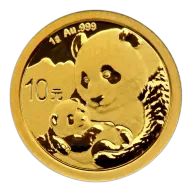
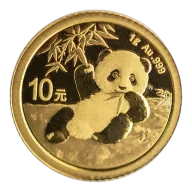
The 1g Gold Panda is the smallest denomination in the Chinese Gold Panda series, carrying a face value of 10 yuan and containing one gram of 999 fine gold. It is produced by the China Gold Coin Corporation (CGCC) and is legal tender of the People's Republic of China.
This denomination exists because of the Panda series' switch from troy ounces to metric grams in 2016. Before that transition, the smallest Gold Panda was the 1/20 oz (1.555g). The modern 1g Panda is both lighter and less expensive than the former 1/20 oz version, lowering the barrier to entry even further. At current gold prices, a 1g Panda costs roughly $100-$120, depending on dealer and premium.
The Panda series stands apart from other bullion coins because of its annually changing reverse design. Each year features a new illustration of giant pandas, depicted eating bamboo, playing, resting, or with their cubs. This rotating design gives every vintage its own identity, bridging the gap between pure bullion and numismatic collecting. The 1g denomination participates fully in this annual cycle, making it accessible to collectors at a fraction of the cost of the 30g (approximately 1 oz) Gold Panda.
The obverse has never changed: it depicts the Hall of Prayer for Good Harvests at the Temple of Heaven in Beijing, a design used since the series began in 1982.
1g Gold Panda Technical Details
| Attribute | Value |
|---|---|
| Gold content | 1.00 g (0.0322 troy oz) |
| Purity | 999 fine (three nines) |
| Diameter | 10 mm |
| Thickness | 0.83 mm |
| Face value | 10 yuan |
| Mint | China Gold Coin Corporation (CGCC) |
| Legal tender | People's Republic of China |
The 999 fineness (three nines) is lower than the 999.9 (four nines) standard used by most competing sovereign mints, including the Royal Canadian Mint, Perth Mint, and Austrian Mint. This is simply the standard China has maintained since the series began. The difference in actual gold content is negligible at the 1g weight: 0.999g versus 0.9999g.
The coin dimensions at 10 mm diameter are comparable to the 1g Maple Leaf, which is also approximately 10 mm. Both are extremely small coins that require protective packaging for practical handling.
One notable quirk: the 2015 Gold Panda was issued without denomination, weight, fineness, or metal inscriptions, just the panda image and year. This omission was widely criticised and was not repeated in subsequent years.
Tax Treatment for the 1g Gold Panda
United States
The Gold Panda's IRA eligibility is disputed. The IRS does not specifically recognise the CGCC as an approved foreign mint for IRA gold purposes, and the Panda's semi-numismatic nature (annual design changes, collector premiums) can classify it as a collectible rather than pure bullion. Some IRA custodians will accept 999-purity sovereign coins; others will not. Buyers planning to hold Gold Pandas in an IRA should verify acceptance with their specific custodian before purchasing. No federal sales tax applies; state exemptions vary.
United Kingdom
VAT-exempt as investment gold. The 999 purity exceeds the 99.5% threshold for investment gold qualification, and the coin is legal tender and minted after 1800. Not CGT-exempt (only UK legal tender coins qualify). At the 1g weight, CGT considerations are minimal given the GBP 3,000 annual allowance.
European Union
VAT-exempt under the EU investment gold directive. The Gold Panda meets all qualifying criteria (legal tender, post-1800, above 900 thousandths purity).
Australia
GST-free as investment-grade gold at 99.5% purity or above. Capital gains apply with 50% discount for holdings over 12 months.
Canada
Standard capital gains treatment (50% inclusion rate). Physical gold bullion is not eligible for RRSPs or TFSAs.
Singapore and Hong Kong
Singapore: the Panda's 999 purity exceeds the 99.5% IPM threshold, qualifying for GST exemption. No capital gains tax. Hong Kong: no sales tax, no CGT, no import duty.
1g Gold Panda vs Other 1g Gold Coins
The Panda's primary competitors at 1g are the 1g Gold Maple Leaf and the 1g Gold Noah's Ark. All three are sovereign-minted legal tender coins, but they differ on purity, security, premium, and collectibility.
The Maple Leaf is 999.9 fine versus the Panda's 999, carries the RCM's micro-engraved radial line security features, and has clear IRA eligibility. It typically trades at a lower premium than the Panda. For buyers focused on cost-effective gold acquisition, the Maple Leaf is the more straightforward choice. The RCM also offers the MapleGram format, packaging twenty-five 1g coins in a divisible sheet at a lower per-gram premium than buying individual coins.
The Noah's Ark is also 999.9 fine and often available at the lowest premium among the three. It lacks the annually changing designs that make the Panda collectible, but its consistent design and low cost make it appealing for buyers who treat 1g coins as pure bullion rather than collectibles.
The Panda's advantage is its collectibility. The annually changing panda designs give each year's coin a distinct identity that the fixed-design Maple Leaf and Noah's Ark lack. Specific vintages can appreciate beyond their metal value, especially if they coincide with notable panda designs or low-production years. This semi-numismatic premium cuts both ways: Pandas cost more to acquire and may face wider buy-sell spreads, making the round-trip cost of ownership higher than for pure bullion coins.
Counterfeiting is a consideration unique to the Panda series. NGC has flagged that counterfeit Pandas are produced "at an alarming rate," and the combination of high premiums and annually changing designs (making visual comparison harder) creates vulnerability. Buying from established dealers or purchasing NGC/PCGS-certified coins is more important for Pandas than for other sovereign bullion coins. The Maple Leaf's Bullion DNA verification system provides a level of anti-counterfeiting protection that the Panda does not offer.
1g Panda Gold Coin: frequently asked questions
-
The cheapest 1g Gold Panda listed here is $191.24, from IDC Coin and Bullion, currently around 34.9% over the gold spot price. The 1g is the smallest denomination in the Panda series, and like all fractional gold coins its premium over spot is proportionally high relative to larger sizes.
-
Gold Panda coins are 999 fine gold (24 carat). The series has maintained this purity standard since it launched in 1982. In 2016 China switched from troy-ounce weights to metric grams, so the standard coin is now 30 grams rather than one troy ounce, but the .999 gold purity has remained consistent throughout.
-
Gold Pandas trade at elevated premiums for several reasons. The reverse design changes every year, giving each issue mild numismatic appeal on top of its metal value. Coins are legal tender of the People's Republic of China, struck by the state-owned China Gold Coin Corporation. This combination of official status, annual changing design, and collector demand pushes premiums above those of generic 1g bars or less collectible coins. The live premium here is currently around 34.9%.
-
Yes. The reverse design of the Gold Panda features a new giant panda illustration each year, making it one of the few bullion series with annually changing designs. The obverse, showing the Hall of Prayer for Good Harvests at the Temple of Heaven in Beijing, has remained unchanged since the series began in 1982. Each coin is issued as legal tender by the People's Republic of China.