20 products · 109 deals Prices & premiums exclude tax to compare across countries
Filters
| Product | /oz | Premium | Price (ex. tax) | |
|---|---|---|---|---|

8 deals
|
$68.02 | +0.57% | $6,801.59 | Compare |

2 deals
|
$68.39 | +1.12% | $6,838.66 | Compare |
| $68.76 | +1.68% | $6,876.40 | Compare | |

3 deals
|
$69.54 | +2.83% | $6,953.96 | Compare |
| $69.54 | +2.83% | $6,953.96 | Compare | |

3 deals
|
$68.78 | +3.17% |
$6,877.73
£5,154
|
Compare |

4 deals
|
$68.84 | +3.27% |
$6,884.00
£5,159
|
Compare |

3 deals
|
$68.87 | +3.31% |
$6,887.19
£5,161
|
Compare |

18 deals
|
$68.94 | +3.42% |
$6,894.21
£5,166
|
Compare |

3 deals
|
$69.05 | +3.58% |
$6,904.71
£5,174
|
Compare |

2 deals
|
$69.21 | +3.82% |
$6,921.22
£5,187
|
Compare |
| $69.51 | +4.27% |
$6,951.27
£5,209
|
Compare | |

22 deals
|
$70.10 |
+5.16%
+26% inc.VAT
|
$7,010.18
£6,304 inc.VAT
|
Compare |

2 deals
|
$70.33 | +5.24% |
$7,033.40
S$8,992
|
Compare |

2 deals
|
$72.11 | +8.06% |
$7,211.14
A$10,128
|
Compare |
| $73.79 | +9.11% | $7,379.01 | Compare | |
| $76.87 | +13.67% | $7,687.00 | Compare | |

2 deals
|
$77.45 | +14.52% | $7,744.88 | Compare |

4 deals
|
$80.83 | +21.26% |
$8,083.63
£6,058
|
Compare |

3 deals
|
$82.31 |
+23.47%
+48% inc.VAT
|
$8,230.69
£7,402 inc.VAT
|
Compare |





Prices are fetched automatically and may not reflect current merchant prices. Currency conversions and tax treatment are approximate. Rankings are based solely on price. We are not a dealer and accept no responsibility for transactions with listed merchants. Past performance is not indicative of future results. This site does not provide investment advice. Full disclaimer
About 100 oz Silver Bars
The 100oz Silver Bar: Bulk Silver for Serious Stackers
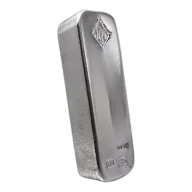
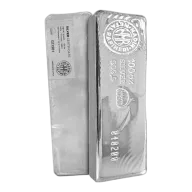
The 100oz weight class is almost exclusively a silver category. One hundred troy ounces of gold would cost well over $300,000 at current prices, so 100oz gold bars barely exist in retail markets; in silver, by contrast, this is a standard unit of trade across North America. A 100oz silver bar weighs approximately 3.11 kg (6.86 lbs), with dimensions varying by manufacturer but running roughly 140mm x 80mm x 25mm. The footprint is comparable to a large smartphone, though the heft in hand is something else entirely.
This size suits one type of buyer above all: the accumulator building a substantial silver position who wants the most metal per dollar spent. The fixed costs of manufacturing, assaying, and packaging a bar are spread across 100 ounces, which makes this the most cost-efficient way to accumulate physical silver in retail quantities. For stackers targeting positions of 500 ounces or more, the premium savings over smaller formats add up to a meaningful amount of extra silver.
The trade-off is divisibility. A 100oz bar is indivisible; you cannot sell part of it. Selling means finding one buyer for the full amount, which at current silver prices represents a few thousand dollars in a single transaction. Buyers who expect to sell incrementally, or who simply want flexibility, are better served by 10oz silver bars or 1oz silver coins, which can be parcelled out as needed.
Standard purity at this weight is .999 fine silver, with the Royal Canadian Mint producing .9999 fine bars. Although the COMEX deliverable size is 1,000oz rather than 100oz, bars from LBMA-accredited refiners such as Johnson Matthey, Engelhard, RCM, Asahi, and Republic Metals are universally accepted by dealers and IRA custodians. For US buyers, 100oz bars are IRA-eligible when produced by LBMA-accredited refiners or ISO 9001 manufacturers meeting the IRS fineness requirement of .999 or better.
One regional note: this is a North American format. European silver markets favour kilo bars (32.15oz) and metric weights, and in the UK the 20% VAT on silver makes the tax implications of a large single purchase more significant. Asian retail markets work almost entirely in metric weights, so the 100oz bar is uncommon there too.
100oz Silver Bar Premiums: The Floor of the Retail Market
Premiums on 100oz silver bars run 2-4% over spot per ounce in normal market conditions, the lowest per-ounce premium of any standard retail silver bar size. That figure is the headline reason this weight class exists. Every cost a refiner incurs in producing a bar (casting or minting, assay, packaging, distribution) is fixed per unit, so dividing it across 100 ounces compresses the markup to a fraction of what smaller products carry.
The comparison down the weight scale makes the point concrete. One-ounce bars carry premiums of $2-4 or more per ounce, often working out to 5-10% over spot. Ten-ounce bars run 3-5%. At 100oz the premium compresses to 2-4%. Notably, the steepest part of this curve sits between 1oz and 10oz; the marginal saving from stepping up from 10oz to 100oz is real but smaller. Buyers should weigh that diminishing return against the loss of divisibility at each step.
Within the 100oz class itself, the manufacturing method matters. Cast bars, poured into moulds with a more rustic finish, price 1-2% cheaper than minted bars of the same weight. Cast production is common at the larger bar sizes, which contributes to the low premiums here.
The exit side of the trade is also favourable. Buyback spreads from major dealers run 1-3% below spot for recognised brands, giving a tighter round trip than most silver products. Brand selection affects this directly: bars from LBMA-accredited refiners command tighter spreads, whereas generic bars can face wider buyback discounts. Paying a small premium for a recognised name at purchase can pay for itself at sale.
Tax treatment changes the calculation by country. In the UK and EU, silver attracts VAT (20% in the UK), and the larger the bar, the more the premium savings help offset that fixed percentage hit. In Canada, Australia, New Zealand, and Singapore, silver bars at qualifying purity are exempt from GST/HST, so the bar competes purely on premium. US buyers face state-dependent sales tax rules, with most states exempting bullion. For buyers in tax-free or exempt jurisdictions, the 100oz bar is the cheapest route to silver weight that remains practical to store at home.
Major 100oz Silver Bars: RCM, Johnson Matthey, Engelhard, and Asahi
The 100oz silver bar market splits into three groups: current sovereign-mint and accredited-refiner production, discontinued legacy brands that trade with a collector element, and generic private-mint bars that compete purely on price.
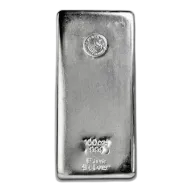
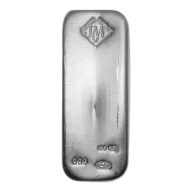
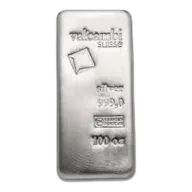
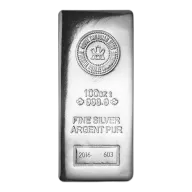
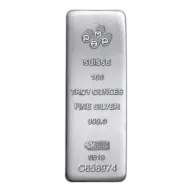
Among current production, the 100oz Royal Canadian Mint silver bar is the standout. It is struck to .9999 fine purity (against the .999 standard for the weight class), serialised, and LBMA Good Delivery listed. The 100oz Asahi Refining silver bar is the modern successor to one of the most storied names in the business: Asahi acquired Johnson Matthey's precious metals refining operations in 2015 and its bars are widely distributed in North America. Swiss refiners are present at this weight too, with the 100oz PAMP Suisse silver bar and 100oz Valcambi bars both coming from LBMA-accredited houses.
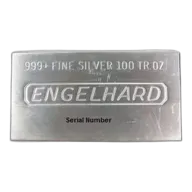
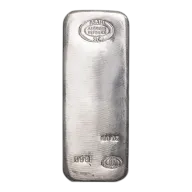
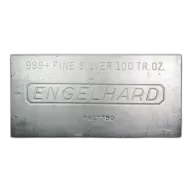
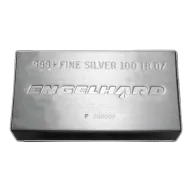
The legacy brands occupy an unusual niche. Johnson Matthey bars have not been produced since the business was sold in 2015, and examples from the 1980s trade at a slight collector premium; the bars remain LBMA and COMEX approved. Engelhard is also discontinued and carries a brand premium on the secondary market driven by collector demand. Both names resell easily, but buyers paying the collector markup should understand they are paying for the brand history, not extra silver.
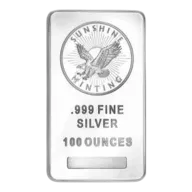
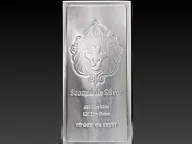
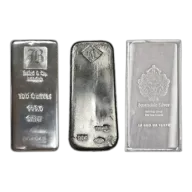
The generic tier includes Sunshine Minting, Republic Metals, and Ohio Precious Metals, which are IRA-eligible when ISO 9001 certified. US dealer listings also commonly carry private-mint names such as the 100oz Scottsdale Stacker and SilverTowne bars. These price at the bottom of the premium range and suit buyers maximising ounces, with the caveat that generic bars may face wider buyback discounts than accredited-refiner product.
Unlike coins, there is no standard tube or roll packaging at this weight. Bars sell individually, sometimes in protective plastic sleeves or mint-sealed packaging. Sealed bars in original packaging resell better than loose bars, so keeping the packaging intact is worth the minor inconvenience.
Selling and Storing 100oz Silver Bars
Liquidity at this weight is high by silver bar standards. Every major bullion dealer buys and sells 100oz bars, and the weight is a standard unit of trade in the North American silver market. Online dealers and larger local shops handle them routinely; smaller local coin shops may be less keen, simply because a single bar represents a few thousand dollars of inventory in one item.
The structural limitation is the buyer pool. A 100oz bar must find one buyer for the full amount, whereas 100 individual 1oz coins can be parcelled out across many transactions. That narrower pool makes the format less liquid than 1oz coins or 10oz products, even though dealer acceptance is universal. Anyone who anticipates selling in increments should weight their holdings toward smaller formats and treat 100oz bars as the long-hold core of a stack.
Two practical points affect the sale process. First, brand: LBMA-accredited refiner bars from RCM, Johnson Matthey, Engelhard, or Asahi command tighter spreads, while generic bars may take a wider discount. Second, verification: most dealers will assay, or at minimum weigh and measure, a secondary-market 100oz bar before buying it. That adds a step compared with coins, whose specifications are fixed and known. Counterfeit silver bars do exist at the 10oz and 100oz sizes, typically copper, lead, or zinc cores plated with silver, and they are detectable by weight and dimension mismatch or a magnet test. Serial numbers and assay certificates from accredited refiners provide the strongest chain-of-custody assurance, which is part of why those brands resell at better prices.
Storage is where the 100oz bar earns its keep. At roughly 3.1 kg, a single bar fits in a home safe or safe deposit box, and most bars are poured or minted in rectangular form that stacks cleanly (some cast bars have irregular surfaces). The format is the most space-efficient way to hold silver value per unit of storage room, a genuine consideration given silver's bulk: the metal's low value-to-weight ratio means a meaningful position occupies real space and weight in any safe. Stacking multiple bars adds weight quickly, so shelving and floor-load limits deserve a thought before the stack grows. Silver tarnishes when exposed to sulphur compounds, so bars should be kept in dry conditions, ideally wrapped or in sealed packaging.
100 oz Silver Bars: frequently asked questions
-
A 100 oz silver bar's melt value is 100 times the $67.63 silver spot price. Dealer prices sit above that figure by a per-ounce premium, which for this size bar tends to be modest. This page compares 121 live listings from 35 dealers, last refreshed 7 minutes ago, so you can find the best available price.
-
A 100 troy ounce silver bar weighs 100 oz, or approximately 3.11 kilograms (3,110 grams). Troy ounces are slightly heavier than standard ounces, so a 100 troy oz bar is heavier than 100 standard ounces. This weight is consistent across all refineries that produce this format.
-
Silver bar purchases are taxed differently depending on where you buy. UK buyers pay 20% VAT on silver bars, unlike gold which is VAT-exempt. In Canada, investment-grade silver bullion is generally GST-exempt. In Australia, silver bullion is subject to GST. On disposal, gains are typically subject to capital gains tax in each country.
-
A 100 troy ounce silver bar is a standard wholesale and retail format, weighing roughly 3.11 kg and refined to at least .999 fineness. It is produced by a number of well-known refineries and sovereign mints worldwide. All bars carry the refiner's hallmark, purity, and serial number.
-
The fabrication cost of refining and stamping a silver bar is largely fixed regardless of size. Spread across 100 troy ounces rather than one or ten, that cost contributes very little per ounce, so the premium above spot is smaller. Strong liquidity in the 100 oz format, a standard size for dealers and institutions, also keeps margins competitive compared with smaller retail bars.
- 100 oz AARUS Silver Bar
- 100 oz ABC Cast Bar Silver Bar
- 100 oz Ainslie Silver Bar
- 100 oz Argentia Silver Bar
- 100 oz Asahi Refining Silver Bar
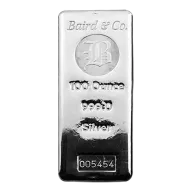
- 100 oz Baird & Co. Silver Bar
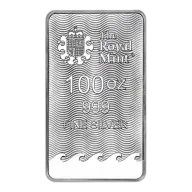
- 100 oz Britannia Silver Bar
- 100 oz Canadian PMX Silver Bar
- 100 oz Credit Suisse Silver Bar
- 100 oz Dillon Gage Silver Bar
- 100 oz Engelhard Bar Silver Bar
- 100 oz Engelhard Silver Bar
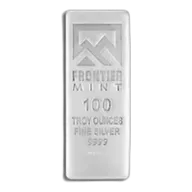
- 100 oz Frontier Mint Silver Bar
- 100 oz Geiger Original Silver Bar
- 100 oz Germania Mint Silver Bar
- 100 oz Heraeus Silver Bar
- 100 oz JBR Recovery Silver Bar
- 100 oz Johnson Matthey Silver Bar
- 100 oz Kinesis Silver Bar
- 100 oz MintID Silver Bar
- 100 oz Nadir Refinery Silver Bar
- 100 oz PAMP Suisse Silver Bar
- 100 oz Perth Mint Silver Bar
- 100 oz Republic Metals Corporation Silver Bar
- 100 oz Royal Canadian Mint Silver Bar
- 100 oz Scotiabank Silver Bar
- 100 oz Scottsdale Mint Silver Bar
- 100 oz Scottsdale Stacker Silver Bar
- 100 oz Silver Bar
- 100 oz Sunshine Minting Silver Bar
- 100 oz The Royal Mint Una and the Lion Silver Bar
- 100 oz Valcambi Silver Bar
- Pre-Owned 100 oz Baird & Co. Silver Bar
- Pre-Owned 100 oz Britannia Silver Bar
- Pre-Owned 100 oz Engelhard Bar Silver Bar
- Pre-Owned 100 oz Engelhard Silver Bar
- Pre-Owned 100 oz Johnson Matthey Silver Bar
- Pre-Owned 100 oz Scottsdale Stacker Silver Bar
- Pre-Owned 100 oz Silver Bar