4 products · 6 deals Prices & premiums exclude tax to compare across countries
Filters





Prices are fetched automatically and may not reflect current merchant prices. Currency conversions and tax treatment are approximate. Rankings are based solely on price. We are not a dealer and accept no responsibility for transactions with listed merchants. Past performance is not indicative of future results. This site does not provide investment advice. Full disclaimer
About the Fortuna Silver
PAMP Suisse's Defining Bar Design in Silver
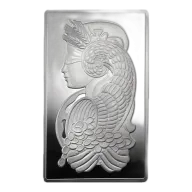
The Fortuna is PAMP Suisse's signature design, first introduced in 1979 as the first decorative motif ever placed on a precious metals bar. Before PAMP created this design, all bullion bars carried nothing more than weight, purity, and refiner stamps. The Lady Fortuna motif, depicting the Roman goddess of fortune blindfolded with a cornucopia overflowing with gold coins, effectively created the entire category of "minted bars" as distinct from plain cast ingots.
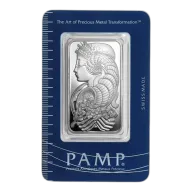
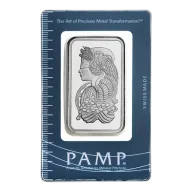
PAMP (Produits Artistiques Métaux Précieux) was founded in 1977 in Ticino, Switzerland, and is now part of the MKS PAMP GROUP. The refinery is LBMA-accredited, and all Fortuna silver bars are .999 fine. Each bar carries a unique serial number and ships in tamper-evident CertiPAMP assay packaging that integrates the assay certificate directly into the sealed blister card.
The silver Fortuna range covers a comprehensive size spectrum. The 1 oz Fortuna Silver Bar is the entry point, with metric sizes at 5g, 10g, 20g, 50g, 100g, 250g, and 500g, plus the 10 oz and 1 Kilo sizes for larger positions. PAMP commands the highest brand premiums in the minted bar market, reflecting the combination of design recognition, VeriScan authentication technology, and strong secondary-market demand.
The premium PAMP charges over generic or competing branded bars is the central question for buyers. The Lady Fortuna design is the most widely recognised bar motif in the global bullion market, and PAMP bars command higher resale prices than bars from most competing refineries. The premium gap narrows on larger sizes: the 100g and 1 kg bars offer better value per gram than the smaller sizes where manufacturing costs per unit weigh more heavily. For buyers prioritising the lowest possible premium over spot, competitors like Valcambi or generic refiner bars offer the same .999 silver at lower cost. For buyers who value brand recognition at the point of resale, PAMP's liquidity advantage can justify the entry premium.
PAMP Fortuna Silver Bar Sizes
| Weight | Purity | Format |
|---|---|---|
| 2.5g | .999 | Minted bar |
| 5g | .999 | Minted bar |
| 10g | .999 | Minted bar |
| 20g | .999 | Minted bar |
| 50g | .999 | Minted bar |
| 1 oz (31.1g) | .999 | Minted bar |
| 100g | .999 | Minted bar |
| 250g | .999 | Minted bar |
| 500g | .999 | Minted bar |
| 1 Kilo | .999 | Minted bar |
All Fortuna silver bars are minted (struck), not cast, producing sharp relief and mirror-like surfaces. The obverse carries the Lady Fortuna design; the reverse shows the PAMP Suisse logo, registered Swiss cross mark, weight, purity, serial number, and assayer's mark. No face value is assigned; these are not legal tender.
VeriScan Authentication
PAMP's patented VeriScan technology scans each bar's microscopic surface topography at the point of manufacture and records the unique profile in PAMP's secure database. Each bar has a surface "fingerprint" at the microscopic level that is impossible to replicate. Buyers can verify authenticity using the PAMP VeriScan smartphone app or PC software with a document scanner. The system reads the bar itself, not the packaging, meaning bars removed from their CertiPAMP blister can still be verified.
CertiPAMP Packaging
Each bar ships in tamper-evident sealed packaging that integrates the assay certificate. The packaging includes microprinting and UV-reactive elements for additional verification. Breaking the seal is detectable and typically reduces resale value, since buyers purchasing PAMP bars at full premium expect intact packaging.
Tax Position for PAMP Suisse Silver Bars
PAMP Fortuna bars are not legal tender in any jurisdiction. They are private-refinery products, and their tax treatment follows the general rules for silver bullion bars.
United States: PAMP gold bars at .9999 fine are IRA-eligible (the gold version exceeds the IRS .995 minimum, and PAMP is LBMA-accredited). The silver version at .999 meets the IRS silver purity requirement (.999+). IRA inclusion for bars requires production by an NYMEX/COMEX or LBMA-accredited refiner, which PAMP satisfies. Capital gains are taxed at the collectibles rate of up to 28%. Form 1099-B reporting is required for sales of 25 or more 1 oz bars in a single transaction.
United Kingdom: Silver bars carry 20% VAT on purchase with no exemption. On disposal, CGT applies at the individual's rate. Gold PAMP bars are VAT-free as investment gold from an LBMA-accredited refiner, but they are not CGT-exempt because bars have no legal tender status. This is the key tax distinction between PAMP gold bars and Gold Britannia coins for UK investors.
Switzerland: No VAT on investment gold. Silver bars carry 8.1% VAT, the lowest rate in Europe. PAMP bars purchased and stored in Swiss vaults benefit from a favourable tax and storage environment.
Canada: Silver at .999 purity is GST/HST-exempt. Capital gains follow the standard 50% inclusion rate.
Australia: Silver bars at 99.9% purity are GST-free as investment-grade precious metals. CGT applies with a 50% discount for holdings over 12 months.
European Union: Silver bars attract the full standard VAT rate in each member state, ranging from 17% to 27%. Gold bars at .995+ purity from LBMA-accredited refiners are VAT-exempt across the EU. The margin scheme available for silver in Germany and the Netherlands applies to pre-owned items, not new production.
Singapore: Investment Precious Metal silver at 99.9% purity in bar form (minimum 0.5 troy ounces) is GST-exempt. PAMP has a significant presence in Singapore through local dealers. No capital gains tax.
Hong Kong: No sales tax, import duty, or capital gains tax on bullion of any kind.
PAMP Fortuna vs Valcambi, Perth Mint, and Royal Canadian Mint Bars
The most direct competitor to the Fortuna is the Valcambi Suisse bar range. Both refineries are LBMA-accredited and Swiss-based, and both produce .999 fine silver bars across a similar size range. Valcambi is the world's largest precious metals refinery by volume (processing over 2,000 tonnes annually), while PAMP is smaller but commands higher brand recognition and premiums. Valcambi bars typically trade at lower premiums than equivalent PAMP bars, making them the better choice for buyers maximising silver per dollar. Valcambi's distinctive innovation is the CombiBar, a single 50g or 100g bar pre-scored into 1g segments that can be snapped apart for fractional transactions. PAMP has no equivalent divisible product, but counters with VeriScan digital authentication, which Valcambi does not offer.
Perth Mint silver bars come with government backing from the Western Australian government, distinguishing them from private-refinery products. Perth Mint uses its own CertiCard packaging with a kangaroo security hologram. In Australian and Asian markets, Perth Mint bars may carry lower premiums than PAMP, partly because of the geographic proximity and the implicit sovereign guarantee. For buyers in those markets, the Perth Mint bar offers similar quality at a lower entry cost.
Royal Canadian Mint (RCM) silver bars are .9999 fine, a higher purity than PAMP's .999. RCM bars benefit from the Bullion DNA anti-counterfeiting system, which provides individual bar-level authentication through a dedicated reader device. RCM bars are popular in North America, where PAMP has a stronger presence in European and Asian markets. For North American buyers, the RCM bar offers government-mint credibility and higher purity at competitive premiums.
The fundamental question with PAMP is whether the brand premium is recovered at resale. PAMP bars consistently achieve higher buyback prices from dealers than generic or lesser-known branded bars. The VeriScan authentication reduces friction in the resale process, since a verified bar requires no independent assay. For buyers who intend to hold and eventually sell through established dealer channels, the PAMP premium can be partially or fully recovered. For buyers planning to sell privately or through channels where brand recognition carries less weight, the premium over a Valcambi or generic bar is harder to justify.
Fortuna Silver: frequently asked questions
-
Fortuna depicts the Roman goddess of fortune, blindfolded and holding a cornucopia overflowing with coins, alongside wheat, poppies, and a wheel of fortune. PAMP introduced the design in 1979 at its refinery in Ticino, Switzerland, making it the first decorative motif ever placed on a precious metals bar. Each bar ships sealed in a tamper-evident CertiPAMP assay card, and bars bearing the VeriScan logo can be digitally authenticated via the PAMP app.
-
Fortuna bar prices are anchored to the live $67.63 spot price for the relevant metal. PAMP's Swiss manufacture, VeriScan authentication, and assay card packaging typically place them at a premium above generic bars. Compare current offers from 6 dealers across 9 tracked listings; individual product group pages show exact dealer prices for each size.
-
Several factors push Fortuna bar prices above generic equivalents: PAMP's Swiss refinery processes bars to tight tolerances; each bar is individually serialised and sealed in a CertiPAMP assay card; VeriScan digitally fingerprints the bar's microscopic surface at manufacture for lifetime authentication. Brand recognition on the secondary market also supports resale premiums. Smaller sizes (1g, 5g) carry proportionally larger premiums than larger bars.
-
PAMP produces Fortuna bars across a wide size range. Gold bars run from 1g through 1 kg, with common retail sizes including 1g, 5g, 10g, 20g, 1 oz, 50g, 100g, 250g, 500g, and 1 kg. Silver is available from 2.5g through 1 kg, with 1 oz and 1 kg being the most common. Platinum Fortuna bars are available from 1g through 1 kg. This page tracks 9 Fortuna listings across all sizes.
-
By annual mine production, platinum is substantially rarer than gold, with far less extracted from the earth each year. Economically viable platinum deposits are found in only a small number of locations worldwide, making supply more concentrated and potentially more volatile than gold supply. Both metals serve as stores of value, but their prices move independently.