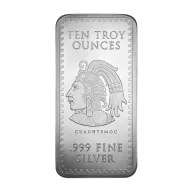
10 products · 28 deals
Filters
| Product | /oz | Premium | Price | |
|---|---|---|---|---|

5 deals
|
$70.29 | +3.93% | $702.87 | Compare |

4 deals
|
$71.96 | +6.41% | $71.96 | Compare |

3 deals
|
$75.37 | +11.45% | $376.87 | Compare |

4 deals
|
$76.88 | +13.68% | $76.88 | Compare |

3 deals
|
$76.94 | +13.77% | $384.70 | Compare |
| $81.04 | +19.83% | $162.08 | View Deal | |
| $81.54 | +20.57% | $40.77 | Compare | |
| $86.88 | +28.47% | $21.72 | Compare | |
| $90.48 | +33.79% | $2,908.99 | View Deal | |
| $109.50 | +61.91% | $10.95 | Compare |





Prices are fetched automatically and may not reflect current merchant prices. Currency conversions and tax treatment are approximate. Rankings are based solely on price. We are not a dealer and accept no responsibility for transactions with listed merchants. Past performance is not indicative of future results. This site does not provide investment advice. Full disclaimer
About the Aztec Calendar Silver
Silver Bullion with a Pre-Columbian Twist
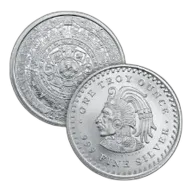
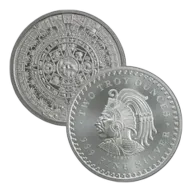
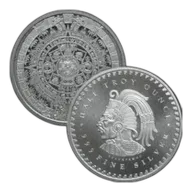
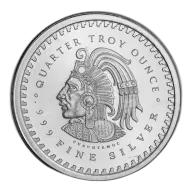
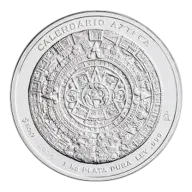
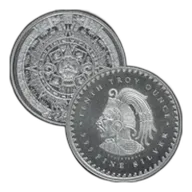
The Aztec Calendar series from Golden State Mint reproduces one of the most recognisable pre-Columbian artworks in the world on .999 fine silver rounds and bars. The design depicts the Aztec Sun Stone, a 25-ton basalt disk carved in the late 15th century, now displayed at the National Museum of Anthropology in Mexico City. On the reverse, the portrait of Cuauhtémoc, the last Aztec emperor who led resistance against Spanish conquest, gives the series a historical weight that most generic silver rounds lack entirely.
Golden State Mint, founded in 1974 and operating from facilities in Southern California and Central Florida, has made the Aztec Calendar one of its best-selling designs. The series is continuously produced with no year dates, no mintage caps, and no annual redesigns. This open-ended production keeps premiums low, making it one of the cheapest ways to buy .999 silver with a design that buyers actually want to look at. The range spans from fractional 1/10 oz rounds through 10 oz bars, with the 1 oz silver round being the most popular size.
As a privately minted product, the Aztec Calendar carries no face value and no sovereign backing. That distinction matters for tax treatment and liquidity. Sovereign coins like the Silver Britannia or Silver Maple Leaf benefit from government-mint credibility and, in some jurisdictions, tax advantages that rounds cannot access. The tradeoff is price: the Aztec Calendar typically trades at significantly lower premiums over spot than any sovereign coin, making it attractive to buyers whose primary goal is accumulating silver by weight rather than by pedigree.
The intricate relief of the Sun Stone design also provides a practical benefit. The complexity of the calendar symbols, day signs, and directional arrows makes the design harder to reproduce convincingly in counterfeit form than a simple generic round. Authentication still relies on weight, dimensions, and silver testing, but the detail quality of a genuine GSM strike is noticeably sharper than typical fakes.
Aztec Calendar Sizes and Dimensions
| Size | Format | Purity | Diameter | Thickness | Packaging |
|---|---|---|---|---|---|
| 1/10 oz | Round | .999 | -- | -- | Tubes of 50 |
| 1/4 oz | Round | .999 | -- | -- | -- |
| 1/2 oz | Round | .999 | -- | -- | Tubes of 20 |
| 1 oz | Round | .999 | 39.3 mm | 3.2 mm | Tubes of 20 |
| 2 oz | Round | .999 | -- | -- | -- |
| 5 oz | Round / Bar | .999 | -- | -- | -- |
| 10 oz | Bar | .999 | -- | -- | -- |
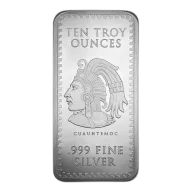
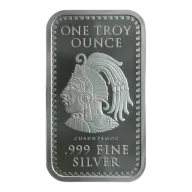
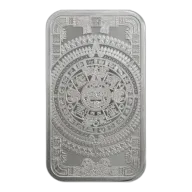
All sizes are struck in .999 fine silver. The round format is coin-shaped with a reeded edge; the bar format, available at 5 oz and 10 oz, is rectangular. Both formats carry the same purity and the same Aztec Calendar design elements. There are no gold versions in this series; copper versions are produced separately.
The series carries no serial numbers, no assay cards, and no proprietary anti-counterfeiting technology. Authentication relies on physical testing: weight verification, dimensional checks, and silver content analysis via specific gravity, XRF, or acid testing. The sharpness of the relief detail in the calendar design also serves as an informal indicator, since counterfeits typically show softer definition in the fine calendar symbols.
Tax Treatment of Privately Minted Silver Rounds
The Aztec Calendar is not legal tender in any jurisdiction. This distinction carries significant tax consequences compared to sovereign silver coins.
United States: The .999 fine silver purity meets the IRS fineness requirement for inclusion in a self-directed precious metals IRA. Golden State Mint lists these rounds as "IRA Approved," though acceptance depends on the specific custodian. Capital gains on silver are taxed at the collectibles rate of up to 28%, the same rate that applies to sovereign coins. There is no 1099-B reporting exemption for private-mint rounds, unlike certain sovereign coins. Sales tax varies by state, with roughly 35 states exempting bullion purchases entirely.
United Kingdom: Silver rounds are subject to 20% VAT on purchase, the same rate applied to all silver bullion regardless of origin. There is no VAT exemption for silver in the UK (only investment gold qualifies). On disposal, capital gains tax applies at the individual's rate, with no CGT exemption because the Aztec Calendar is not UK legal tender. For UK buyers, the combined VAT-on-purchase and CGT-on-sale burden makes privately minted rounds less efficient than Silver Britannias, which are at least CGT-exempt as legal tender.
Canada: Silver bullion at .999 purity is exempt from GST/HST under the Excise Tax Act, covering both sovereign coins and private-mint rounds. Capital gains are taxed at a 50% inclusion rate.
Australia: Investment-grade silver requires 99.9% purity for GST exemption. The Aztec Calendar at .999 fine meets this threshold. CGT applies on disposal with a 50% discount for holdings over 12 months.
European Union: Silver rounds attract the full local VAT rate in most EU countries, ranging from 17% in Luxembourg to 27% in Hungary. The margin scheme available in Germany, the Netherlands, and some other countries applies only to pre-owned silver, not new private-mint products.
Singapore and Hong Kong: Singapore exempts Investment Precious Metal silver at 99.9% purity from the 9% GST. Hong Kong charges no sales tax or import duty on bullion of any kind. Both jurisdictions have no capital gains tax.
The Sun Stone and the Emperor Behind the Design
The obverse design reproduces the Aztec Sun Stone, frequently called the Aztec Calendar Stone despite the fact that modern scholarship has concluded it was not a functioning calendar at all. The original artifact is a monolithic basalt disk measuring 3.58 metres in diameter, 98 cm thick, and weighing approximately 25 tonnes. It was created during the late Postclassic period, most likely under the reign of Motecuhzoma II (Montezuma II), sometime between 1502 and 1521.
The central figure is generally identified as Tonatiuh, the Aztec solar deity, depicted holding human hearts in clawed hands. Surrounding this figure are 20 symbols representing the 20 days of the Aztec month, arranged in a ring with four arrows pointing to the cardinal directions. The outer ring contains additional cosmological symbols. Modern archaeologists interpret the disk as a solar monument symbolising rulership and cosmological power, and possibly a ceremonial basin for gladiatorial sacrifice. A date glyph near the top, 13 Reed, corresponds to both a mythological creation date and the historical year 1427 CE.
The stone was buried during the Spanish destruction of Tenochtitlan and rediscovered in December 1790, beneath the central plaza of Mexico City, which had been built directly over the Aztec capital. It has been housed at the National Museum of Anthropology in Mexico City since its discovery and remains one of the most reproduced pre-Columbian artworks in the world, appearing on Mexican coinage (the old 20 centavo coin used a simplified version), restaurant decor, and tourist merchandise globally.
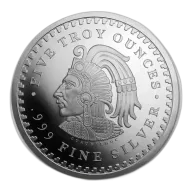
The reverse portrait depicts Cuauhtémoc, the last Aztec emperor of Tenochtitlan, who ruled from 1520 to 1521 and led the indigenous resistance against Hernán Cortés and the Spanish conquest. He is shown wearing a traditional feathered headdress and ear ornaments. Cuauhtémoc remains a national hero in Mexico, with the prominent Mexico City neighbourhood Colonia Cuauhtémoc named in his honour. The choice of subject pairs the cosmic symbolism of the Sun Stone with a historical figure of armed resistance, giving the design a layered cultural significance that distinguishes it from the patriotic or heraldic imagery typical of bullion products.
Aztec Calendar vs Sovereign Silver Coins and Other Rounds
The most direct comparison for the Aztec Calendar is against other privately minted silver rounds. In the generic round market, the dominant designs skew toward American patriotic themes: Walking Liberty, Buffalo, and various eagle motifs. The Aztec Calendar stands out by drawing on Mesoamerican history, offering a cultural specificity that appeals to a different audience. Premiums on GSM Aztec Calendar rounds are comparable to other branded generic rounds, and occasionally slightly higher due to the design's popularity among stackers and collectors. Against unbranded generic rounds, the difference is small but consistent.
Against sovereign silver coins, the comparison shifts to a different set of tradeoffs. The 1 oz Silver Maple Leaf at .9999 purity carries government-mint credibility, security features including the Bullion DNA authentication system, and higher purity. The 1 oz Silver Britannia provides CGT exemption for UK taxpayers, a benefit no round can offer. The 1 oz Silver Libertad brings Mexican sovereign-mint status, extremely low mintages, and much higher premiums. All three cost more per ounce of silver than the Aztec Calendar, and all three are more liquid on the secondary market.
The Libertad comparison is particularly relevant given the shared Mexican and Aztec visual themes. The Libertad is a sovereign coin minted by Casa de Moneda de Mexico with legal tender status (though, unusually, no face value). Its mintages are among the lowest of any major bullion series, and premiums reflect that scarcity. The Aztec Calendar round offers Mexican and Aztec thematics at a fraction of the cost, sacrificing legal tender status and mintage-driven collectibility for much lower premiums over spot.
For buyers focused on accumulating the most silver for their money, the Aztec Calendar competes well against all sovereign coins on price. The gap is largest against American Silver Eagles, which carry premiums of 20-30% over spot in normal markets. The Aztec Calendar trades much closer to spot. The tradeoff is liquidity: sovereign coins from established mints sell back to dealers more easily and at tighter spreads than privately minted rounds. For long-term accumulators who prioritise ounces over brand, and who find the design more compelling than a blank generic, the Aztec Calendar fills that niche effectively.
Aztec Calendar Silver: frequently asked questions
-
The value of an Aztec Calendar round is primarily its silver content, priced close to the live $67.63 silver spot price plus a small fabrication premium. We track 28 listings from 7 dealers, so you can compare current premiums in the table above. These are privately minted rounds, not legal tender coins, and carry no face value.
-
Golden State Mint produces the Aztec Calendar in a wide range of sizes: 1/10 oz, 1/4 oz, 1/2 oz, 1 oz, 2 oz, 5 oz, and 10 oz. The smaller sizes are round-shaped; the 5 oz and 10 oz are also available in bar format. All are .999 fine silver. There is no gold version of this design.
-
Golden State Mint is a private US mint founded in 1974, headquartered in Sanford, Florida, with operations also in Southern California. These are silver rounds, not government-issued coins, so they carry no legal tender status or face value. GSM states the rounds are IRA-approved, though IRA eligibility depends on your specific custodian.
-
The obverse reproduces the Aztec Sun Stone (Piedra del Sol), a carved basalt disk created in the late 15th century and now displayed at the National Museum of Anthropology in Mexico City. The central figure is Tonatiuh, the Aztec solar deity. Surrounding it are 20 symbols representing the days of the Aztec month, four directional arrows, and outer calendar rings. The reverse features a portrait of Cuauhtemoc, the last Aztec emperor, who resisted the Spanish conquest.