1 listing
Filters
| Product | /oz | Premium | Price | |
|---|---|---|---|---|

 Coins Online
|
$70.29 | +3.93% | $702.87 | View Deal |
Prices are fetched automatically and may not reflect current merchant prices. Currency conversions and tax treatment are approximate. Rankings are based solely on price. We are not a dealer and accept no responsibility for transactions with listed merchants. Past performance is not indicative of future results. This site does not provide investment advice. Full disclaimer
About the 10 oz Aztec Calendar Silver Bar
The Aztec Calendar in a 10 oz Bar Format
The 10 oz Aztec Calendar silver bar from Golden State Mint reproduces one of the most recognisable pre-Columbian artworks in the world on a .999 fine silver bar. The design is based on the Aztec Sun Stone (Piedra del Sol), a 25-ton carved basalt disk created in the late 15th century, now displayed at the National Museum of Anthropology in Mexico City. Golden State Mint has produced this design continuously since the series launched, making it one of their best-selling and most widely recognised product lines.
Golden State Mint (GSM) is a private US mint founded in 1974 by Jim Pavlakos, with operations in Southern California and Central Florida (headquartered in Sanford, FL). The Aztec Calendar is available across a range of sizes from 1/10 oz rounds up to this 10 oz bar format. At 10 ounces, the bar format replaces the round shape used for smaller sizes, giving the design a rectangular presentation that works well for the calendar's intricate detail.
The appeal here is straightforward: a visually distinctive design at private-mint pricing. The Aztec Calendar trades at premiums comparable to or slightly above other generic 10 oz silver bars, placing it well below sovereign-mint products. For buyers who want more visual interest than a plain stamped bar but do not want to pay the premium that comes with brands like PAMP Suisse's Fortuna or Geiger Edelmetalle's Original, the Aztec Calendar fills that gap.
Aztec Calendar 10 oz Bar Specifications
| Attribute | Value |
|---|---|
| Weight | 10 troy ounces (311.035 g) |
| Purity | .999 fine silver |
| Manufacturer | Golden State Mint |
| Format | Rectangular bar |
| Legal tender | No |
| Serial number | No |
| Year dating | None (continuously produced) |
| Mintage | Unlimited (no caps) |
Design Details
The obverse features a reproduction of the Aztec Sun Stone. The central figure is Tonatiuh, the Aztec solar deity, depicted holding human hearts in clawed hands. Twenty symbols representing the days of the Aztec month are arranged in a ring around the central figure, with four arrows pointing to the cardinal directions. The outer ring contains additional calendar symbols. The overall effect translates the circular stone's detail into the rectangular bar format.
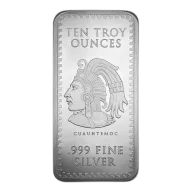
The reverse features a portrait of Cuauhtémoc, the last Aztec Emperor of Tenochtitlan, who ruled from 1520 to 1521 and led the resistance against Hernán Cortés and the Spanish conquest. He is depicted wearing a traditional feathered headdress and ear ornaments. The design has remained constant across all sizes and production years, with no annual variations, limited editions, or date stamps.
No dedicated anti-counterfeiting features are incorporated. Authentication relies on standard silver testing: precise weight measurement, dimension verification, magnet slide test, and specific gravity testing. The complexity of the Aztec Calendar design itself provides some informal counterfeit resistance, as the fine relief details are difficult to reproduce accurately.
Tax Treatment for the Aztec Calendar Silver Bar
As a privately minted .999 silver bar with no face value, the Aztec Calendar has no legal tender status in any jurisdiction. Tax treatment follows the standard rules for silver bullion.
United States
Golden State Mint states the Aztec Calendar is "IRA Approved." The .999 purity meets the IRS Section 408(m) fineness requirement for silver in a self-directed IRA, though actual eligibility depends on the specific custodian accepting private-mint products. Capital gains are taxed at the collectibles rate of up to 28%. Sales tax is state-dependent, with approximately 35 states fully exempting investment-grade silver.
United Kingdom
Subject to 20% VAT on purchase. Not CGT-exempt, as the bar has no legal tender status. Silver bars face both VAT on acquisition and CGT on disposal in the UK. For UK buyers, 10 oz Britannia silver bars share the same 20% VAT but carry CGT exemption as UK legal tender products.
Canada
GST/HST exempt at 99.9% purity or above for silver in bar form. The .999 purity qualifies for this exemption.
Australia
GST-free for investment-grade silver at 99.9% purity in tradeable form. The bar meets the purity threshold. Capital gains subject to CGT with a 50% discount for individual holdings exceeding 12 months.
Singapore and Hong Kong
Singapore exempts IPM silver bars at 99.9% purity from 9% GST. No capital gains tax applies. Hong Kong imposes no sales tax, import duty, or capital gains tax on bullion.
The Sun Stone Behind the Design
The original Aztec Sun Stone that this bar reproduces was carved from basalt during the late Postclassic period, likely under the reign of Motecuhzoma II (Montezuma II) between approximately 1502 and 1521. It measures 3.58 metres in diameter, is 98 centimetres thick, and weighs roughly 25 tonnes. A date glyph near the top corresponds to both a mythological creation date and the historical year 1427 CE.
Despite being commonly called a "calendar," modern scholarship interprets the stone as a solar disk symbolising rulership, and possibly a ceremonial basin or ritual altar for gladiatorial sacrifices. It was not a functioning timekeeping instrument. The stone was discovered in December 1790 buried in the central plaza of Mexico City, which was built over the ruins of the Aztec capital Tenochtitlan. It has been housed at the National Museum of Anthropology since 1964 and is one of the most reproduced pre-Columbian artworks in the world.
Cuauhtémoc, depicted on the reverse, is a national hero in Mexico. He led the Aztec resistance against the Spanish conquest and remains a symbol of indigenous defiance against European colonialism. The Mexico City neighbourhood Colonia Cuauhtémoc bears his name. His inclusion on the bar connects the astronomical imagery of the Sun Stone with the human history of the Aztec Empire's final chapter.
Golden State Mint has produced this design without interruption since the series began. The absence of year dates and mintage limits means all bars are functionally identical regardless of when they were struck, which simplifies stacking and resale. GSM itself has operated for over 50 years, making it one of the longest-running private mints in the United States.
Aztec Calendar vs Other 10 oz Silver Bars
The Aztec Calendar competes in the generic-to-mid-tier bracket of the 10 oz bar market. Against unbranded generic bars, it offers a far more interesting design at a premium that is often only marginally higher. Many dealers price GSM's Aztec Calendar within a dollar or two per ounce of their cheapest generic options, making it an easy upgrade for buyers who prefer visual appeal without a significant cost increase.
Compared to the 10 oz American Reserve bar from Asahi Refining, the Aztec Calendar trades on design rather than provenance. The American Reserve emphasises its LBMA-accredited, domestically sourced supply chain; the Aztec Calendar offers an artistically detailed product at a comparable price point. Neither carries serial numbers at this size, and both are .999 fine.
Against sovereign-mint options like the 10 oz Britannia bar from The Royal Mint, the Aztec Calendar trades at a substantially lower premium. The Britannia carries government backing, CGT exemption in the UK, and latent security features. For buyers in the UK, the Britannia's CGT exemption makes it the more tax-efficient choice despite the higher upfront cost. For US buyers, where both products receive the same tax treatment, the premium difference is the primary consideration.
The Aztec Calendar's closest thematic competitor is the Mexican Libertad, which carries similar Mesoamerican cultural weight. The Libertad is a sovereign coin with legal tender status, limited mintages, and significantly higher premiums. The Aztec Calendar bar offers Mexican and Aztec imagery at a fraction of the Libertad's cost, appealing to buyers drawn to the cultural aesthetics without the collector premium.
10 oz Aztec Calendar Silver Bar: frequently asked questions
-
The cheapest 10oz Aztec Calendar silver bar tracked here is $702.87, available from Coins Online. The price moves with the $67.63 silver spot price, so checking back regularly gives the most up-to-date figure.
-
Dealers currently charge around 3.9% over the $67.63 silver spot price for the 10oz Aztec Calendar bar. Larger bars like this tend to carry lower per-ounce premiums than 1oz rounds or coins, making them a cost-efficient way to buy silver by weight if you are less focused on design or collectibility.
-
The 10oz Aztec Calendar is a privately minted silver bar produced by Golden State Mint, a US private mint founded in 1974. It contains 10 troy ounces (311.035 grams) of .999 fine silver. The bar features a design based on the Aztec Sun Stone, a late 15th-century carved basalt disk now held at the National Museum of Anthropology in Mexico City. It is not legal tender.
-
A 10 troy ounce silver bar contains 10 oz of silver. Troy ounces are the standard unit for precious metals and are slightly heavier than an avoirdupois ounce: one troy ounce equals 31.1035 grams, so 10 troy ounces equals 311.035 grams.