54 products · 940 deals
Filters
| Product | /oz | Premium | Price | |
|---|---|---|---|---|
| $4,340.77 | -0.10% |
$4,340.77
£3,253
|
Compare | |

3 deals
|
$4,375.49 | +0.70% |
$4,375.49
£3,279
|
Compare |

4 deals
|
$4,383.68 | +0.89% |
$4,383.69
£3,285
|
Compare |

13 deals
|
$4,384.18 | +0.90% |
$4,384.18
£3,285
|
Compare |

63 deals
|
$4,384.83 | +0.91% |
$4,384.83
£3,286
|
Compare |

100 deals
|
$4,391.57 | +1.07% |
$4,391.57
£3,291
|
Compare |
| $4,455.29 | +1.07% | $4,455.29 | View Deal | |

52 deals
|
$4,430.51 | +1.96% |
$4,430.51
£3,320
|
Compare |

10 deals
|
$4,430.51 | +1.96% |
$4,430.51
£3,320
|
Compare |

88 deals
|
$4,433.26 | +2.03% |
$4,433.26
£3,322
|
Compare |

3 deals
|
$4,501.74 | +2.12% | $4,501.74 | Compare |
| $4,502.89 | +2.15% | $4,502.89 | View Deal | |

93 deals
|
$4,439.10 | +2.16% |
$4,439.10
£3,327
|
Compare |

2 deals
|
$4,440.72 | +2.20% |
$4,440.72
£3,328
|
Compare |
| $4,447.76 | +2.36% |
$4,447.76
£3,333
|
Compare | |

65 deals
|
$4,451.57 | +2.45% |
$4,451.57
£3,336
|
Compare |

40 deals
|
$4,452.22 | +2.46% |
$4,452.22
£3,336
|
Compare |

63 deals
|
$4,454.42 | +2.51% |
$4,454.42
£3,338
|
Compare |

6 deals
|
$4,455.29 | +2.53% |
$4,455.29
£3,339
|
Compare |

11 deals
|
$4,455.64 | +2.54% |
$4,455.64
£3,339
|
Compare |
| $4,456.48 | +2.56% |
$4,456.48
£3,340
|
Compare | |

67 deals
|
$4,466.65 | +2.79% |
$4,466.65
£3,347
|
Compare |

2 deals
|
$4,470.99 | +2.89% |
$4,471.00
£3,351
|
Compare |
| $4,472.54 | +2.93% |
$4,472.54
£3,352
|
Compare | |

47 deals
|
$4,479.51 | +3.09% |
$4,479.51
£3,357
|
Compare |
| $4,481.84 | +3.14% |
$4,481.85
£3,359
|
Compare | |
| $4,482.04 | +3.15% |
$4,482.05
£3,359
|
Compare | |
| $4,492.20 | +3.38% |
$4,492.20
£3,366
|
Compare | |
| $4,516.71 | +3.95% |
$4,516.71
£3,385
|
Compare | |

6 deals
|
$4,583.33 | +3.98% | $4,583.33 | Compare |










Prices are fetched automatically and may not reflect current merchant prices. Currency conversions and tax treatment are approximate. Rankings are based solely on price. We are not a dealer and accept no responsibility for transactions with listed merchants. Past performance is not indicative of future results. This site does not provide investment advice. Full disclaimer
About 1 oz Gold Coins
The Standard Unit of the Gold Market
One troy ounce, 31.1035 grams, is the weight against which the entire gold market is priced. Spot quotes, dealer premiums and buyback offers all reference the troy ounce, which makes 1oz gold coins the cleanest product to compare across dealers: whatever a dealer charges above spot is the premium, with no per-gram arithmetic in the way. The format dates to 1967, when the South African Krugerrand became the first modern bullion coin and established the 1oz standard that every competing mint has followed since.
The typical buyer is consolidating wealth rather than testing the water. At current gold prices a single coin is a four-figure purchase, so 1oz coins suit investors making substantial allocations who still want divisibility; ten 1oz coins can be sold one at a time, where a single 10oz bar cannot. Buyers wanting smaller entry points step down to quarter-ounce or tenth-ounce fractional coins, but pay sharply more per ounce of gold for the privilege.
The economics favour this weight. For coins, 1oz is the sweet spot for low premiums: acquiring 10oz of gold as ten 1oz coins costs approximately USD 3,500-4,000 less in premium than buying the same gold as 1/10oz coins. Going the other way, 1oz gold bars shave another point or two off the premium thanks to simpler manufacturing, at the cost of the legal tender status and sovereign strike that give coins their recognition and, in some countries, their tax advantages.
Tax is where coins earn their keep. Investment gold is VAT-exempt in the UK and across the EU, GST-exempt in Canada, Australia, New Zealand and Singapore at qualifying purities, and free of any sales tax in Hong Kong. On top of that, UK legal tender coins such as the gold Britannia are exempt from capital gains tax, a double exemption no bar can match. One caveat for 22ct coins: New Zealand charges 15% GST on Eagles, Krugerrands and Sovereigns because they fall below the 99.5% purity threshold, and Singapore's GST exemption likewise excludes them.
How 1oz Gold Coin Premiums Compare
1oz gold coins from sovereign mints carry typical premiums of 3-5% over spot in normal market conditions, with the broader sovereign coin range running roughly 3-8%. That is the lowest percentage premium available in coin form; the per-unit costs of striking, packaging and distribution are spread across a full ounce of metal, which is why this weight is the benchmark for premium comparison.
Within the 1oz group there is a stable hierarchy. The gold Krugerrand and Gold Maple Leaf historically carry among the lowest premiums of the sovereign coins, with secondary market Krugerrands often available at just 2-4% over spot. The American Gold Eagle typically commands a slight premium above those, supported by US domestic demand. Random-year secondary market coins generally trade 1-3% below current-year issues and are the same metal in the same coin; current-year matters only to collectors.
Down the weight scale, premiums climb steeply. Half-ounce coins run roughly 5-8%, quarter-ounce 7-10%, and tenth-ounce 8-15%, because production costs per coin barely fall as the metal content shrinks. Up the scale and across formats, premiums fall: branded 1oz bars run roughly 1-4%, and kilo bars reach 0.5-2%. The 1oz coin sits at the point where premium, divisibility and recognition balance, which is why it is the highest-volume format in the market.
Premiums are not static. They widen during high-demand periods, as in 2020 and the 2025 price surge, and can spike to 10% or more even on standard 1oz coins. Spreads matter as much as headline premiums: retail round-trip spreads on 1oz sovereign coins typically run 4-8%, with dealers buying at spot minus 1-3% and selling at spot plus 3-6%. A coin bought at a 5% premium might sell back at 2-4% over spot, and well-known coins keep that spread narrower than bars in many markets.
The Eight Coins That Define the 1oz Market
Every major sovereign mint strikes a 1oz gold coin, and the differences come down to purity standard, tax position and regional recognition rather than gold content. Two of the most traded coins are 22ct, but a 1oz Krugerrand or Eagle still contains a full troy ounce of fine gold; the copper and silver alloy adds durability and brings the total coin weight to 33.93g.
| Coin | Mint | Purity | First issued | Notable |
|---|---|---|---|---|
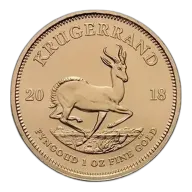
| Krugerrand | South African Mint | .9167 (22ct) | 1967 | First modern bullion coin; still the most widely held |
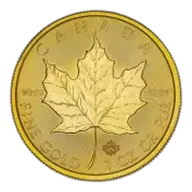
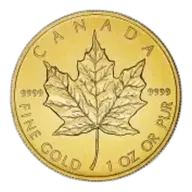
| Maple Leaf | Royal Canadian Mint | .9999 | 1979 | First .9999 gold coin; Bullion DNA anti-counterfeiting since 2014 |
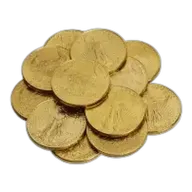
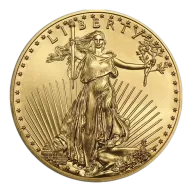
| American Gold Eagle | US Mint | .9167 (22ct) | 1986 | Only 22ct coin eligible for US IRAs, by specific statutory exemption |
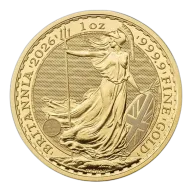
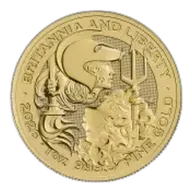
| Britannia | Royal Mint | .9999 (since 2013) | 1987 | CGT-exempt in the UK; tincture line security features |
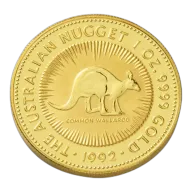
| Kangaroo | Perth Mint | .9999 | 1986 | Annual reverse design changes; originally the Gold Nugget |
| Philharmonic | Austrian Mint | .9999 | 1989 | Euro-denominated; the staple coin of continental Europe |
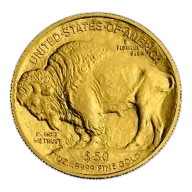
| American Buffalo | US Mint | .9999 | 2006 | First US .9999 gold coin; IRA-eligible |
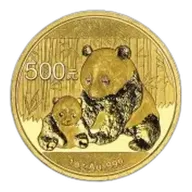
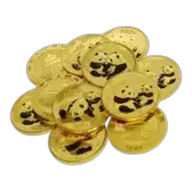
| Panda | China Mint | .999 | 1982 | Switched to a 30g metric weight in 2016; annual design changes |
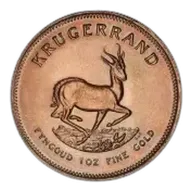
Jurisdiction usually decides the choice. UK buyers default to the 1oz gold Britannia for its CGT exemption, which no foreign coin shares. US buyers split between the Eagle, with its unique IRA carve-out despite 22ct purity, and the American Buffalo for a domestic .9999 option. The Krugerrand's copper alloy gives it a distinctive orange-gold colour and often the lowest premium on the secondary market, while the gold Philharmonic is the only major coin with a euro face value. New Zealand and Singapore buyers should favour the .9999 coins, since 22ct issues miss those countries' purity thresholds for tax exemption.
Selling, Storing and Verifying 1oz Gold Coins
1oz sovereign gold coins are the most liquid form of physical gold a retail investor can hold. Every dealer worldwide trades them, they are recognised by banks, assay offices and buyback programmes without further verification, and the global gold market operates around 23 hours a day across London, New York and Asia. Selling is typically same-day pricing with payment in one to five business days, and online dealers commonly quote instant buybacks. Recognition has a home-market tilt: the Maple Leaf sells most easily in Canada, the Eagle in the US, the Britannia and Sovereign in the UK, and the Krugerrand in South Africa.
Packaging conventions are uniform. 1oz gold coins ship in mint tubes of 10 for the major series including the Britannia, Krugerrand, Eagle and Maple Leaf, with monster boxes available for bulk orders. The coins are compact, around 32.7mm in diameter and 2.8mm thick for the Britannia, so a tube of 10 fits in a small safe and roughly USD 1 million in gold fits in a shoebox. Gold does not tarnish or corrode, so there are no atmosphere or humidity concerns; the practical risk is mechanical. Pure .9999 gold is soft, and coins should stay in capsules or tubes to avoid scratches, while 22ct coins tolerate handling better thanks to their harder alloy.
Authentication is simpler for coins than for bars. Intricate sovereign mint designs, tight weight and diameter tolerances, and modern security features make 1oz coins a low counterfeiting risk; there is no tungsten-core threat at coin thickness because the density mismatch would be immediately apparent. The Maple Leaf carries laser-engraved Bullion DNA micro-engraving verifiable at authorised dealers, and the Britannia uses picosecond-laser tincture lines and micro-text. Basic checks of weight, diameter and thickness, plus the ring test, catch crude fakes, and dealers widely use Sigma Metalytics verifiers.
For resale value, condition and provenance help but are not decisive; dealers buy on metal content and recognition. Keeping coins in original tubes or capsules preserves the option of selling at full coin premium rather than a handling-marked discount, and well-known 1oz coins hold their premium better on resale than gold bars or generic rounds.
1 oz Gold Coins: frequently asked questions
-
A 1oz gold coin contains 1 oz of gold (31.1035 g). This is a troy ounce, not the everyday avoirdupois ounce (28.35 g). The troy ounce is the standard unit for precious metals worldwide, so all gold coin weights use this measure.
-
In Canada, gold coins are treated as capital property. When you sell, 50% of your gain is included in your taxable income and taxed at your marginal rate. There is no separate collectibles rate as in the US. GST does not apply to qualifying investment gold coins (0%). Keep records of your purchase price to calculate the gain accurately.
- 1 oz American Buffalo Gold Coin
- 1 oz American Eagle Gold Coin
- 1 oz American Gold Eagle Gold Coin
- 1 oz American Liberty Gold Coin
- 1 oz Armillary Gold Coin
- 1 oz Australian Nugget Gold Coin
- 1 oz Austrian Mint Zodiac Gold Coin
- 1 oz Barbados Trident Gold Coin
- 1 oz Big 5 Gold Coin
- 1 oz Big Five Gold Coin
- 1 oz Bird of Paradise Gold Coin
- 1 oz Bounty Gold Coin
- 1 oz Britannia and Liberty Gold Coin
- 1 oz Britannia Gold Coin
- 1 oz British Lion Gold Coin
- 1 oz Call of the Wild Gold Coin
- 1 oz Canadian Moose Gold Coin
- 1 oz Chinese Myths and Legends Gold Coin
- 1 oz Chronos Gold Coin
- 1 oz Commander Gold Coin
- 1 oz Coronation Gold Coin
- 1 oz Dragon Rectangular Gold Coin
- 1 oz Dwelling Taniwha Gold Coin
- 1 oz EC8 Gold Coin
- 1 oz Emu Gold Coin
- 1 oz Five Blessings Gold Coin
- 1 oz Gold Coin
- 1 oz Gold Kiwi Gold Coin
- 1 oz Gold Lion Gold Coin
- 1 oz Growling Cougar Gold Coin
- 1 oz Guardian Lions Gold Coin
- 1 oz Harry Potter Gold Coin
- 1 oz Hawksbill Turtle Gold Coin
- 1 oz Klondike Gold Rush Gold Coin
- 1 oz Lady Justice Gold Coin
- 1 oz Legendary Creatures Gold Coin
- 1 oz Libertad Gold Coin
- 1 oz Loggerhead Turtle Gold Coin
- 1 oz Maple Leaf Gold Coin
- 1 oz Music Legends Gold Coin
- 1 oz Myths and Legends Gold Coin
- 1 oz Noah's Ark Gold Coin
- 1 oz PAMP Suisse Lunar Gold Coin
- 1 oz Panda Gold Coin
- 1 oz Perth Mint Kangaroo Gold Coin
- 1 oz Perth Mint Koala Gold Coin
- 1 oz Perth Mint Lunar Gold Coin
- 1 oz Philharmonic Gold Coin
- 1 oz Pobjoy Mint Noble Gold Coin
- 1 oz Queen's Beasts Gold Coin
- 1 oz Queen's Virtues Gold Coin
- 1 oz Ram of Calvary Gold Coin
- 1 oz Rand Refinery Krugerrand Gold Coin
- 1 oz Robin Hood Gold Coin
- 1 oz Royal Arms Gold Coin
- 1 oz Royal Australian Mint Kangaroo Gold Coin
- 1 oz Royal Australian Mint Lunar Gold Coin
- 1 oz Single Sourced Mine Gold Coin
- 1 oz Somalia Elephant Gold Coin
- 1 oz South African Mint Krugerrand Gold Coin
- 1 oz St George and the Dragon Gold Coin
- 1 oz Swan Gold Coin
- 1 oz The Lion and The Eagle Gold Coin
- 1 oz The Royal Mint Lunar Gold Coin
- 1 oz Tower Mint Angel Gold Coin
- 1 oz Tudor Beasts Gold Coin
- 1 oz Two Dragons Gold Coin
- 1 oz Wonders of Australia Gold Coin
- 1 oz World's Wildlife Gold Coin
- Pre-Owned 1 oz American Buffalo Gold Coin
- Pre-Owned 1 oz American Eagle Gold Coin
- Pre-Owned 1 oz American Gold Eagle Gold Coin
- Pre-Owned 1 oz Armillary Gold Coin
- Pre-Owned 1 oz Australian Nugget Gold Coin
- Pre-Owned 1 oz Big 5 Gold Coin
- Pre-Owned 1 oz Big Five Gold Coin
- Pre-Owned 1 oz Britannia and Liberty Gold Coin
- Pre-Owned 1 oz Britannia Gold Coin
- Pre-Owned 1 oz China Mint Gold Coin
- Pre-Owned 1 oz Coronation Gold Coin
- Pre-Owned 1 oz Gold Coin
- Pre-Owned 1 oz Libertad Gold Coin
- Pre-Owned 1 oz Maple Leaf Gold Coin
- Pre-Owned 1 oz Music Legends Gold Coin
- Pre-Owned 1 oz Myths and Legends Gold Coin
- Pre-Owned 1 oz Panda Gold Coin
- Pre-Owned 1 oz Perth Mint Kangaroo Gold Coin
- Pre-Owned 1 oz Perth Mint Lunar Gold Coin
- Pre-Owned 1 oz Philharmonic Gold Coin
- Pre-Owned 1 oz Queen's Beasts Gold Coin
- Pre-Owned 1 oz Royal Arms Gold Coin
- Pre-Owned 1 oz Somalia Elephant Gold Coin
- Pre-Owned 1 oz South African Mint Krugerrand Gold Coin
- Pre-Owned 1 oz St George and the Dragon Gold Coin
- Pre-Owned 1 oz The Lion and The Eagle Gold Coin
- Pre-Owned 1 oz The Royal Mint Gold Coin
- Pre-Owned 1 oz The Royal Mint Lunar Gold Coin
- Pre-Owned 1 oz Tower Mint Angel Gold Coin
- Pre-Owned 1 oz Tudor Beasts Gold Coin
- Pre-Owned 1 oz Two Dragons Gold Coin
- American Buffalo
- American Eagle
- American Gold Eagle
- American Liberty
- Armillary
- Australian Nugget
- Barbados Trident
- Big 5
- Big Five
- Bird of Paradise
- Bounty
- Britannia
- Britannia and Liberty
- British Lion
- Call of the Wild
- Canadian Moose
- Chinese Myths and Legends
- Chronos
- Commander
- Coronation
- Dragon Rectangular
- Dwelling Taniwha
- EC8
- Emu
- Five Blessings
- Gold Kiwi
- Growling Cougar
- Guardian Lions
- Harry Potter
- Hawksbill Turtle
- Isle of Man Angel
- Klondike Gold Rush
- Lady Justice
- Legendary Creatures
- Libertad
- Loggerhead Turtle
- Maple Leaf
- Music Legends
- Myths and Legends
- Noah's Ark
- Noble
- PAMP Lunar
- Panda
- Perth Kangaroo
- Perth Koala
- Perth Lunar
- Philharmonic
- Queen's Beasts
- RAM Kangaroo
- RAM Lunar
- Ram of Calvary
- Rand Refinery Krugerrand
- Robin Hood
- Royal Arms
- Royal Mint Lunar
- SA Mint Krugerrand
- Singapore Gold Lion
- Single Sourced Mine
- Somalia Elephant
- St George and the Dragon
- St Helena Queen's Virtues
- Swan
- The Lion and The Eagle
- Tudor Beasts
- Two Dragons
- Wonders of Australia
- World's Wildlife
- Zodiac