3 listings
Filters

 Elite Rare Coins


Prices are fetched automatically and may not reflect current merchant prices. Currency conversions and tax treatment are approximate. Rankings are based solely on price. We are not a dealer and accept no responsibility for transactions with listed merchants. Past performance is not indicative of future results. This site does not provide investment advice. Full disclaimer
About the 1 oz Canadian Moose Gold Coin
The Gold Call of the Wild Moose from the Royal Canadian Mint
The 1 oz Canadian Moose Gold Coin was issued in 2019 as the sixth and final coin in the Royal Canadian Mint's Call of the Wild series. It contains one troy ounce of 99.999% pure gold (five nines), a purity level that only the Royal Canadian Mint offers among major world mints. This five-nines fineness surpasses the 999.9 standard used by the 1oz Gold Britannia, 1oz Gold Philharmonic, and virtually every other sovereign gold coin in production.
The Call of the Wild series ran from 2014 to 2019, featuring iconic Canadian wildlife across six designs. The Moose carries a $200 CAD face value, significantly higher than the $50 face value of the standard 1oz Gold Maple Leaf. Each coin in the series was struck to the RCM's exacting standards, with individual coins sealed in assay cards guaranteeing weight and purity. The series is now discontinued, meaning available supply comes entirely from the secondary market.
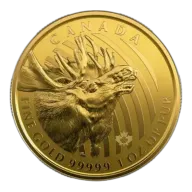
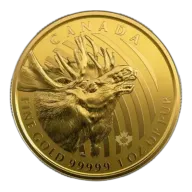
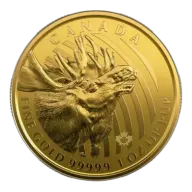
The moose (Alces alces) is the largest member of the deer family and one of the most recognisable symbols of the Canadian wilderness. The reverse design, by Senior RCM Engraver Emily S. Damstra, depicts a bull moose in its natural habitat. For gold buyers seeking the highest commercially available purity in a legal tender coin from a world-class sovereign mint, the Call of the Wild Moose represents the upper limit of what the bullion market offers.
Call of the Wild Moose Gold Coin Specifications
| Attribute | Value |
|---|---|
| Metal | Gold |
| Purity | .99999 (999.99 fine, five nines) |
| Weight | 1 troy ounce (31.103 g) |
| Diameter | 30 mm |
| Face Value | $200 CAD |
| Year of Issue | 2019 |
| Mint | Royal Canadian Mint |
| Series | Call of the Wild (6th of 6 coins) |
| Finish | Brilliant Uncirculated |
| Packaging | Sealed assay card |
The Complete Call of the Wild Series
| Year | Design | Face Value |
|---|---|---|
| 2014 | Howling Wolf | $200 CAD |
| 2015 | Growling Cougar | $200 CAD |
| 2016 | Roaring Grizzly | $200 CAD |
| 2017 | Elk | $200 CAD |
| 2018 | Golden Eagle | $200 CAD |
| 2019 | Moose | $200 CAD |
The five-nines purity (99.999%) places this coin in a class of its own among bullion issues. For comparison, the standard Gold Maple Leaf is 99.99% pure (four nines), and most other sovereign gold coins use 999.9 or lower. The additional decimal of purity has minimal effect on metal content (the difference is roughly 0.003 grams per ounce) but is a genuine technical achievement in minting and a mark of the RCM's metallurgical capability.
Tax Treatment of the Canadian Moose Gold Coin
As a 99.999% pure gold coin with legal tender status guaranteed by the Canadian government, the Call of the Wild Moose enjoys favourable tax treatment in most major bullion markets.
Canada
GST/HST exempt. Canadian law exempts investment gold coins of 99.5%+ purity with legal tender status from all federal and provincial sales taxes. The $200 face value is a legal tender guarantee, though the market value of the gold content far exceeds it. Capital gains on disposal are subject to the 50% inclusion rate.
United Kingdom
VAT-exempt as investment gold. The coin's 99.999% purity and legal tender status easily clear the UK threshold (995+ fineness for post-1800 legal tender coins). Not CGT-exempt, as it is not UK legal tender. Gains on disposal are taxed at the individual's rate (18% or 24%) with a £3,000 annual allowance. Eligible for SIPP inclusion. For CGT-exempt gold, UK buyers would need to look at the 1oz Gold Britannia or Gold Sovereigns.
United States
The Call of the Wild series meets IRA eligibility requirements under IRS Section 408(m), as the gold purity exceeds the 99.5% threshold. Individual coins sealed in their original assay cards are accepted by most precious metals IRA custodians. No federal sales tax applies; state-level exemptions cover approximately 35 states.
Australia and New Zealand
GST-free in Australia as investment-grade gold exceeding the 99.5% purity threshold. GST-exempt in New Zealand under the fine bullion exemption (gold 99.5%+).
Singapore and Hong Kong
GST-exempt in Singapore under the IPM scheme. Hong Kong imposes no sales tax, import duty, or capital gains tax on gold bullion.
The Call of the Wild Programme
The Call of the Wild series was launched in 2014 as a premium companion to the Royal Canadian Mint's flagship Gold Maple Leaf programme. Each annual release featured a different Canadian predator or large mammal rendered in 99.999% pure gold, a purity standard that only the RCM offers for bullion coins. The series began with the Howling Wolf and progressed through the Growling Cougar, Roaring Grizzly, Elk, and Golden Eagle before concluding with the Moose in 2019.
The programme was distinct from the earlier Canadian Wildlife Series (2011-2013), which was a silver bullion series. The Call of the Wild was gold-only, with a $200 face value (four times the Gold Maple Leaf's $50) and sealed assay card packaging. Each coin's design showcased a different RCM engraver's interpretation of Canada's wildlife.
The Moose design was created by Emily S. Damstra, an accomplished wildlife artist whose work also appeared on the Canadian Wildlife silver series (the 2013 Pronghorn Antelope and Wood Bison) and on circulating US coinage. Her bull moose design captures the animal in a naturalistic pose with a full set of antlers, set against the suggestion of Canadian wilderness.
The obverse of the 2019 Moose carries the Susanna Blunt portrait of Queen Elizabeth II, which appeared on Canadian coinage from 2003 until the transition to King Charles III's portrait. The series therefore represents one of the final RCM gold bullion programmes to carry the late Queen's effigy, adding a historical dimension to its collectibility.
Unlike the continuously produced Gold Maple Leaf, the Call of the Wild programme had a defined six-coin scope and was closed after the Moose. No further releases have been announced. This finite supply, combined with the five-nines purity and the RCM's reputation, has kept secondary market premiums firm for all six designs.
Canadian Moose vs Other 1 oz Gold Coins
The most direct comparison for the 1 oz Gold Moose is the standard 1oz Gold Maple Leaf, which comes from the same mint. Both carry Canadian legal tender status and the RCM's weight and purity guarantee. The Maple Leaf uses 99.99% gold (four nines) versus the Moose's 99.999% (five nines), and the Maple Leaf has a $50 face value versus $200. The Maple Leaf is produced annually in unlimited quantities with modern security features including DNA anti-counterfeiting technology and radial line micro-engraving. The Moose, as a discontinued limited series coin, trades at a higher premium but lacks these security features.
Against the 1oz Gold Krugerrand (91.67% purity, no face value), the Moose offers dramatically higher gold purity and Canadian legal tender status. The Krugerrand's lower purity is a deliberate design choice for durability, and its premiums are typically lower due to massive production volumes since 1967. For buyers who prioritise purity above all else, the Moose is the clear choice; for those who prioritise liquidity and low premiums, the Krugerrand has the advantage.
The 1oz Gold Philharmonic (99.99% purity, 1.50 EUR face value) and 1oz Gold Britannia (99.99% purity, 100 GBP face value) both use four-nines gold. The Britannia carries CGT exemption for UK buyers, which the Moose does not. The Philharmonic carries EU legal tender status with favourable VAT treatment across Europe. Both are continuously produced, making them easier to source and typically cheaper over spot than the discontinued Moose.
The key differentiator for the Call of the Wild Moose is the combination of five-nines purity, discontinued status, and sealed assay card presentation. It appeals to buyers who value the highest available purity from a sovereign mint and are willing to pay a premium for a coin that is no longer being produced.