17 products · 322 deals
Filters
| Product | /oz | Premium | Price | |
|---|---|---|---|---|

8 deals
|
$4,558.99 | +3.42% | $2,279.50 | Compare |

28 deals
|
$4,518.86 | +4.00% |
$2,259.44
£1,693
|
Compare |

39 deals
|
$4,540.74 | +4.50% |
$2,270.38
£1,701
|
Compare |

33 deals
|
$4,545.95 | +4.62% |
$2,272.98
£1,703
|
Compare |
| $4,624.06 | +6.42% |
$2,312.04
£1,733
|
Compare | |
| $4,636.64 | +6.71% |
$2,318.33
£1,737
|
View Deal | |

34 deals
|
$4,637.92 | +6.74% |
$2,318.95
£1,738
|
Compare |

36 deals
|
$4,686.33 | +7.85% |
$2,343.17
£1,756
|
Compare |

23 deals
|
$4,703.57 | +8.25% |
$2,351.78
£1,762
|
Compare |

61 deals
|
$4,715.28 | +8.52% |
$2,357.65
£1,767
|
Compare |

13 deals
|
$4,727.27 | +8.79% |
$2,363.64
£1,771
|
Compare |

34 deals
|
$4,747.34 | +9.25% |
$2,373.66
£1,779
|
Compare |
| $4,842.19 | +11.44% |
$2,421.10
£1,814
|
View Deal | |

3 deals
|
$4,929.44 | +13.44% |
$2,464.72
£1,847
|
Compare |

4 deals
|
$5,054.28 | +14.66% | $2,527.15 | Compare |
| $5,000.43 | +15.08% |
$2,500.21
£1,874
|
View Deal | |
| $5,016.68 | +15.45% |
$2,508.35
£1,880
|
View Deal |







Prices are fetched automatically and may not reflect current merchant prices. Currency conversions and tax treatment are approximate. Rankings are based solely on price. We are not a dealer and accept no responsibility for transactions with listed merchants. Past performance is not indicative of future results. This site does not provide investment advice. Full disclaimer
About 1/2 oz Gold Coins
Half the Coin, Most of the Efficiency
A half troy ounce is 15.5517 grams of fine gold, the largest of the fractional gold weights and the closest in character to the full-ounce coins it sits beneath. The 1/2oz is primarily a gold coin weight: every major sovereign mint produces one in its flagship series, the format is universally recognised, and the bars and silver coins that exist at this weight are niche by comparison.
The buyer here wants flexibility without the steep cost of going small. At roughly half the outlay of a 1oz gold coin, the half ounce still represents meaningful gold content per purchase, and its premium penalty is modest: roughly 5-8% over spot against 3-5% for full ounces, which works out to around USD 40-60 per half ounce. Compare that with the 7-12% charged at quarter ounce and the 10-18% at tenth ounce, and the 1/2oz emerges as the cheapest way to break a troy ounce into pieces.
Divisibility is the practical case. Two half ounces can be sold separately as needs arise; a single 1oz coin cannot. For investors who expect to liquidate in stages, or who want purchases to fit a budget that a full ounce exceeds, the half ounce delivers that flexibility while giving up the least premium of any fractional size. Liquidity supports the strategy: among gold coin weights, 1/2oz ranks second only to 1oz, with all dealers buying half-ounce sovereign coins.
UK buyers get the usual Britannia advantage, since the 1/2oz gold Britannia is CGT-exempt as UK legal tender, and should not confuse the weight with the Half Sovereign: that historic coin contains just 0.1177oz of gold (about 3.66g of 22ct), a much smaller product that happens to share the word "half". Investment gold at this weight is VAT-exempt in the UK and EU and tax-free at purchase across most of the English-speaking world under the same rules that govern the larger coins.
The Smallest Fractional Premium Penalty
1/2oz gold coins carry premiums of roughly 5-8% over spot, with the American Gold Eagle as the benchmark. At USD 4,200 gold, a 1/2oz Eagle costs approximately USD 2,205-2,268, against USD 2,163-2,205 for the equivalent half of a 1oz Eagle. The difference, roughly USD 40-60 per half ounce, is the entire cost of the format's flexibility, and it is significantly less than the penalty attached to the smaller fractionals.
Position on the fractional curve is the half ounce's whole argument. The ladder runs 3-5% at 1oz, 5-8% at 1/2oz, 7-12% at 1/4oz and 10-18% at 1/10oz. Each step down roughly doubles the gap to full-ounce pricing, so stopping at the first step preserves most of the premium efficiency of the 1oz coin while halving the unit cost. Buyers who do not specifically need quarter or tenth-ounce ticket sizes give up money for nothing by going smaller.
Resale economics reinforce the purchase maths. The bid-ask spread on 1/2oz gold coins is tighter than on smaller fractionals, and because the acquisition premium was lower, value retention through a full round trip is better than at 1/4oz or 1/10oz. The half ounce is the only fractional weight where the spread profile approaches full-ounce territory rather than degrading sharply.
Volume buying trims the cost further. Dealers often offer slight per-coin discounts on tube purchases, typically 10-20 coins per tube at this weight, which compounds the half ounce's already-modest premium into pricing that can rival splitting the same budget across 1oz coins. As with all gold coins, secondary market and random-year examples price below current-year issues, and the premium bands widen during demand spikes; the relative ordering across weights holds through both conditions.
Half-Ounce Coins Across the Flagship Series
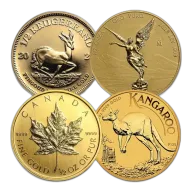
Every major world mint strikes a 1/2oz gold coin as part of its flagship series, each inheriting the parent coin's design, purity standard and legal tender status at half the gold content.
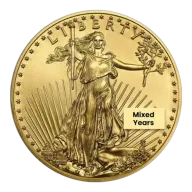
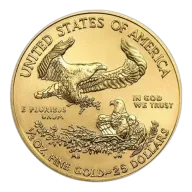
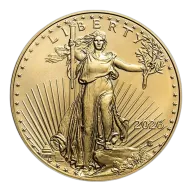
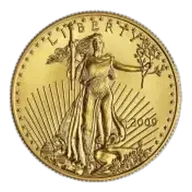
- American Gold Eagle 1/2oz, US Mint, USD 25 face value, 22ct. Produced since 1986 and IRA-eligible.
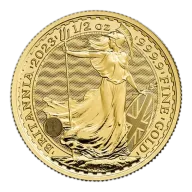
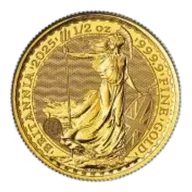
- Gold Britannia 1/2oz, Royal Mint, GBP 50 face value, 24ct. CGT-exempt for UK investors.
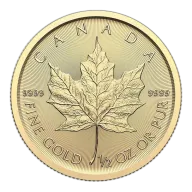
- Canadian Gold Maple Leaf 1/2oz, Royal Canadian Mint, 24ct.
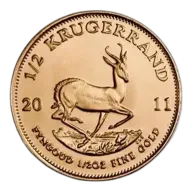
- South African Krugerrand 1/2oz, South African Mint, 22ct.
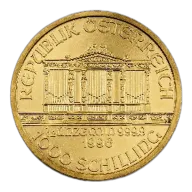
- Austrian Philharmonic 1/2oz, Austrian Mint, 24ct.
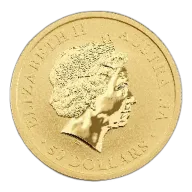
- Australian Kangaroo 1/2oz, Perth Mint, 24ct.
- Chinese Gold Panda 15g, China Mint. The nearest metric equivalent in the Panda's gram-denominated range.
The 22ct and 24ct split mirrors the 1oz market: Eagles and Krugerrands use a durable copper-alloyed 22ct standard while the Britannia, Maple Leaf, Philharmonic and Kangaroo are fine gold. Either way the gold content is a true half troy ounce; the alloyed coins simply weigh more in total.
Alternatives at or near this weight are thin. Gold bars at 1/2oz exist from some private mints but are niche, without the premium advantage that makes bars compelling at 1oz and above. Silver offers no mainstream product here, as 1/2oz silver pieces are mostly commemoratives or proofs rather than bullion. The one historic neighbour is the British Half Sovereign, CGT-exempt and traditionally popular for gifting, but at 0.1177oz of gold it is a far smaller coin serving a different price point; UK buyers wanting an actual half ounce of CGT-free gold should look to the Britannia.
Resale Strength Second Only to the Full Ounce
Among gold coin weights, the half ounce ranks second only to 1oz for liquidity. All dealers buy 1/2oz sovereign gold coins, the format is universally recognised, and bid-ask spreads run tighter than on any smaller fractional. For a seller, that means quotes close to the going premium rather than the discounted offers that meet quarter and tenth-ounce coins, and faster transactions because no buyer needs convincing about the product.
Value retention is the format's quiet strength. The 1/2oz acquisition premium of 5-8% leaves less to recover at resale than the steeper premiums on smaller coins, so the round-trip cost of ownership stays close to full-ounce economics. Investors who plan to sell in stages get the divisibility they paid for without surrendering much of it to spread; selling one of two half ounces realises half the position at near-1oz efficiency, something no smaller fractional can match.
Physically, these are convenient coins. A 1/2oz Eagle is approximately 27mm in diameter, slightly smaller than a UK 50p coin, and weight is negligible in storage terms; a full tube of 20 coins weighs approximately 311g and fits easily in a small safe alongside other tubes. Standard dealer packaging runs 10-20 coins per tube, and tube purchases often attract small per-coin discounts at acquisition that improve the position's overall economics.
Handling rules follow the metal. The 24ct half ounces, including the Britannia, Maple Leaf and Philharmonic, are soft fine gold and belong in capsules or original tubes to protect their surfaces; the 22ct Eagle and Krugerrand tolerate handling better but still resell best unmarked. Kept sealed and bought from the flagship series, a half-ounce position is about as close to the liquidity of 1oz gold coins as divisible gold gets, which is precisely the compromise the weight exists to offer.
1/2 oz Gold Coins: frequently asked questions
-
The metal content of a 1/2 oz gold coin is worth half the current troy ounce spot price, which you can see as $4,408.10 on this page. Dealer prices add a premium above that metal value, so check the table above for live retail offers across all tracked dealers.
-
A 1/2 oz gold coin contains 15.5518 grams of gold. This is a troy ounce measurement, not a standard (avoirdupois) ounce. A troy ounce is 31.1035 grams, so the half-ounce coin is exactly half of that.
-
Tax treatment depends on your country. In the UK, investment gold coins are exempt from VAT, and gains fall under CGT with a £3,000 annual exemption before rates of 18% or 24% apply. In the US, gold coins are taxed as collectibles at up to 28% on long-term gains. In Canada, 50% of any gain is included in taxable income.
-
Smaller coins typically carry a higher premium over spot per troy ounce than full-ounce coins. Dealers charge more per gram on fractional sizes because production costs (minting, packaging, distribution) are spread over less metal. If cost per ounce of gold is your priority, the 1 oz size usually offers a lower premium. The premiums tab on this page shows current data for comparison.
- 1/2 oz American Buffalo Gold Coin
- 1/2 oz American Eagle Gold Coin
- 1/2 oz American Gold Eagle Gold Coin
- 1/2 oz Australian Nugget Gold Coin
- 1/2 oz Britannia Gold Coin
- 1/2 oz Gold Coin
- 1/2 oz Gold Lion Gold Coin
- 1/2 oz Helvetia Gold Coin
- 1/2 oz Libertad Gold Coin
- 1/2 oz Maple Leaf Gold Coin
- 1/2 oz Noah's Ark Gold Coin
- 1/2 oz Panda Gold Coin
- 1/2 oz Perth Mint Kangaroo Gold Coin
- 1/2 oz Perth Mint Lunar Gold Coin
- 1/2 oz Philharmonic Gold Coin
- 1/2 oz Rand Refinery Krugerrand Gold Coin
- 1/2 oz Royal Australian Mint Kangaroo Gold Coin
- 1/2 oz Royal Australian Mint Lunar Gold Coin
- 1/2 oz South African Mint Krugerrand Gold Coin
- 1/2 oz Tower Mint Angel Gold Coin
- 1/2 oz US Mint Liberty Gold Coin
- Pre-Owned 1/2 oz American Eagle Gold Coin
- Pre-Owned 1/2 oz American Gold Eagle Gold Coin
- Pre-Owned 1/2 oz Britannia Gold Coin
- Pre-Owned 1/2 oz Gold Coin
- Pre-Owned 1/2 oz Maple Leaf Gold Coin
- Pre-Owned 1/2 oz Panda Gold Coin
- Pre-Owned 1/2 oz Perth Mint Kangaroo Gold Coin
- Pre-Owned 1/2 oz Perth Mint Lunar Gold Coin
- Pre-Owned 1/2 oz Philharmonic Gold Coin
- Pre-Owned 1/2 oz South African Mint Krugerrand Gold Coin
- Pre-Owned 1/2 oz US Mint Gold Coin