1 listing
Filters
| Product | /oz | Premium | Price | |
|---|---|---|---|---|

 Golden Eagle Coins
|
$4,832.00 | +9.62% | $2,416.01 | View Deal |
Prices are fetched automatically and may not reflect current merchant prices. Currency conversions and tax treatment are approximate. Rankings are based solely on price. We are not a dealer and accept no responsibility for transactions with listed merchants. Past performance is not indicative of future results. This site does not provide investment advice. Full disclaimer
About the 1/2 oz Helvetia Gold Coin
Swiss Private-Mint Gold from Degussa
The 1/2 oz Degussa Helvetia gold coin is a private-issue product from Degussa Goldhandel AG Switzerland, one of Europe's largest precious metals retailers. Despite the word "coin" in its marketing, this is technically a round or medallion: it carries no face value and is not legal tender of Switzerland or any other country. The distinction matters for tax purposes in several jurisdictions.
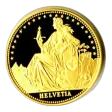
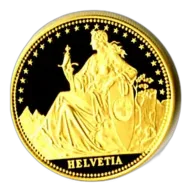
Degussa's Helvetia series draws on quintessentially Swiss iconography. Two obverse designs exist within the range: the Helvetia Matterhorn, depicting the pyramid-shaped summit of the Matterhorn (4,478 metres), and the Helvetia Goldhans, featuring William Tell with his crossbow and his son Walter. Both share a common reverse showing the Swiss Confederation coat of arms and the inscription "Helvetia," the neo-Latin name for Switzerland that has been in use since Roman times and gives Switzerland its CH country code.
The series fills a specific gap in the Swiss bullion market. Switzerland's federal mint (Swissmint) produces commemorative coins but does not issue bullion-grade investment coins. This leaves the bullion coin format to private issuers like Degussa, who compete for the market alongside the country's LBMA-accredited refineries (PAMP Suisse, Argor-Heraeus, Valcambi, Metalor), which focus primarily on bars. The Helvetia series is Degussa's attempt to offer a round-format Swiss bullion product with national branding.
The coins are struck by Huguenin, a Swiss medal and coin manufacturer based in Le Locle (canton of Neuchatel) that has been active since 1868. Huguenin's long manufacturing heritage provides quality assurance, though the Helvetia series lacks the advanced anti-counterfeiting features (holograms, latent images, micro-engraving) found on products from major sovereign mints.
At 900 fineness, this coin sits below the standard for modern bullion coins. Most competitors in the 1/2 oz gold coin category operate at 999.9 fineness. The 900 purity is more commonly associated with historic coins like pre-1933 US gold pieces and older European sovereigns. Buyers should verify whether this purity level meets their jurisdiction's threshold for investment gold tax exemptions.
Degussa Helvetia Gold Coin Specifications
| Attribute | Value |
|---|---|
| Gross weight | 15.5518 g (1/2 troy oz) |
| Fine gold content | 13.997 g |
| Purity | 900 (21.6 karat) |
| Manufacturer | Degussa Goldhandel AG (Switzerland) |
| Minter | Huguenin (Le Locle, Switzerland) |
| Legal tender | No (private-issue round) |
| Face value | None |
| Series | Helvetia |
Design Variants
Two distinct obverse designs are produced under the Helvetia brand. The Matterhorn design was introduced to commemorate the 150th anniversary of the first ascent on 14 July 1865 by a team led by Edward Whymper. Seven climbers reached the summit, but four died during the descent in one of mountaineering's most famous tragedies. The Goldhans design, launched on Swiss National Day (1 August 2015), depicts William Tell, the legendary Swiss folk hero who defied Habsburg authority. "Goldhans" is a playful Swiss-German dialect reference. William Tell is likely a legendary rather than historical figure; the crossbow story first appears in a 15th-century chronicle, with no contemporaneous evidence of his existence.
The shared reverse features the Swiss Confederation coat of arms (a white cross on a red background, formally adopted in 1889) with the inscription "Helvetia," the Latin name for Switzerland used since the Roman era. Each coin carries the Degussa mark and weight/purity stampings. No advanced anti-counterfeiting features such as holograms, latent images, or micro-engraving have been documented for this series; authentication relies on the manufacturing quality of the Huguenin strike and the Degussa brand markings.
Tax Position of a Private-Issue 900-Fine Round
The Helvetia's combination of private-issue status and 900 fineness creates a complicated tax picture that varies significantly by jurisdiction.
- United Kingdom: The UK investment gold exemption covers gold bars of 995+ fineness and qualifying coins (post-1800, legal tender, 900+ fine). The Helvetia is neither a bar at 995+ nor a qualifying coin (it has no legal tender status). At 900 fineness, it falls below the bar threshold. Its VAT treatment is ambiguous and may depend on how HMRC classifies it; buyers should seek confirmation from their dealer. It is definitively not CGT-exempt (not UK legal tender).
- European Union: The EU Investment Gold Directive exempts gold bars at 995+ purity and qualifying coins at 900+ purity with legal tender status. The Helvetia's 900 fineness is insufficient for the bar pathway, and its lack of legal tender status disqualifies it from the coin pathway. Standard VAT rates (17% to 27%) would likely apply in most EU countries.
- Switzerland: Investment gold is VAT-exempt in Switzerland. The definition of investment gold for Swiss VAT purposes may be more flexible than the EU directive; Degussa markets the gold versions as investment products. Buyers purchasing domestically through Degussa's Swiss retail outlets should confirm the VAT treatment at point of sale.
- United States: No federal sales tax. State treatment varies. Not IRA-eligible (below the 99.5% purity threshold and lacks legal tender status).
- Canada: GST/HST exemption requires 99.5% purity. The Helvetia does not qualify and is subject to full GST/HST.
- Australia: GST exemption for investment-grade gold requires 99.5% purity. The Helvetia at 900 fineness would attract 10% GST.
- New Zealand: Fine bullion exemption requires 99.5% gold purity. The Helvetia attracts 15% GST.
- Singapore: IPM exemption requires 99.5% gold purity. The Helvetia is subject to 9% GST.
- Hong Kong: No sales tax of any kind, regardless of purity or classification.
The tax position makes this product primarily suited to the Swiss and German domestic markets where Degussa has retail presence and can clarify the VAT treatment directly. In most international markets, the sub-995 purity and lack of legal tender status combine to create tax disadvantages compared to standard bullion coins from sovereign mints.
Helvetia vs Standard Fractional Gold Coins
The Degussa Helvetia competes at a structural disadvantage against established sovereign mint products in the 1/2 oz gold coin category. The disadvantages are threefold: lower purity, no legal tender status, and limited international distribution.
A 1/2 oz Gold Britannia contains 15.55 grams of fine gold at 999.9 fineness, versus 13.997 grams in the Helvetia at 900 fineness. The Britannia is UK legal tender (CGT-exempt), VAT-exempt globally as investment gold, IRA-eligible in the US, and available from hundreds of dealers worldwide. The Helvetia offers none of these advantages. A similar comparison applies to the 1/2 oz Gold Maple Leaf and 1/2 oz Gold Philharmonic.
The Helvetia's appeal is narrower and more specific. For Swiss residents, it offers a domestically produced gold product with national cultural significance, purchased directly from Degussa's retail locations in Zurich and Geneva. Switzerland does not have a sovereign bullion coin programme, so the Helvetia (alongside products from PAMP, Argor-Heraeus, and Valcambi) fills that gap. The design quality from Huguenin is high, and the Matterhorn and William Tell motifs carry genuine cultural resonance for Swiss buyers.
For international buyers, the case is harder to make. The purity disadvantage means less fine gold per coin, the tax disadvantages add cost in most jurisdictions, and the limited dealer network makes resale more challenging than for globally recognised coins. Buyers outside the Swiss/German market would find better value in any of the major sovereign mint fractional gold coins, which deliver more fine gold, better tax treatment, and stronger liquidity at comparable or lower premiums.
1/2 oz Helvetia Gold Coin: frequently asked questions
-
The cheapest 1/2 oz Helvetia listed here is $2,416.01, from Golden Eagle Coins, at around 9.6% over gold spot. Because the coin is 900 fine, its fine gold content is approximately 0.45 troy oz rather than a full half-ounce, so value tracks that fine content against the $4,408.10 gold spot price.
-
The coin has a gross 1/2 oz (15.5518 grams) at 900 purity (22.5 carat), giving approximately 13.997 grams of fine gold, equivalent to around 0.45 troy ounces. The balance is copper alloy. When comparing prices, use the fine gold content rather than the nominal weight.
-
The Helvetia is a private bullion coin produced by Degussa Goldhandel AG and struck by Huguenin, a Swiss medallion manufacturer based in Le Locle. The design takes its name from Helvetia, the Latin name for Switzerland. Degussa's Helvetia coins are not legal tender and carry no face value; they are valued for their gold content. The series draws on Swiss iconography, including the Matterhorn and the coat of arms.
-
Weigh the coin: a genuine 1/2 oz Helvetia should be 15.5518 grams. Check for the 900 purity stamp and Degussa hallmark on the reverse. A ring test (tap the coin against a hard surface) produces a sustained clear tone in solid gold. Genuine gold is non-magnetic, so a strong magnet should produce no attraction. A dealer can confirm specific gravity or use an XRF tester if you want further assurance.