44 products · 171 deals Prices & premiums exclude tax to compare across countries
Filters
| Product | /oz | Premium | Price (ex. tax) | |
|---|---|---|---|---|
| $68.64 | +1.50% | $686.40 | View Deal | |

8 deals
|
$68.74 | +1.65% | $687.43 | Compare |

2 deals
|
$69.84 | +3.27% | $698.38 | Compare |

5 deals
|
$70.29 | +3.93% | $702.87 | Compare |
|
10
2 deals
|
$69.56 | +4.35% |
$695.60
CA$975
|
Compare |

7 deals
|
$71.19 | +5.27% | $711.91 | Compare |

4 deals
|
$71.63 | +5.92% | $716.30 | Compare |
| $71.88 | +6.29% | $718.80 | View Deal | |
| $71.93 | +6.36% | $719.32 | Compare | |

3 deals
|
$72.28 | +6.88% | $722.83 | Compare |
| $72.36 | +7.00% | $723.60 | View Deal | |

2 deals
|
$72.36 | +7.00% | $723.60 | Compare |

2 deals
|
$71.59 | +7.39% |
$715.92
£537
|
Compare |

5 deals
|
$71.66 | +7.49% |
$716.60
£537
|
Compare |

42 deals
|
$72.07 |
+8.10%
+30% inc.VAT
|
$720.64
£648 inc.VAT
|
Compare |
| $73.82 | +9.16% | $738.24 | View Deal | |

4 deals
|
$73.42 |
+10.12%
+19% inc.VAT
|
$734.25
€693 inc.VAT
|
Compare |

2 deals
|
$72.80 | +10.36% |
$728.02
NZ$1,275
|
Compare |

3 deals
|
$73.76 | +10.65% |
$737.64
£553
|
Compare |

15 deals
|
$73.77 | +10.66% |
$737.69
£553
|
Compare |
| $74.86 | +10.69% | $748.56 | View Deal | |

2 deals
|
$74.88 | +10.72% | $748.80 | Compare |

2 deals
|
$75.86 | +12.18% | $758.62 | Compare |

3 deals
|
$76.36 | +12.91% | $763.60 | Compare |
| $75.58 | +13.26% |
$755.82
A$1,062
|
Compare | |
| $76.83 | +13.61% | $768.31 | Compare | |
| $76.87 | +13.67% | $768.73 | Compare | |
| $76.88 | +13.68% | $768.79 | Compare | |
| $76.88 | +13.68% | $768.81 | View Deal | |

2 deals
|
$76.94 | +13.77% | $769.40 | Compare |











Prices are fetched automatically and may not reflect current merchant prices. Currency conversions and tax treatment are approximate. Rankings are based solely on price. We are not a dealer and accept no responsibility for transactions with listed merchants. Past performance is not indicative of future results. This site does not provide investment advice. Full disclaimer
About 10 oz Silver Bars
The Stacker's Default: 10oz Silver Bars
Ten troy ounces is 311.035 grams of silver, and the 10oz bar is widely considered the most popular silver bar size, the point where premium savings and practical divisibility meet. It is the dominant retail silver bar weight in the US and Canada, and the standard dealer recommendation for anyone buying USD 300-500 or more of silver at a time.
The economic argument is the steep section of the bar premium curve. The single biggest premium drop on the entire silver bar scale happens between 1oz and 10oz, typically 4-5 percentage points. A 1oz silver bar carries roughly 5-15% over spot; a 10oz bar carries 3-6%, saving roughly USD 1-1.50 per ounce. Beyond 10oz the curve flattens: kilo bars price at a similar 3-6% and 100oz bars at 2-5%, so each further step up saves less than the first one did.
The buyer profile is the committed stacker rather than the first-timer. Single-ounce products suit small, frequent purchases and tiny increments at resale; 10oz bars suit buyers accumulating weight on a budget who still want units small enough to sell individually. The trade against bigger formats runs the other way: a kilo bar costs roughly USD 900+ and a 100oz bar represents a USD 3,000+ commitment in one indivisible lump, while 10oz units keep the holding granular.
Tax follows the standard silver bar rules. In the UK, bars carry 20% VAT on purchase and CGT liability on sale, with no legal tender exemption available, which makes the premium efficiency of the 10oz size particularly relevant; the larger the bar, the more the premium saving offsets the fixed VAT percentage. Buyers in Canada, Australia, New Zealand and Singapore get GST exemption at the standard purity thresholds, most US states charge no sales tax on bullion, and Hong Kong charges nothing at any stage.
Where the Premium Curve Pays You to Size Up
10oz silver bars carry premiums of roughly 3-6% over spot in normal market conditions. The arithmetic against smaller units is straightforward: at USD 30 spot, a 10oz bar at a 4% premium costs approximately USD 312, while the same ten ounces bought as 1oz bars at 10% premium costs about USD 330, roughly USD 18 saved per 10oz purchased. Repeated across a meaningful stack, that difference compounds into whole extra ounces of silver.
Looking down the scale, the 10oz bar is the escape from small-format pricing. 1oz bars run 5-15% and 5oz bars 6-10%; the jump to 10oz delivers the largest single premium reduction available anywhere on the silver bar ladder. Looking up the scale, the gains shrink. Kilo bars at 32.15oz sit in a similar 3-6% band, with the per-ounce difference between 10oz and kilo often under 1%, and 100oz bars reach 2-5%. For most buyers the marginal saving past 10oz does not cover the liquidity cost of the bigger units, which is exactly why dealers anchor their recommendations at this weight.
Format choices within the weight shift the price slightly. Both cast and minted finishes are common at 10oz, with cast bars running 1-2% cheaper than minted equivalents across the bar market. Bars from recognised mints carry a small brand premium over generic pours but command tighter spreads at resale, so the cheapest sticker price is not always the cheapest cost of ownership.
Coins at this weight are a different market. 10oz silver coins exist, including the Royal Mint Valiant, 10oz Queen's Beasts issues and Perth Mint Lunar 10oz coins, but they carry higher premiums than bars and often collector pricing on top. A buyer at the 10oz weight who wants investment silver rather than a collectible is almost always better served by the bar, while the 1oz sovereign coin market remains the place for coin-specific advantages like legal tender status.
The 10oz Bar Market by Maker
The 10oz weight attracts nearly every major silver refiner and several government mints, in both cast and minted finishes. Recognition at resale tracks the name on the bar.
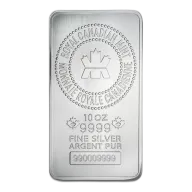
- Royal Canadian Mint: government mint production with serialisation; a North American staple at this weight.
- Royal Mint: the UK government mint's bar line, denominated in troy ounces.
- PAMP Suisse: LBMA-accredited Swiss refiner; minted finish.
- Valcambi: LBMA-accredited Swiss refiner.
- Asahi: successor to Johnson Matthey's refining operations; widely distributed in North America.
- Sunshine Minting: major US refiner with the MintMark SI security feature on branded bars.
- Scottsdale Mint: US private mint with a popular 10oz line.
- Nadir and Geiger Edelmetalle: European refiners producing 10oz bars alongside metric sizes.
Finish is the main variant decision. Minted 10oz bars are cut, stamped and polished, usually shipping in sealed mint packaging that aids resale; cast bars are poured into moulds with a more rustic look and a slightly lower price, and may ship loose. Cast finishes become more common as bars get larger, and 10oz is the weight where both styles are equally mainstream.
The same weight exists in other metals and forms for context. 10oz gold bars from PAMP, Valcambi, RCM and Perth Mint serve wealthier investors at roughly USD 30,000+ per bar, with very low 1-3% premiums but enormous concentrated value per unit. And the 10oz silver coins, the Valiant, Queen's Beasts and Perth Lunar issues, offer the weight in coin form at collector-tier premiums. For pure silver accumulation, the bar remains the rational pick at this size, with brand choice mattering more than maker-by-maker specification differences.
Selling, Handling and Storing 10oz Bars
10oz silver bars have excellent liquidity. All major online dealers and local coin shops buy them readily, and the weight is familiar enough that no buyer needs persuading about what it is. Bars from recognised mints such as the Royal Canadian Mint, PAMP and the Royal Mint command tighter spreads; generic bars remain liquid but can face slightly wider pricing. Sealed original mint packaging helps at resale, so minted bars are worth keeping in their plastic.
The liquidity trade-off is granularity. A 10oz bar sells as a unit; there is no selling three ounces of it. Stackers who anticipate piecemeal liquidation often hold a mix, with 10oz bars as the core and a sleeve of 1oz coins or bars for small disposals. Against larger formats the 10oz unit is the more sellable: kilo and 100oz bars find fewer retail buyers per listing, while the 10oz price point keeps the buyer pool broad.
Physically, the bar is compact relative to its value. A typical 10oz silver bar measures approximately 84 x 49 x 8mm and weighs 311g, and stacked bars are space-efficient; ten 1oz bars occupy more total room once packaging and air gaps are counted. Silver's bulk still asserts itself at scale, since significant holdings run to tens of kilograms, and vault storage for silver is disproportionately expensive compared with gold because fees track weight and space. Home storage favours the format: flat bars stack densely in a modest safe.
Care requirements are the standard silver set. Tarnish from airborne sulphur compounds is cosmetic and does not affect melt value, but presentation matters when selling above melt, so keep bars dry, sealed where possible, and away from rubber and PVC. Authentication concerns are modest at this weight; counterfeit 10oz bars exist, with base-metal cores as the usual method, and weight, dimension and magnet-slide checks catch them. Buying branded bars from reputable dealers, and keeping them sealed, settles both the authenticity and the resale questions in advance.
10 oz Silver Bars: frequently asked questions
-
A 10 oz silver bar contains 10 oz of silver, giving it a melt value of roughly 10 times the $67.63 silver spot price. Dealer buy prices sit above that melt value by a premium that varies between suppliers. This page tracks 204 listings from 52 dealers so you can compare live prices.
-
A 10 troy ounce silver bar weighs 10 oz, equivalent to 311.035 grams. Troy ounces are slightly heavier than standard (avoirdupois) ounces, so a 10 troy oz bar is not the same as 10 standard ounces. This weight is standard across all brands of 10 oz silver bar.
-
Tax rules on silver bars vary by country. In the UK, silver bars attract 20% VAT on purchase, unlike investment gold which is exempt. In Canada, investment-grade silver bullion is generally GST/HST-exempt. In Australia, silver bullion is subject to GST. US buyers face state-level sales tax rules that differ by state.
-
The 10 troy oz size is produced by a range of refineries and sovereign mints. Most bars are struck or cast to .999 fine silver and carry the refiner's hallmark, weight, and purity stamp. Brand choice affects the premium you pay above spot, but not the underlying silver content. Use the comparison table to see which brands are currently available.
- 10 oz AARUS Silver Bar
- 10 oz ABC Cast Bar Silver Bar
- 10 oz ABC Refinery Silver Bar
- 10 oz Academy Silver Bar
- 10 oz Ainslie Silver Bar
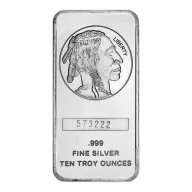
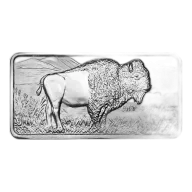
- 10 oz American Buffalo Silver Bar
- 10 oz American Flag Silver Bar
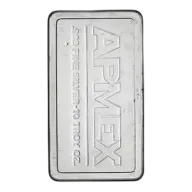
- 10 oz APMEX Silver Bar
- 10 oz Argentia Silver Bar
- 10 oz Asahi Refining Silver Bar
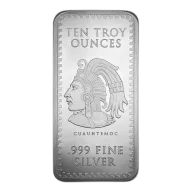
- 10 oz Aztec Calendar Silver Bar
- 10 oz Beaver Bullion Silver Bar
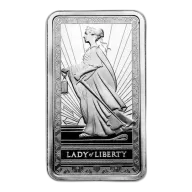
- 10 oz Britannia and Liberty Silver Bar
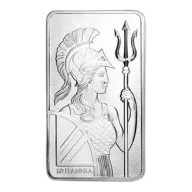
- 10 oz Britannia Silver Bar
- 10 oz Building Blocks Silver Bar
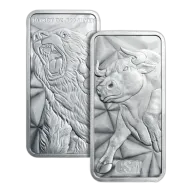
- 10 oz Bull and Bear Silver Bar
- 10 oz Bull & Bear Silver Bar
- 10 oz Canadian PMX Silver Bar
- 10 oz Credit Suisse Silver Bar
- 10 oz Dillon Gage Silver Bar
- 10 oz Dragon Silver Bar
- 10 oz East India Company Silver Bar
- 10 oz Elemetal Mint Silver Bar
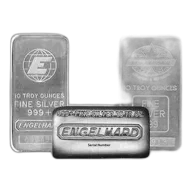
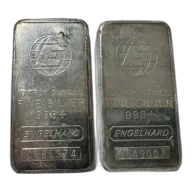
- 10 oz Engelhard Bar Silver Bar
- 10 oz Engelhard Silver Bar
- 10 oz Eureka Silver Bar
- 10 oz Fiji Samurai Silver Bar
- 10 oz First Mint Cast Bar Silver Bar
- 10 oz Fortuna Silver Bar
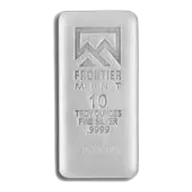
- 10 oz Frontier Mint Silver Bar
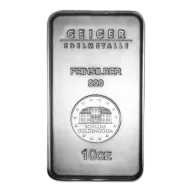
- 10 oz Geiger Original Silver Bar
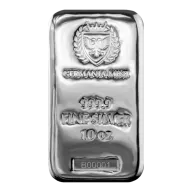
- 10 oz Germania Mint Silver Bar
- 10 oz Goddess Mara Silver Bar
- 10 oz Gold Bullion Australia Silver Bar
- 10 oz Golden Analytical Silver Bar
- 10 oz Golden State Mint Silver Bar
- 10 oz Heraeus Silver Bar
- 10 oz Highland Mint Silver Bar
- 10 oz Imperium Silver Bar
- 10 oz Intrinsic Tender Silver Bar
- 10 oz Istanbul Gold Refinery Silver Bar
- 10 oz JBR Recovery Silver Bar
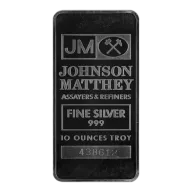
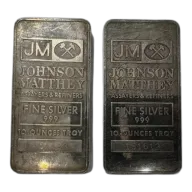
- 10 oz Johnson Matthey Silver Bar
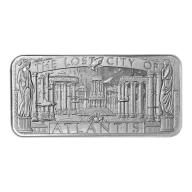
- 10 oz Lost Cities Silver Bar
- 10 oz Mini Chunk Silver Bar
- 10 oz MintID Silver Bar
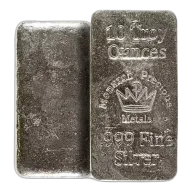
- 10 oz Monarch Precious Metals Silver Bar
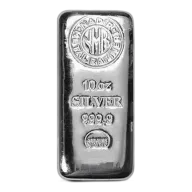
- 10 oz Nadir Refinery Silver Bar
- 10 oz New Zealand Mint Silver Bar
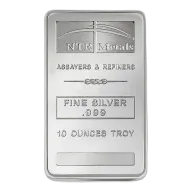
- 10 oz NTR Metals Silver Bar
- 10 oz PAMP Suisse Liberty Silver Bar
- 10 oz PAMP Suisse Lunar Silver Bar
- 10 oz PAMP Suisse Silver Bar
- 10 oz Perth Mint Lunar Silver Bar
- 10 oz Perth Mint Silver Bar
- 10 oz Queen's Beasts Silver Bar
- 10 oz Queen's Virtues Silver Bar
- 10 oz Regency Mint Silver Bar
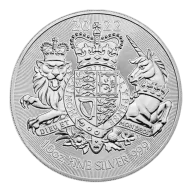
- 10 oz Royal Arms Silver Bar
- 10 oz Royal Canadian Mint Silver Bar
- 10 oz Scotiabank Silver Bar
- 10 oz Scottsdale Mint Archangel Michael Silver Bar
- 10 oz Scottsdale Mint Silver Bar
- 10 oz Scottsdale Stacker Silver Bar
- 10 oz Silver Bar
- 10 oz Silver Buffalo Silver Bar
- 10 oz SilverTowne Buffalo Silver Bar
- 10 oz SilverTowne Silver Bar
- 10 oz Sunshine Minting Silver Bar
- 10 oz TD Silver Bar
- 10 oz Themis Silver Bar
- 10 oz The Royal Mint Silver Bar
- 10 oz The Royal Mint Una and the Lion Silver Bar
- 10 oz The Vortex Silver Bar
- 10 oz The Wild Silver Bar
- 10 oz Tombstone Nugget Silver Bar
- 10 oz Tombstone Silver Bar
- 10 oz USA Eagle Silver Bar
- 10 oz Valcambi Silver Bar
- 10 oz Walking Liberty Silver Bar
- 10 oz Wall Street Mint Silver Bar
- Pre-Owned 10 oz Asahi Refining Silver Bar
- Pre-Owned 10 oz Britannia and Liberty Silver Bar
- Pre-Owned 10 oz Britannia Silver Bar
- Pre-Owned 10 oz East India Company Una and the Lion Silver Bar
- Pre-Owned 10 oz Engelhard Bar Silver Bar
- Pre-Owned 10 oz Engelhard Silver Bar
- Pre-Owned 10 oz Fortuna Silver Bar
- Pre-Owned 10 oz Geiger Original Silver Bar
- Pre-Owned 10 oz Johnson Matthey Silver Bar
- Pre-Owned 10 oz Perth Mint Silver Bar
- Pre-Owned 10 oz Royal Canadian Mint Silver Bar
- Pre-Owned 10 oz Scottsdale Mint Silver Bar
- Pre-Owned 10 oz Silver Bar
- Pre-Owned 10 oz The Royal Mint Three Graces Silver Bar
- ABC Cast Bar
- American Buffalo
- Aztec Calendar
- Britannia
- Britannia and Liberty
- Bull and Bear
- Bull and Bear
- Dragon
- Engelhard Silver Bars
- Eureka
- Fiji Samurai
- First Mint Cast Bar
- Fortuna
- Geiger Edelmetalle Geiger Original
- Goddess Mara
- Imperium Collection
- Lost Cities
- Mini Chunk
- PAMP Liberty
- PAMP Lunar
- Perth Lunar
- Queen's Beasts
- Royal Arms
- Royal Mint Three Graces
- Royal Mint Una and the Lion
- Scottsdale Archangel Michael
- Scottsdale Stacker
- Silver Buffalo Round
- Silver Building Blocks
- SilverTowne American Flag
- SilverTowne Buffalo
- St Helena Queen's Virtues
- St Helena Una and the Lion
- Themis
- The Vortex
- The Wild
- Tombstone
- Tombstone Nugget
- USA Eagle
- Walking Liberty
- Wall Street Mint