1 listing
Filters
| Product | /oz | Premium | Price | |
|---|---|---|---|---|

 Monument Metals
|
$64.83 | +4.22% | $648.30 | View Deal |
Prices are fetched automatically and may not reflect current merchant prices. Currency conversions and tax treatment are approximate. Rankings are based solely on price. We are not a dealer and accept no responsibility for transactions with listed merchants. Past performance is not indicative of future results. This site does not provide investment advice. Full disclaimer
About the 10 oz Highland Mint Buffalo Silver Bar
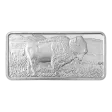
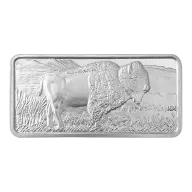
The 10 oz Highland Mint Buffalo Silver Bar
The 10 oz Highland Mint Buffalo Silver Bar contains 10 troy ounces (311.035 grams) of .999 fine silver and carries the same Buffalo Nickel design that Highland Mint uses across its widely traded round series. Highland Mint is a private mint in Melbourne, Florida, established in the 1980s and better known for officially licensed sports memorabilia than for bullion, yet its Buffalo products have become some of the most widely distributed generic silver in the US market thanks to its large-scale 50,000 square foot production facility.
The appeal is straightforward: an iconic American design on a weight that does the heavy lifting in a silver stack. The 10 oz format typically carries premiums of 3-6% under normal conditions versus 5-15% for 1 oz bars, saving roughly $1 to $1.50 per ounce, and dealers commonly recommend it as the core size for anyone buying $300-$500 or more at a time. A 10 oz bar measures around 84mm x 49mm x 8mm, compact relative to its value, and many stackers find a single 10 oz bar more space-efficient than ten 1 oz pieces with their packaging and air gaps.
As a generic private-mint bar it has no legal tender status, no assay card, and no advanced security technology; the "HM" mint mark, .999 purity, and precise weight are its authenticity markers. That keeps the price down, which is exactly the point. Buyers who want provenance pay up for sovereign mint products; buyers who want the most silver per dollar in a manageable unit look at 10 oz silver bars like this one.
Tax Treatment of the 10 oz Buffalo Silver Bar
At .999 fineness this bar meets the investment-silver purity thresholds in the major exempt jurisdictions, though silver never gets the near-universal tax break that gold does:
- US: No federal sales tax; this is the bar's primary market and most states exempt bullion, with some applying thresholds (Florida exempts purchases over $500, New York and Massachusetts over $1,000). Long-term capital gains are taxed at the collectibles rate of up to 28%. IRA eligibility is unlikely: silver must be at least 99.9% pure and come from an accredited refiner, and Highland Mint products generally do not meet the accredited-manufacturer requirement.
- UK: 20% VAT on purchase, and as a bar with no legal tender status it is also liable for Capital Gains Tax on disposal.
- Canada: No GST/HST on silver refined to at least 99.9% purity in bar form, which this bar meets.
- Australia: GST-free as investment-grade silver at 99.9%+ purity.
- New Zealand: GST-exempt at 99.9%+ silver purity.
- Singapore: 0% GST under the Investment Precious Metals scheme for 99.9%+ silver, with no capital gains tax.
- Hong Kong: No sales tax, import duty, or capital gains tax.
- EU: New silver attracts the full standard VAT rate, 17-27% depending on the country.
The Buffalo Nickel Design, From 1913 to Highland Mint
The design on this bar is one of the most reproduced in American bullion. Sculptor James Earle Fraser created the original Buffalo Nickel (also called the Indian Head Nickel) for the US Mint, where it circulated from 1913 to 1938. The obverse carries a composite Native American portrait; Fraser reportedly worked from three models, Iron Tail (Lakota Sioux), Two Moons (Cheyenne), and John Big Tree (Seneca), though numismatists debate the attribution. The reverse bison was reportedly modelled on Black Diamond, a bison at the New York Central Park Zoo, another detail that remains debated. After the coin was demonetised the design entered the public domain, which is why so many private mints reproduce it today.
Highland Mint introduced its Buffalo silver round in 2014, adapting Fraser's artwork with inscriptions changed to "LIBERTY" on the obverse and weight and purity markings on the reverse, with the "HM" mint mark replacing Fraser's original "F". The Buffalo design now appears across Highland Mint's range, including this 10 oz bar alongside rounds in 1 oz, 1/2 oz, 1/4 oz, and 1/10 oz sizes, all in .999 fine silver.
The design's dominance in the private round and bar market rests on three things: it is free to use, it carries strong American cultural resonance, and the imagery appeals broadly to collectors. The US Mint's own American Buffalo gold coin, issued since 2006 in .9999 fine gold, is the official government adaptation of the same artwork, a measure of how durable Fraser's 1913 design has proved.
Highland Mint Buffalo vs Other 10 oz Silver Bars
The 10 oz silver bar field splits into two tiers. Recognised mints such as the Royal Canadian Mint, Royal Mint, PAMP Suisse, Valcambi, Asahi, Sunshine Minting, and Scottsdale Mint command tighter spreads at buyback; generic bars like the Highland Mint Buffalo remain liquid, since all major online dealers and local coin shops buy 10 oz bars readily, but may face slightly wider spreads. What the Highland Mint bar gives up in brand cachet it claws back at purchase, where generics price below big-name refiners.
Within the generic tier, the closest competition comes from other Buffalo-design products. Sunshine Minting's Buffalo pieces add the MintMark SI micro-engraved security feature, readable with a proprietary decoder lens, which Highland Mint cannot match. SilverTowne has a longer history in the bullion market with a very similar product. Highland Mint's answer is its "HM" mark and year dating, which provide more provenance than truly anonymous generic silver, plus distribution muscle that puts its Buffalo products in virtually every US online dealer's catalogue.
Against 1 oz silver rounds including Highland Mint's own Buffalo round, the bar wins on cost per ounce but loses divisibility: selling a 10 oz bar is all or nothing. Against kilo bars the per-ounce premium difference is often under 1%, so the 10 oz format's flexibility usually outweighs the marginal saving. For a US stacker prioritising silver weight per dollar with an American design, this bar is one of the cheaper routes to it.