
10 products · 259 deals
Filters
| Product | /oz | Premium | Price | |
|---|---|---|---|---|

10 deals
|
$4,433.29 | +2.03% |
$4,433.29
£3,322
|
Compare |

93 deals
|
$4,449.63 | +2.40% |
$4,449.63
£3,335
|
Compare |

33 deals
|
$4,545.95 | +4.62% |
$2,272.98
£1,703
|
Compare |

45 deals
|
$4,548.11 | +4.67% |
$1,137.03
£852
|
Compare |
| $4,931.62 | +11.88% | $1,232.91 | View Deal | |
| $4,904.00 | +12.86% |
$490.39
CA$687
|
Compare | |

61 deals
|
$4,939.56 | +13.68% |
$493.95
£370
|
Compare |

11 deals
|
$4,939.94 | +13.69% |
$247.00
£185
|
Compare |

2 deals
|
$5,623.82 | +27.58% | $180.81 | Compare |
| $5,648.91 | +28.15% | $282.45 | View Deal |







Prices are fetched automatically and may not reflect current merchant prices. Currency conversions and tax treatment are approximate. Rankings are based solely on price. We are not a dealer and accept no responsibility for transactions with listed merchants. Past performance is not indicative of future results. This site does not provide investment advice. Full disclaimer
About the Maple Leaf Gold
Canada's Gold Standard in Bullion
The Canadian Gold Maple Leaf is one of the most traded gold bullion coins in the world, produced by the Royal Canadian Mint since 1979. It was the first 1oz gold coin struck in fine gold (.999 at launch, upgraded to .9999 in November 1982), challenging the assumption that bullion coins required alloying for durability. That .9999 purity has remained its defining characteristic for over four decades, matched since by the Gold Britannia (from 2013), Philharmonic, and American Buffalo, but pioneered by the Maple Leaf.
The coin's creation had a specific historical catalyst. Apartheid-era sanctions against South Africa restricted international availability of the Krugerrand, which had been the world's only major gold bullion coin since 1967. The Royal Canadian Mint saw an opportunity to fill the resulting global vacuum, and the Maple Leaf became the primary alternative for investors worldwide. Within a few years, it had established a permanent position in the international market that persisted long after Krugerrand restrictions were lifted in the 1990s.
Six gold denominations are produced: 1oz (C$50 face value), 1/2oz (C$25), 1/4oz (C$10), 1/10oz (C$5), 1/20oz (C$1), and a 1g coin (C$0.50). The range of sizes, from a 1-gram entry point to the standard 1oz, gives the Maple Leaf one of the widest denomination lineups of any sovereign gold coin. All are Canadian legal tender at their face values, though the market value of each far exceeds the denomination.
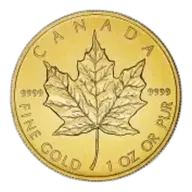
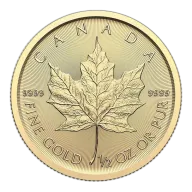
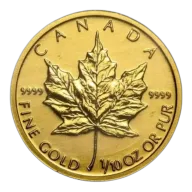
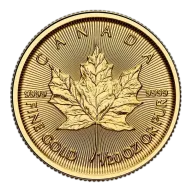
The reverse design, the iconic sugar maple leaf, has remained essentially unchanged since 1979. Minor refinements have occurred, and background radial lines were added in 2015 for security, but the fundamental image is the same. This design continuity, combined with four-nines purity and the Royal Canadian Mint's security technology suite, makes the Maple Leaf a benchmark product in the global bullion market.
Gold Maple Leaf Denominations and Technical Data
| Size | Weight | Diameter | Thickness | Face Value | Edge |
|---|---|---|---|---|---|
| 1 oz | 31.11 g | 30.0 mm | 2.80 mm | C$50 | Reeded |
| 1/2 oz | 15.55 g | 25.0 mm | 2.23 mm | C$25 | Reeded |
| 1/4 oz | 7.78 g | 20.0 mm | 1.78 mm | C$10 | Reeded |
| 1/10 oz | 3.11 g | 16.0 mm | 1.13 mm | C$5 | Reeded |
| 1/20 oz | 1.55 g | 14.1 mm | 0.92 mm | C$1 | Reeded |
| 1 g | 1.00 g | ~10.0 mm | varies | C$0.50 | Reeded |
Purity: .9999 fine gold (99.99% pure, 24 karat). Since the coin is virtually pure gold, total weight and gold content are essentially identical.
At .9999 purity, the Maple Leaf is softer than alloyed coins like the Gold Eagle (.9167) or Krugerrand (.9167). Edge contact marks, bag marks, and surface scratches are common characteristics of pure gold and should not be mistaken for damage. Handle by the edges and store in protective capsules.
The 1oz Maple Leaf's 30.0mm diameter is slightly smaller than the 32.70mm Gold Eagle and 32.69mm Britannia, reflecting its lighter total weight (no alloy mass).
Security Features
From 2014, every Gold Maple Leaf carries a micro-engraved laser mark: a textured maple leaf privy mark with the last two digits of the production year, visible only under magnification. This mark is the basis for the Bullion DNA system. The Royal Canadian Mint captures a high-resolution image of each die's micro-engraving, encrypts it, and stores it in a secure database. Authorised dealers use a dedicated reader device to photograph a coin's mark and match it against the database, providing instant individual coin-level authentication.
From 2015, radial lines were added: precisely machined lines stretching across both sides of the coin, creating a light-diffracting pattern. These lines are extremely difficult to replicate and provide an additional visual authentication layer.
Gold Maple Leaf Tax Treatment by Country
United Kingdom
Gold Maple Leafs are VAT-exempt as investment gold (post-1800 legal tender coin from a government mint, purity above .900). On disposal, the Maple Leaf is not CGT-exempt. Only UK legal tender coins (Britannias and Sovereigns) qualify for the CGT exemption. This is the most important distinction for UK buyers comparing the Maple Leaf with the Britannia: both are VAT-free to buy, but the Britannia's CGT exemption means tax-free profits on sale regardless of gain size.
United States
Gold, Silver, and Platinum Maple Leafs are all IRA-eligible, meeting the IRS purity requirements (.995+ for gold, .999+ for silver, .9995 for platinum). The .9999 gold purity exceeds the threshold comfortably. Outside an IRA, gains are taxed as collectibles at a maximum 28% federal rate. The Maple Leaf competes directly with the Gold Eagle in the US market, with lower average premiums (historically about 1.3 percentage points below Eagles) offset by the Eagle's deeper domestic brand loyalty.
Canada
Gold Maple Leafs are exempt from GST/HST under the Excise Tax Act as investment-grade gold bullion. Capital gains are taxed at a 50% inclusion rate (66.67% above C$250,000 annually from June 2024). Physical bullion, including Maple Leafs, is not eligible for RRSPs or TFSAs; only mining stocks and precious metals ETFs qualify for these registered accounts.
Australia
At .9999 purity, the Gold Maple Leaf qualifies as investment-grade gold and is GST-free (threshold: 99.5%). Capital gains are subject to a 50% discount for individuals holding more than 12 months.
European Union
Gold Maple Leafs qualify as investment gold under the EU Gold Directive and are VAT-exempt across all member states. Silver Maple Leafs are subject to local VAT rates, though some countries (Germany, Netherlands) offer margin scheme taxation on imported or pre-owned silver coins.
Singapore and Hong Kong
Singapore exempts the Maple Leaf from GST under the Investment Precious Metals scheme at .9999 purity with legal tender status. No capital gains tax applies. Hong Kong charges no tax of any kind on gold bullion.
From Apartheid-Era Opportunity to Global Bullion Standard
The Gold Maple Leaf was launched in 1979, positioned to capture market share from the South African Krugerrand as Western nations imposed sanctions against the apartheid regime. The initial plan was modest: a three-year trial with a total run of 5 million coins. The first-year mintage of 1,000,000 coins proved the concept, and the program became permanent.
In November 1982, the Royal Canadian Mint upgraded the purity from .999 to .9999, a move that established four-nines gold as a viable standard for circulating bullion coins. This was unprecedented; the conventional wisdom held that pure gold was too soft for coinage. The Mint proved otherwise, and the .9999 standard eventually became the target for competitors including the Austrian Philharmonic (1989), Chinese Panda, and the Britannia (upgraded in 2013).
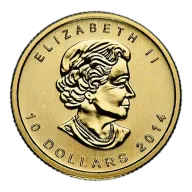
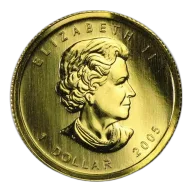
The obverse has carried four portraits of Queen Elizabeth II by different artists (Arnold Machin 1979-1989, Dora de Pedery-Hunt 1990-2003, Susanna Blunt 2004-2023) and, from 2024, King Charles III by Steven Rosati. The reverse maple leaf has been a constant since launch, refined but never fundamentally altered.
The RCM has produced several notable special editions. In 2007, the "Big Maple Leaf" set a record: a 100kg coin of .99999 purity (five nines), measuring 50cm in diameter. Only six were made. One was stolen from Berlin's Bode Museum in 2017 in a widely reported heist. The five-nines purity remains the highest ever achieved by a government mint for a struck coin.
The MintShield coating, introduced on Silver Maple Leafs in 2018, addressed the persistent industry complaint of "milk spots," white calcium deposits that formed on silver coins over time. Milk spots are cosmetic and do not affect silver content, but they reduce visual appeal and secondary market desirability. MintShield was the first purpose-built solution by any mint, and its introduction on silver complemented the Bullion DNA authentication system that had been rolled out on gold (2014) and silver (2015) coins.
Peak Silver Maple Leaf production reached 28,222,061 coins in 2013. The RCM stopped publishing detailed annual gold mintage figures after 2013, making precise production tracking for gold difficult.
Gold Maple Leaf Against Major Competitors
The American Gold Eagle (.9167, 22 karat) is the Maple Leaf's primary competitor in the North American market. The Eagle's copper-silver alloy makes it harder and more scratch-resistant; the Maple Leaf's .9999 purity makes it softer but purer. The Eagle weighs 33.931g total for 1oz of gold; the Maple Leaf weighs 31.11g because it carries no alloy mass. Both are IRA-eligible. Premiums on Gold Eagles have historically averaged about 1.3 percentage points above Maple Leafs. The Eagle dominates the US secondary market on brand loyalty; the Maple Leaf holds stronger recognition internationally.
The Gold Britannia (.9999 since 2013) is the closest purity match. For UK buyers, the Britannia's CGT exemption makes it the superior choice on tax grounds alone. Both carry four-nines gold; both have advanced security technology (Bullion DNA versus the Britannia's four visual features). The Britannia changes its reverse design annually, adding mild collectability; the Maple Leaf's fixed design emphasises consistency. Premiums in the UK market are broadly comparable between the two.
The South African Krugerrand (.9167, copper alloy) was the coin the Maple Leaf was created to replace in international markets. The Krugerrand has deeper historical roots (1967 vs 1979) and remains the most widely distributed gold coin ever produced, but the Maple Leaf's .9999 purity meets tax exemption thresholds in jurisdictions where the Krugerrand's .9167 does not (notably Singapore, and New Zealand where 22-karat gold attracts 15% GST). The Krugerrand has no face value and is not IRA-eligible.
The Austrian Philharmonic (.9999) is a direct purity peer. The Philharmonic carries lower premiums in European markets and competes with the Maple Leaf for the "affordable four-nines gold" segment. It lacks the Maple Leaf's Bullion DNA authentication but has strong recognition across continental Europe.
The Maple Leaf's scratch susceptibility is a frequently cited concern. Pure gold marks and scratches more easily than alloyed alternatives. This is inherent to the metal, not a manufacturing defect, and does not affect bullion value (dealers buy by weight and purity, not visual grade). Buyers who prioritise handling resistance may prefer the Eagle or Krugerrand; those who prioritise purity, security technology, and international tax eligibility will find the Maple Leaf difficult to match.