
7 products · 265 deals
Filters
| Product | /oz | Premium | Price | |
|---|---|---|---|---|

67 deals
|
$4,488.84 | +3.31% |
$4,488.84
£3,364
|
Compare |
| $4,495.02 | +3.45% |
$4,495.02
£3,369
|
Compare | |

61 deals
|
$4,715.28 | +8.52% |
$2,357.65
£1,767
|
Compare |

71 deals
|
$4,787.29 | +10.17% |
$478.74
£359
|
Compare |

62 deals
|
$4,812.43 | +10.75% |
$1,203.11
£902
|
Compare |
| $4,842.19 | +11.44% |
$2,421.10
£1,814
|
View Deal | |
| $5,051.82 | +14.60% | $1,262.96 | View Deal |





Prices are fetched automatically and may not reflect current merchant prices. Currency conversions and tax treatment are approximate. Rankings are based solely on price. We are not a dealer and accept no responsibility for transactions with listed merchants. Past performance is not indicative of future results. This site does not provide investment advice. Full disclaimer
About the American Eagle Gold
America's Flagship Gold Bullion Coin
The American Gold Eagle is the United States' flagship gold bullion coin, authorised by the Gold Bullion Coin Act of 1985 and first released in 1986. It is one of the most widely traded gold coins in the world and the dominant gold bullion product in the US domestic market.
The Gold Eagle is distinctive among modern sovereign coins for its 22-karat (.9167 fine) composition, using a traditional "crown gold" alloy of 91.67% gold, 3% silver, and 5.33% copper. This alloy makes it one of only two major sovereign bullion coins still struck below .999 purity, the other being the South African Krugerrand. Each coin contains its stated weight of pure gold; the alloy adds mass on top, so a 1oz Gold Eagle actually weighs 33.931 grams total while delivering exactly 1 troy ounce (31.108g) of gold.
The 22-karat composition is a deliberate trade-off. The copper-silver alloy makes the coin harder and more scratch-resistant than .9999 fine competitors like the Canadian Maple Leaf or Gold Britannia. It also gives the Eagle a subtly warmer tone than pure gold coins. Proponents consider this practical durability an advantage for a coin that will be handled and traded; critics note that the purity question matters in markets where 24-karat gold is the standard, particularly in Asia.
Four denominations are produced: 1oz ($50 face value), 1/2oz ($25), 1/4oz ($10), and 1/10oz ($5). This full fractional lineup, maintained continuously since 1986, is a practical advantage over the American Gold Buffalo, which is effectively limited to the 1oz size. The fractional Eagles serve investors wanting smaller, more affordable entry points without abandoning the US Mint umbrella.
Gold Eagle Denominations and Dimensions
| Size | Pure Gold | Total Weight | Diameter | Thickness | Face Value |
|---|---|---|---|---|---|
| 1 oz | 31.108 g | 33.931 g | 32.70 mm | 2.87 mm | $50 |
| 1/2 oz | 15.554 g | 16.965 g | 27.00 mm | 2.24 mm | $25 |
| 1/4 oz | 7.777 g | 8.483 g | 22.00 mm | 1.83 mm | $10 |
| 1/10 oz | 3.111 g | 3.393 g | 16.50 mm | 1.19 mm | $5 |
Alloy composition: 91.67% gold, 3.00% silver, 5.33% copper.
Edge: Reeded. From 2021 (Type II), the edge includes an anti-counterfeiting variation, with an intentionally omitted reed whose position changes annually.
The total weight of each denomination exceeds its gold content by roughly 9.1%, reflecting the alloy mass. This is a point of frequent confusion among new buyers. A 1oz Gold Eagle contains exactly 1 troy ounce of pure gold; the extra 2.823g is silver and copper that add no meaningful value. The coin is priced by its gold content, not its total weight.
By law, the gold used in American Eagles must come from sources within the United States, alloyed with silver and copper. The alloy is the traditional English "crown gold" standard, first established for English gold coinage in 1526 and used for the original gold sovereign.
Gold Eagle Tax and Legal Status
American Gold Eagles are legal tender of the United States at their stated face values. This legal tender status, combined with a specific statutory exemption regarding purity, creates a distinctive tax profile.
United States
The Gold Eagle's IRA eligibility is unusual. Under IRC Section 408(m)(3), American Eagle coins are specifically named as qualifying investments for self-directed precious metals IRAs, bypassing the general .995 purity requirement that applies to other gold products. This statutory exemption exists because the coin was created partly as a retirement savings vehicle. Eagles must be held by an approved custodian; home storage is not permitted.
Outside retirement accounts, gains are taxed at the collectibles rate: up to 28% federal for holdings over one year, ordinary income rates for shorter holds. This is higher than the 15-20% long-term rate on equities. IRS Form 1099-B reporting is required for dealer sales of 25 or more 1oz Gold Eagles in a single transaction. State sales tax varies by jurisdiction; approximately 35 states exempt investment bullion entirely.
United Kingdom
Gold Eagles are VAT-exempt as investment gold. They meet the EU-derived criteria for qualifying gold coins (post-1800, government-issued, face value). However, Eagles are not UK legal tender and therefore do not qualify for the CGT exemption available to Britannias and Sovereigns. UK holders face CGT at 18-24% on gains above the £3,000 annual allowance.
European Union
Gold Eagles appear on the EU's annual list of recognised investment gold coins and are VAT-exempt across all member states under the Investment Gold Directive.
Canada
GST/HST exempt as investment gold. Not eligible for RRSPs. Capital gains taxed at the 50% inclusion rate.
Australia
The Gold Eagle's .9167 purity is below Australia's 99.5% threshold for investment gold GST exemption. Australian buyers should confirm GST treatment with the ATO, as the coin may attract 10% GST despite being a recognised sovereign bullion product. This is a notable disadvantage compared to .9999 fine coins.
Singapore
The .9167 purity falls below Singapore's 99.5% IPM requirement. Gold Eagles do not qualify for GST exemption in Singapore and attract the standard 9% GST. This is a market where the Maple Leaf or Britannia offer a clear tax advantage.
The Gold Eagle from 1986 to the Type II Redesign
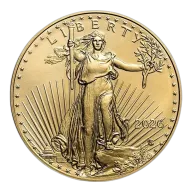
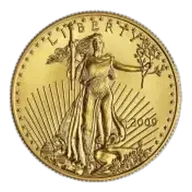
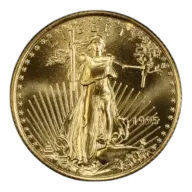
The Gold Eagle carries one of the most storied design lineages in American coinage. The obverse adapts Augustus Saint-Gaudens' Lady Liberty from the 1907 $20 Double Eagle, routinely called the most beautiful American coin ever produced. The striding Liberty with torch and olive branch, framed against rays of light with the Capitol building in the background, translates Saint-Gaudens' original vision to a modern bullion format.
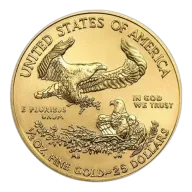
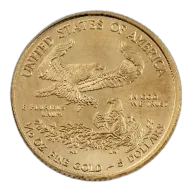
The original reverse (Type I, 1986-2021) was Miley Busiek Frost's "Family of Eagles," depicting a male eagle carrying an olive branch flying above a nest with a female eagle and hatchlings. Frost described it as a tribute to the American family. This design remained unchanged for 35 years.
In 2021, the program underwent its first major design change. The Type II reverse, designed by Jennie Norris and sculpted by Renata Gordon, features a close-up portrait of a bald eagle's head with detailed feather rendering. Norris' selection was notable: the design was her first-ever coin submission to the US Mint's Artistic Infusion Program, and it won one of the most prestigious coin design commissions in the world.
Both Type I and Type II were produced during 2021's transition year, with Type I in the first half and Type II in the second half. This created a brief supply pinch that drove secondary market premiums sharply higher for both variants. Type I 2021 coins are collected as the final year of the original design.
Production volumes have been highly volatile, driven by demand rather than predetermined targets. The 1oz mintage peaked at 1,505,026 in 1999, collapsed to 108,000 in 2019, surged to 747,500 during the COVID demand spike in 2020, and has declined again to 143,500 (to date) in 2025. The financial crisis years of 2008-2009 saw surging demand; in 2009, the Mint suspended proof and uncirculated versions entirely, diverting all capacity to bullion strikes.
Gold Eagle Against Competing Sovereign Coins
The Gold Eagle's 22-karat composition is its most distinctive characteristic, and the axis along which comparisons with competing sovereign coins are most revealing.
The Canadian Maple Leaf is .9999 fine versus the Eagle's .9167. The Maple Leaf weighs exactly 31.11g (its gold content); the Eagle weighs 33.931g total for the same 1oz gold content. The Royal Canadian Mint's Bullion DNA system provides individual coin-level authentication through a database matching service, a technology the Eagle lacks. Premiums on Gold Eagles have historically averaged about 1.3 percentage points higher than Maple Leafs. The Eagle dominates the US secondary market; the Maple Leaf has stronger international recognition.
The South African Krugerrand shares the Eagle's 22-karat approach (.9167 fine, alloyed with copper only, no silver). Both weigh 33.93g for 1oz of gold. The Krugerrand was the world's first modern bullion coin (1967) and established the concept the Eagle later adopted. The Krugerrand carries no face value and is not IRA-eligible, significant disadvantages in the US market. In international markets, particularly Africa and Europe, the Krugerrand's 40-year head start gives it deep recognition.
The Gold Britannia upgraded from 22 karat to .9999 fine in 2013. For UK residents, the Britannia's CGT exemption is decisive; Eagles attract capital gains tax. The Britannia's four security features (latent image, surface animation, micro-text, tincture lines) provide visual authentication that the Eagle cannot match. In the US market, the Eagle's domestic provenance outweighs these factors.
The American Gold Buffalo is the US Mint's own .9999 fine alternative, effectively the Eagle's in-house competitor. The choice between them reduces to purity preference (Buffalo) versus denomination range and scratch resistance (Eagle). Both are IRA-eligible; the Eagle's specific statutory exemption from purity rules makes it one of only two 22-karat coins permitted in US retirement accounts.
The Austrian Philharmonic, at .9999 fine, typically offers lower premiums in European markets. For US buyers ordering internationally, the premium advantage can be offset by shipping costs and the Philharmonic's unfamiliarity to some US dealers.
American Eagle Gold: frequently asked questions
-
American Eagle prices track the live spot price for the relevant metal, plus a dealer premium that reflects US Mint production costs, legal tender status, and market demand. We track prices from 34 dealers across the gold, silver, and platinum variants, so you can compare the full range of available offers in one place.
-
Purity varies by metal. Gold Eagles are 22-karat (.9167 fine), alloyed with silver and copper for durability, though each coin contains its full stated weight of pure gold. Silver Eagles are .999 fine silver. Platinum Eagles are .9995 fine platinum. The Gold Eagle's 22-karat alloy is unusual among modern sovereign bullion coins; it was chosen to make the coins more resistant to scratching and handling damage.
-
The face value is a legal-tender denomination set by Congress when the programme was authorised, giving the coins the standing of official US currency. For Silver Eagles the denomination is $1; Gold Eagles range from $5 to $50; Platinum Eagles up to $100. These figures were never intended to represent market value, which is determined by the coin's metal content at spot prices and far exceeds the nominal denomination.
-
American Eagles are produced by the US Mint, a sovereign government facility, to exacting specifications with a government guarantee of weight and purity. Production costs, authorised-dealer distribution, and legal tender status all contribute to premiums above the raw spot price. The programme's long history, widespread recognition, and IRA eligibility also support demand, which sustains premiums compared with generic rounds or bars.