

Prices are fetched automatically and may not reflect current merchant prices. Currency conversions and tax treatment are approximate. Rankings are based solely on price. We are not a dealer and accept no responsibility for transactions with listed merchants. Past performance is not indicative of future results. This site does not provide investment advice. Full disclaimer
About the American Buffalo Gold
America's Purest Gold Bullion Coin
The American Gold Buffalo is the first and only .9999 fine gold bullion coin issued by the United States Mint. Introduced in 2006 under the Presidential $1 Coin Act of 2005, it was created to give American investors a 24-karat option that could compete directly with the Canadian Maple Leaf, Austrian Philharmonic, and other .9999 fine coins that had dominated international markets while the US offered only the 22-karat American Gold Eagle.
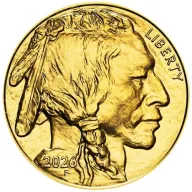
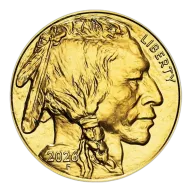
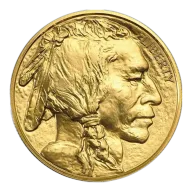
The coin adapts one of the most celebrated designs in American numismatic history: James Earle Fraser's 1913 Indian Head (Buffalo) nickel, featuring a composite portrait of a Native American man on the obverse and an American bison on the reverse. The design translation from a small nickel to a full-size gold bullion coin preserves the fine hair strands, fur texture, and detail that made the original one of the most recognisable coin designs in American history.
For American investors, the Gold Buffalo fills a specific gap. Those who want the highest purity gold with US government backing and IRA eligibility have exactly one option. The Gold Eagle provides government backing and IRA eligibility at .9167 (22 karat), while non-US coins like the Maple Leaf offer .9999 purity without US Mint provenance. The Buffalo is where these requirements converge.
All bullion-strike Gold Buffalos are produced at the West Point Mint. The standard offering is the 1oz coin ($50 face value). Fractional sizes (1/2oz, 1/4oz, 1/10oz) were produced only in 2008 and promptly discontinued, making those pieces scarce collector items rather than regular bullion products. Buyers seeking fractional gold from the US Mint are directed to the Gold Eagle program, which maintains a full fractional lineup.
Gold Buffalo Specifications and Denominations
| Specification | 1 oz (Standard) |
|---|---|
| Purity | .9999 fine (99.99% pure gold, 24 karat) |
| Gold content | 31.108 g (1 troy oz exactly) |
| Total weight | 31.108 g |
| Diameter | 32.70 mm |
| Thickness | 2.95 mm |
| Face value | $50 |
| Edge | Reeded |
| Mint | West Point (W mint mark) |
Because the Buffalo is pure gold with no alloy, its total weight equals its gold content. This contrasts with the 1oz Gold Eagle, which weighs 33.931g total because its copper-silver alloy adds mass on top of the stated gold content. Both coins contain exactly 1 troy ounce of pure gold.
The .9999 purity makes the Buffalo physically softer than 22-karat coins. Contact marks and surface scratches are inherent to pure gold, not manufacturing defects. Handling by the edges and storage in protective capsules is recommended.
Fractional Sizes (2008 Only)
| Denomination | Face Value | Gold Content | Diameter |
|---|---|---|---|
| 1/2 oz | $25 | 15.554 g | 26.50 mm |
| 1/4 oz | $10 | 7.777 g | 22.00 mm |
| 1/10 oz | $5 | 3.110 g | 16.50 mm |
Fewer than 100,000 total fractional Buffalo coins were minted in 2008. Production challenges with the pure gold composition at small sizes, combined with insufficient demand alongside the established Gold Eagle fractional program, led to their discontinuation. These pieces trade at significant numismatic premiums above their gold content.
Gold Buffalo Tax and Legal Status
The American Gold Buffalo is US legal tender with a $50 face value, though its market value is determined by gold content. This legal tender status, combined with .9999 purity, shapes its tax treatment across jurisdictions.
United States
The Buffalo is IRA-eligible. At .9999 fine, it exceeds the IRS minimum purity requirement of .995 for gold held in a self-directed IRA. The coin must be held by an approved custodian, not stored personally. Outside retirement accounts, gains on the Buffalo are taxed as collectibles at a maximum 28% federal rate, the same treatment applied to all physical precious metals regardless of legal tender status. IRS Form 1099-B reporting is required for sales of 25 or more pieces in a single transaction. State sales tax varies: approximately 35 states exempt investment bullion, with partial exemptions and full taxation elsewhere.
United Kingdom
The Gold Buffalo qualifies for VAT exemption as investment gold. It meets the criteria as a bullion coin with face value, issued by a government mint, with fineness above .900. It is not UK legal tender, so it does not qualify for the CGT exemption available to Britannias and Sovereigns. UK investors face CGT at 18% (basic rate) or 24% (higher rate) on gains above the £3,000 annual allowance.
European Union
The Gold Buffalo appears on the EU's annual list of recognised investment gold coins and is VAT-exempt across all member states under the EU Gold Directive.
Canada
Exempt from GST/HST as investment gold above 99.5% purity. Not eligible for RRSPs as it is not issued by a Canadian mint. Capital gains are taxed at the standard 50% inclusion rate.
Australia
At .9999 fine, the Buffalo meets the 99.5% purity threshold for GST exemption as investment-grade gold. Capital gains subject to a 50% discount for holdings exceeding 12 months.
Singapore and Hong Kong
Singapore exempts the Buffalo from GST under the Investment Precious Metals scheme (qualifying purity and legal tender). Hong Kong charges no sales tax, import duty, or capital gains tax on gold bullion.
From the Buffalo Nickel to 24-Karat Gold
The American Gold Buffalo draws its design from the Indian Head nickel, created by sculptor James Earle Fraser in 1913. Fraser described the obverse portrait as a composite based on three tribal leaders: Iron Tail of the Oglala Lakota, Two Moons of the Northern Cheyenne, and Big Tree of the Kiowa, though historians have debated the exact attribution. The reverse bison is believed to have been modelled after Black Diamond, a well-known resident of the Central Park Zoo in New York City, though Fraser himself gave conflicting accounts over the years.
Fraser's original design was controversial at the Treasury when introduced in 1913, but it became one of the most beloved designs in American coinage history. The Buffalo nickel circulated from 1913 to 1938 and its imagery endured in the American consciousness long after the coin left circulation.
The Gold Buffalo's creation in 2006 addressed a competitive gap. The US Mint had offered only the 22-karat Gold Eagle since 1986, while international competitors, particularly the Canadian Maple Leaf, had established .9999 fine gold as the global standard. Many buyers, especially in Asian markets where 24-karat gold is the cultural standard, preferred the higher purity coins from Canada, Austria, and Australia. Congress authorised the Buffalo to give the US Mint a competitive 24-karat product.
Production has not been without disruption. In 2009, during the financial crisis, the US Mint suspended Buffalo production because it could not source enough .9999 fine gold blanks to meet surging demand. This remains the only year since 2006 that new bullion Buffalos were not minted. The 2008 fractional experiment, producing 1/2oz, 1/4oz, and 1/10oz denominations, was abandoned after a single year due to manufacturing challenges with pure gold at small sizes.
Notable special editions include the 2013-W Reverse Proof, commemorating the 100th anniversary of Fraser's original Buffalo nickel design, and the 2026-W Proof, a dual-dated coin (1776-2026) with a "250" privy mark marking America's 250th anniversary, limited to 15,000 pieces.
Gold Buffalo Compared to Other Sovereign Gold Coins
The most direct comparison is with the American Gold Eagle, since both are US Mint products competing for the same buyer base. The Eagle is .9167 fine (22 karat) with a copper-silver alloy, while the Buffalo is .9999 fine (24 karat). Both contain exactly 1 troy ounce of pure gold in the 1oz denomination, but the Eagle weighs 33.931g total versus the Buffalo's 31.108g because of the alloy mass. The Eagle's alloy makes it harder and more scratch-resistant; the Buffalo's pure gold is softer and more susceptible to contact marks. The Eagle comes in four denominations (1oz through 1/10oz); the Buffalo is effectively 1oz only. Both are IRA-eligible. The Eagle has deeper secondary market liquidity due to its 20-year head start (1986 vs 2006).
Against the Canadian Maple Leaf, the comparison is between two .9999 fine coins from different government mints. The Maple Leaf has the Royal Canadian Mint's Bullion DNA anti-counterfeiting system and MicroEngraved laser security mark, technologies the Buffalo lacks. The Maple Leaf is available in more sizes (1oz down to 1 gram). The Buffalo holds stronger brand appeal in the US market, while the Maple Leaf has broader international recognition. Premiums are generally comparable.
The Gold Britannia, also .9999 fine since 2013, offers advanced security features including a latent image, surface animation, micro-text, and tincture lines. In the UK, the Britannia is CGT-exempt as legal tender, a tax advantage the Buffalo cannot match for UK residents. Premiums in the UK market tend to favour the Britannia.
The Austrian Philharmonic, another .9999 fine coin, is euro-denominated and popular in European markets. It typically carries lower premiums than the Buffalo in European dealerships but higher premiums in the US.
The Gold Buffalo's unique position is clear: it is the only .9999 fine gold coin from the US government. For American investors who want pure gold, IRA eligibility, and the backing of the US Mint in a single product, no alternative exists.
American Buffalo Gold: frequently asked questions
-
The American Gold Buffalo trades at a premium over the live gold spot price per troy ounce. The 1 oz coin contains exactly one troy ounce of .9999 fine gold, so its base value moves directly with spot. We track 64 listings from 34 dealers, letting you compare prices across the market in real time.
-
Yes. The American Gold Buffalo is struck in .9999 fine (24-karat) gold, making it the purest gold bullion coin produced by the US Mint. This distinguishes it from the American Gold Eagle, which is struck in .9167 (22-karat) gold alloyed with silver and copper. Each Buffalo coin contains exactly its stated weight of pure gold.
-
The higher purity requires a more refined gold blank. Achieving .9999 fineness demands additional refining steps compared with the .9167 Eagle alloy, and that extra processing cost is reflected in the premium. The Buffalo programme also launched 20 years after the Eagle, giving it a shorter production history and less secondary-market depth, which can push premiums higher for equivalent gold content.
-
Check the key specifications: a genuine 1 oz Buffalo weighs 31.108 grams, measures 32.70mm in diameter, and has a reeded edge. The coin bears the West Point "W" mint mark and the inscription ".9999 FINE GOLD." A neodymium magnet should not attract gold (it is non-magnetic); a basic acid test can confirm gold content. For certainty, professional third-party grading services such as NGC or PCGS provide certified authentication.