8 listings
Filters
| Product | /oz | Premium | Price | |
|---|---|---|---|---|
|
1/
 Gold Stock Canada
Out of Stock
Gold Stock Canada
Out of Stock
|
$4,718.71 | +8.59% |
$2,359.31
CA$3,305
|
View Deal |
|
1/
Gold Stock Canada
Out of Stock
|
$4,718.71 | +8.59% |
$2,359.31
CA$3,305
|
View Deal |
|
1/
Gold Stock Canada
Out of Stock
|
$4,718.71 | +8.59% |
$2,359.31
CA$3,305
|
View Deal |
|
1/
Gold Stock Canada
Out of Stock
|
$4,718.71 | +8.60% |
$2,359.31
CA$3,305
|
View Deal |
|
20
 Pacific Precious Metals
Out of Stock
Pacific Precious Metals
Out of Stock
|
$5,069.88 | +15.01% | $2,534.95 | View Deal |
 Elite Rare Coins
Out of Stock
Elite Rare Coins
Out of Stock
|
$5,078.20 | +15.20% | $2,539.11 | View Deal |
 A Coin Shop
Out of Stock
A Coin Shop
Out of Stock
|
$5,083.20 | +15.32% | $2,541.61 | View Deal |
 AU Capital Management
Out of Stock
AU Capital Management
Out of Stock
|
$5,087.18 | +15.41% | $2,543.60 | View Deal |
Prices are fetched automatically and may not reflect current merchant prices. Currency conversions and tax treatment are approximate. Rankings are based solely on price. We are not a dealer and accept no responsibility for transactions with listed merchants. Past performance is not indicative of future results. This site does not provide investment advice. Full disclaimer
About the 1/2 oz American Buffalo Gold Coin
America's Only 24-Karat Fractional Gold Coin
The 1/2 oz American Gold Buffalo is one of the rarest products in the modern US Mint bullion catalogue. Fractional Buffalos were produced in a single year only, 2008, and have not been struck since. Fewer than 100,000 total fractional Buffalo coins were minted across all three denominations (1/2 oz, 1/4 oz, 1/10 oz), making them scarce relative to the millions of fractional American Gold Eagles produced annually.
The Buffalo was created in 2006 as America's first 999.9 fine (24 karat) gold bullion coin, a direct response to the competitive advantage held by the Canadian Maple Leaf and Austrian Philharmonic in international markets where buyers preferred pure gold over the 22-karat alloy used in the Gold Eagle. The 1/2 oz denomination carries a $25 face value and contains exactly half a troy ounce of pure gold.
The 2008 fractional experiment was not repeated. The pure gold composition created manufacturing challenges at smaller sizes, and demand was insufficient to justify a separate production line alongside the established Gold Eagle fractional programme. As a result, the 1/2 oz Buffalo exists in a peculiar category: a genuine US Mint bullion product with a one-year production run that now trades with significant numismatic premiums above its gold content.
For investors seeking a 1/2 oz 24-karat gold coin from the US Mint, the Buffalo is the only option. The 1/2 oz American Gold Eagle is readily available and more liquid, but its 22-karat composition means the coin contains copper and silver alloy alongside its half ounce of pure gold. Buyers who specifically want pure gold in a fractional American coin must look to the secondary market for 2008-dated Buffalos.
2008 Half-Ounce Buffalo Specifications
| Specification | Detail |
|---|---|
| Metal content | 1/2 troy oz (15.554 g) of gold |
| Purity | 999.9 fine (24 karat) |
| Diameter | 26.50 mm |
| Face value | $25 USD |
| Edge | Reeded |
| Mint | West Point Mint (W mint mark) |
| Years produced | 2008 only |
| Designer | James Earle Fraser (adapted from the 1913 Buffalo nickel) |
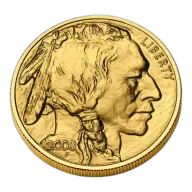
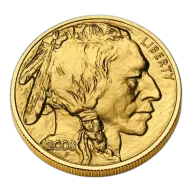
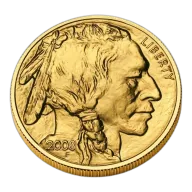
The obverse features Fraser's composite portrait of a Native American man, believed to be based on three tribal leaders: Iron Tail (Oglala Lakota), Two Moons (Northern Cheyenne), and Big Tree (Kiowa). The reverse depicts a standing American bison, modelled after "Black Diamond," a bison that lived at the Central Park Zoo in New York City, though Fraser himself gave varying accounts of the model's identity.
The design is a faithful adaptation of the iconic 1913 Indian Head (Buffalo) nickel, modified for the larger gold coin format. Inscriptions on the reverse include "UNITED STATES OF AMERICA," "E PLURIBUS UNUM," "IN GOD WE TRUST," the $25 denomination, and ".9999 FINE GOLD." The coin's fine detail, particularly the hair strands on the portrait and fur texture on the bison, provides inherent authentication through its complexity.
Tax Position of the 1/2 oz Gold Buffalo
As US legal tender struck by the US Mint, the Gold Buffalo qualifies for favourable treatment in its home market and is recognised as investment gold internationally.
Country-by-Country Treatment
- United States: IRA-eligible. The Gold Buffalo at 999.9 fineness exceeds the IRS minimum purity requirement of 99.5% for gold held in Individual Retirement Accounts. It is also explicitly backed by being a US government-issued coin. Capital gains on bullion are taxed at the collectibles rate of up to 28% for long-term holdings, with short-term gains taxed as ordinary income. IRS Form 1099-B reporting applies to sales of 25 or more pieces in a single transaction. State sales tax treatment varies; approximately 35 states exempt bullion entirely.
- United Kingdom: VAT-exempt as investment gold (qualifies as a bullion coin with face value, issued by a government mint, at 900+ fineness). Not UK legal tender, so subject to capital gains tax. The annual CGT allowance is currently £3,000.
- European Union: Listed on the EU's annual investment gold coin list, making it VAT-exempt across all member states.
- Canada: GST/HST exempt as gold bullion at 99.5%+ purity. Not RRSP-eligible (not issued by a Canadian mint).
- Australia: GST-exempt as investment-grade gold at 999.9 fine, exceeding the 99.5% purity threshold.
- New Zealand: GST-exempt as gold at 99.5%+ purity.
- Singapore: GST-exempt under the Investment Precious Metals scheme.
- Hong Kong: No sales tax, no import duty, no capital gains tax.
Buffalo vs Eagle at Half an Ounce
The most natural comparison for the 1/2 oz Gold Buffalo is the 1/2 oz American Gold Eagle, the other half-ounce gold coin from the US Mint. The fundamental difference is purity: the Buffalo is 999.9 fine (24 karat), containing exactly 15.554 grams of pure gold, and the Eagle is 916.7 fine (22 karat), also containing exactly half a troy ounce of pure gold but alloyed with copper and silver, making the total coin weight heavier at 18.506 grams.
In practical terms, the 22-karat alloy makes the Gold Eagle more resistant to scratching and contact marks. The Buffalo's pure gold composition is noticeably softer, and coins show handling marks more readily. This is a physical property of the metal, not a quality defect, but it means Buffalos benefit from protective capsules during storage.
Availability is the decisive factor. The 1/2 oz Gold Eagle has been produced continuously since 1986 and is one of the most liquid gold coins in the world. The 1/2 oz Buffalo was struck only in 2008, with total fractional production under 100,000 coins across all three sizes. Secondary market Buffalos carry numismatic premiums that far exceed standard bullion markups, making them impractical for cost-conscious gold accumulation.
Internationally, the 1/2 oz Canadian Gold Maple Leaf offers 999.9 purity with continuous annual production, micro-engraved laser security marks, and the Bullion DNA verification system. For buyers who want pure gold in a fractional format without paying numismatic premiums, the Maple Leaf is the more practical choice. The 1/2 oz Gold Britannia provides the same 999.9 purity with the added benefit of CGT exemption for UK taxpayers.
1/2 oz American Buffalo Gold Coin: frequently asked questions
-
Yes. The US Mint produced 1/2 oz, 1/4 oz, and 1/10 oz fractional American Buffalo coins in 2008 alongside the standard 1 oz version. Fewer than 100,000 fractional Buffalo coins were minted in total that year, and production was not repeated. Examples available today come from the secondary market.
-
Yes. Every American Buffalo coin is 999.9 fine gold, the standard known as 24 karat. The 1/2 oz coin contains exactly half a troy ounce of pure gold. This distinguishes it from the American Gold Eagle, which is .9167 fine (22 karat) and includes a copper-silver alloy for added durability.
-
A genuine 1/2 oz Buffalo weighs 15.554 g and measures 26.50 mm in diameter, with a reeded edge and a W mint mark. Pure gold is non-magnetic, so a magnet test is a quick first check. The high-relief portrait and bison design carries fine engraving detail that is difficult to replicate convincingly. Buy from an authorised dealer or have the coin graded by a recognised service if there is any doubt.
-
Both the Buffalo and the Eagle contain the same fine gold per stated denomination, but the Buffalo is .9999 fine (24 karat) while the Eagle is .9167 fine (22 karat). The Buffalo typically trades at a comparable or slightly higher premium over spot, reflecting its lower mintage volumes relative to the Eagle. The Eagle generally has deeper secondary-market liquidity.