24 products · 135 deals
Filters
| Product | /oz | Premium | Price | |
|---|---|---|---|---|

24 deals
|
$4,850.29 | +11.62% |
$155.94
£117
|
Compare |
| $4,850.29 | +11.62% |
$155.94
£117
|
View Deal | |

6 deals
|
$4,972.94 | +14.13% |
$159.88
€139
|
Compare |

15 deals
|
$5,036.90 | +14.26% | $161.94 | Compare |

5 deals
|
$4,978.54 | +14.57% |
$160.06
£120
|
Compare |
| $5,000.70 | +14.96% |
$160.78
A$226
|
View Deal | |

2 deals
|
$5,043.22 | +15.94% |
$162.14
A$228
|
Compare |

9 deals
|
$5,071.09 | +16.70% |
$163.04
£122
|
Compare |

2 deals
|
$5,074.00 | +16.77% |
$163.13
£122
|
Compare |

8 deals
|
$5,186.89 | +19.37% |
$166.76
£125
|
Compare |

5 deals
|
$5,256.35 | +20.63% |
$169.00
€147
|
Compare |

17 deals
|
$5,310.16 | +22.21% |
$170.73
£128
|
Compare |

10 deals
|
$5,367.44 | +23.52% |
$172.57
£129
|
Compare |

3 deals
|
$5,394.38 | +24.15% |
$173.43
CA$243
|
Compare |

3 deals
|
$5,410.19 | +24.51% |
$173.94
£130
|
Compare |
| $5,456.26 | +25.57% |
$175.42
£131
|
View Deal | |
| $5,602.77 | +28.94% |
$180.13
£135
|
View Deal | |
| $5,853.46 | +34.71% |
$188.19
£141
|
View Deal | |
| $5,968.43 | +37.36% |
$191.89
£144
|
View Deal | |

2 deals
|
$5,981.30 | +37.65% |
$192.30
£144
|
Compare |

2 deals
|
$6,477.62 | +48.69% |
$208.26
S$266
|
Compare |
| $6,555.73 | +50.49% |
$210.77
S$269
|
View Deal | |

13 deals
|
$6,777.78 | +55.98% |
$217.91
£163
|
Compare |

2 deals
|
$7,849.58 | +80.65% |
$252.37
CA$354
|
Compare |
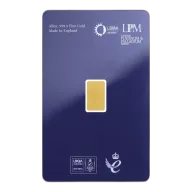

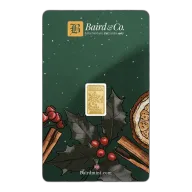
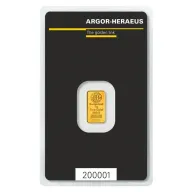
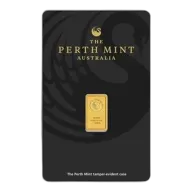






Prices are fetched automatically and may not reflect current merchant prices. Currency conversions and tax treatment are approximate. Rankings are based solely on price. We are not a dealer and accept no responsibility for transactions with listed merchants. Past performance is not indicative of future results. This site does not provide investment advice. Full disclaimer
About 1g Gold Bars
1 Gram Gold Bars: Entry-Level Gold Ownership
A 1 gram gold bar is the smallest standard bar weight produced by major refineries, containing 0.03215 troy ounces of gold. At current prices, a 1g bar costs roughly $100 to $120, making it the lowest-cost way to own physical gold from an LBMA-accredited refiner. The format is almost exclusively a gold product; 1g silver bars exist but contain less than a dollar of metal and are novelty items.
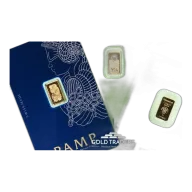
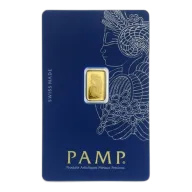
The 1g bar market is dominated by Swiss refineries. The 1g PAMP Suisse Fortuna, with its iconic Lady Fortuna design, is the most recognised 1g bar globally. 1g Valcambi bars are the most widely stocked, available from over 70 dealers. The 1g Perth Mint bar, backed by the Western Australian government, and the 1g Argor-Heraeus Kinebar, with its holographic security element, round out the major branded options. Each is produced as a thin minted wafer, sealed in a credit-card-sized assay card with a unique serial number and purity certification.
These bars serve a different market from the typical bullion accumulation buyer. The primary use cases are gifting (weddings, birthdays, religious occasions), introducing someone to gold ownership, and maximum divisibility for barter or emergency scenarios. In the Middle East and South Asia, small gram bars are a traditional gift format, with refineries like the Istanbul Gold Refinery producing heavily for this market. In North America and Europe, 1g bars are marketed mainly as gifts and entry-level products.
For wealth accumulation, 1g bars are the least efficient way to buy gold. The manufacturing, assaying, packaging, and distribution costs are roughly fixed regardless of bar size, and when spread across a single gram of gold, these costs dominate the price. Buying 31.1 grams (one troy ounce) as individual 1g bars at typical premiums would cost roughly $280 more than a single 1 oz gold bar at standard premiums. Buyers focused on accumulating metal per dollar should look at larger bar sizes.
Premium Economics of 1g Gold Bars
Premiums on 1g gold bars typically range from 8 to 15 percent over spot, the highest premium-to-metal ratio of any standard bar weight. At 12 percent premium on a bar worth roughly $103 in metal, that amounts to about $9 of premium per gram. This is a direct consequence of fixed manufacturing costs being divided by a very small amount of gold.
Brand matters at this weight. The 1g PAMP Suisse Fortuna typically carries the highest premium among 1g bars (15 to 25 percent over spot), reflecting the Lady Fortuna design's recognition and PAMP's VeriScan authentication technology. Valcambi 1g bars sit in the middle of the range, offering LBMA accreditation and global recognition at somewhat lower premiums. Generic or lesser-known brand 1g bars may trade closer to the 8 percent floor, but the resale market is less forgiving for unbranded products.
For context, premiums scale inversely with bar size across the gold bar range: 1g bars at 8-15 percent, 10g bars at roughly 4-8 percent, 1 oz bars at 1-4 percent, and 10 oz bars at 1-3 percent. A buyer spending $1,000 on gold will get measurably more metal by purchasing a single 10g bar than ten individual 1g bars.
The one exception to the premium penalty is Valcambi's CombiBar, a perforated sheet of 50 or 100 individual 1g bars that can be snapped apart. The per-gram premium on a CombiBar sheet is lower than buying 1g bars individually, because the manufacturing and packaging costs are amortised across the full sheet. The tradeoff is that you must buy the entire sheet upfront, which costs the same as a 50g or 100g bar.
Major 1g Gold Bars
The 1g gold bar market is concentrated among a handful of LBMA-accredited refiners, with Swiss producers holding the dominant position.
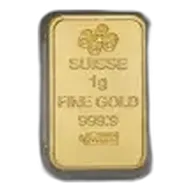
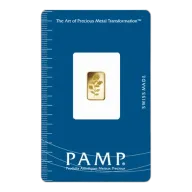
PAMP Suisse Fortuna (52 dealers) is the flagship 1g bar. The Lady Fortuna design, introduced in 1979, was the first decorative motif ever placed on a precious metals bar. Each bar ships in CertiPAMP assay packaging with VeriScan digital authentication. The 1g Fortuna measures just 8.9 x 14.7 x 0.4mm. PAMP commands the highest brand premium at this weight but also holds the strongest resale value.
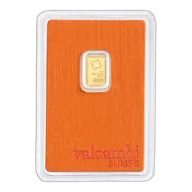
Valcambi (72 dealers) is the most widely available 1g gold bar, stocked by more dealers than any other branded option. Valcambi's clean, minimalist design focuses on weight, purity, and serial number markings without decorative imagery. The bar ships in a standard tamper-evident assay card. Valcambi is the world's largest precious metals refinery by volume, processing over 2,000 tonnes annually.
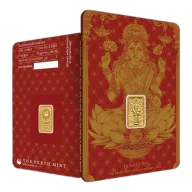
Perth Mint (50 dealers) is the only government-backed option in the major 1g bar field. Backed by the Western Australian government, Perth Mint bars carry an implicit sovereign guarantee. Popular in the Australian and Asian markets, with growing North American distribution.
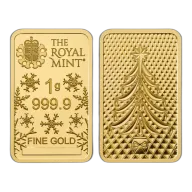
Royal Mint Britannia (31 dealers) extends the Britannia brand from coins into bar form. The 1g Britannia Gold Bar carries the Britannia design and is produced by the UK's official mint. It does not carry the CGT exemption that Britannia coins enjoy (bars are not legal tender), but the Royal Mint backing provides strong recognition in the UK and European markets.
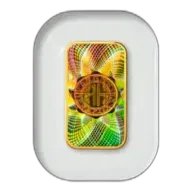
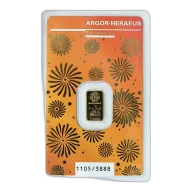
Argor-Heraeus Kinebar (23 dealers) features a Kinegram holographic security element embossed directly into the gold surface, using the same diffractive optical technology found on banknotes and government documents. The 1g Kinebar carries only a modest premium over standard Argor-Heraeus bars for this added security. Argor-Heraeus also produces the 1g GoldSeed, a distinctive round-format set containing ten individual 1g bars.
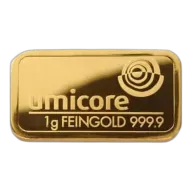
Umicore (21 dealers) is a Belgian refinery and LBMA-accredited producer popular in the European market. Umicore 1g bars are widely available through European dealers and carry competitive premiums.
Resale and Storage for 1g Gold Bars
Branded 1g bars from LBMA-accredited refiners (PAMP, Valcambi, Perth Mint, Argor-Heraeus) in sealed assay cards are liquid and accepted by dealers globally. The assay card is critical: it provides the authentication chain that dealers rely on to avoid the cost of independent testing. Breaking the seal on a 1g bar's assay card is rarely worthwhile, since re-assaying a bar worth $100 in metal could cost a meaningful percentage of its value.
Buyback prices for 1g bars reflect the acquisition premium. Dealers buying 1g bars typically offer close to spot or slightly below, meaning the seller absorbs most or all of the original premium paid. On secondary markets (eBay, collector forums, peer-to-peer sales), 1g bars from recognised brands can sell above spot, particularly the PAMP Fortuna, which commands collector interest beyond its pure metal value. Unbranded or opened-assay bars have poor resale prospects relative to their acquisition cost.
In practice, 1g bars are more commonly gifted or collected than resold. The high premium on purchase and the friction of selling small-value items mean that the round-trip transaction costs are proportionally high compared to larger bar sizes. Buyers who anticipate needing to sell should consider 5g or 10g bars for a better balance of affordability and resale economics.
Storage is the one area where 1g bars have an unqualified advantage. A 1g gold bar in its assay card is roughly credit-card sized but much thinner, and the bar itself measures approximately 8mm by 15mm. Any number of 1g bars can be stored in a desk drawer, a home safe, or a safety deposit box with negligible space requirements. The assay card should be stored flat and protected from bending or moisture damage to preserve resale value.
1g Gold Bars: frequently asked questions
-
The raw metal in a 1g gold bar is worth roughly 1/31.1035 of $4,408.10 per troy oz. Retail prices run higher than that because fabrication, assay card, and packaging costs are charged on top. We compare 149 listings from 51 dealers so you can find the keenest price available.
-
The cost of producing a bar, printing an assay card, and packaging is largely fixed regardless of size. On a 1g bar those fixed costs represent a much larger share of the bar's metal value than on a 100g or 1 oz bar, which pushes the per-gram premium higher. The smaller the bar, the more you pay per gram for the convenience of a small denomination.
-
Most 1g gold bars sold as investment products are .9999 fine (24 carat), the highest commercial purity standard. The fineness is stamped on the bar and on its assay certificate or card.
-
In most markets, buying gold does not trigger a mandatory purchase report, though disposing of it at a gain may create a tax obligation. In the UK, gains above £3,000 must be declared; in Canada, investment gold is GST-free at 0% and any gain is reported on your annual return. Check your country's rules before buying.
- 1g ABC Refinery Gold Bar
- 1g Ainslie Gold Bar
- 1g Argor-Heraeus Gold Bar
- 1g Argor-Heraeus Lunar Gold Bar
- 1g Asahi Refining Gold Bar
- 1g Asahi Refining Lunar Gold Bar
- 1g Britannia Gold Bar
- 1g BulMint Gold Bar
- 1g C.Hafner Gold Bar
- 1g Chinese Lunar Gold Bar
- 1g Christmas Coins Gold Bar
- 1g CombiBar Gold Bar
- 1g Credit Suisse Gold Bar
- 1g Credit Suisse Liberty Gold Bar
- 1g Emirates Gold Bar
- 1g Emirates Gold Diwali Gold Bar
- 1g Fortuna Gold Bar
- 1g Geiger Original Gold Bar
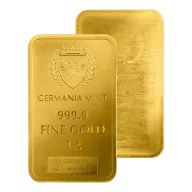
- 1g Germania Mint Gold Bar
- 1g Gold Bar
- 1g Holiday Gold Bar
- 1g Jerusalem of Gold Bar
- 1g Johnson Matthey Gold Bar
- 1g Ka `Bah. Mecca Gold Bar
- 1g Kinebar Gold Bar
- 1g Maplegram Gold Bar
- 1g Metalor Gold Bar
- 1g Minted Bars Gold Bar
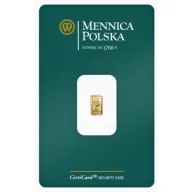
- 1g Mint of Poland Gold Bar
- 1g Nadir Refinery Gold Bar
- 1g PAMP Suisse Gold Bar
- 1g PAMP Suisse Lunar Gold Bar
- 1g Perth Mint Gold Bar
- 1g Rosa Gold Bar
- 1g Royal Canadian Mint Gold Bar
- 1g Snowy Owl Gold Bar
- 1g Swiss Kantonalbank Gold Bar
- 1g Themis Gold Bar
- 1g The Royal Mint Gold Bar
- 1g UBS Gold Bar
- 1g Umicore Gold Bar
- 1g Valcambi Gold Bar
- Pre-Owned 1g Britannia Gold Bar
- Pre-Owned 1g BulMint Gold Bar
- Pre-Owned 1g Credit Suisse Gold Bar
- Pre-Owned 1g Degussa Goldbars Gold Bar
- Pre-Owned 1g Emirates Gold Bar
- Pre-Owned 1g Fortuna Gold Bar
- Pre-Owned 1g Geiger Edelmetalle Gold Bar
- Pre-Owned 1g Gold Bar
- Pre-Owned 1g Happy Diwali Gold Bar
- Pre-Owned 1g Heraeus Gold Bar
- Pre-Owned 1g Nadir Refinery Gold Bar
- Pre-Owned 1g Perth Mint Kangaroo Gold Bar
- Pre-Owned 1g TD Gold Bar
- Pre-Owned 1g The Royal Mint Gold Bar
- Pre-Owned 1g Umicore Gold Bar
- Argor-Heraeus Lunar
- Asahi Lunar
- Britannia
- Chinese Lunar
- Christmas Coins
- CombiBar
- Credit Suisse Liberty
- Degussa Goldbars
- Emirates Gold Diwali
- Fortuna
- Geiger Edelmetalle Geiger Original
- Happy Diwali
- Holiday
- Jerusalem of Gold
- Ka `Bah. Mecca
- Kinebar
- Maplegram
- PAMP Lunar
- PAMP Rosa
- Perth Kangaroo
- Rand Refinery Minted Bars
- Snowy Owl
- Themis