1 listing
Filters
| Product | /oz | Premium | Price | |
|---|---|---|---|---|

 Suisse Gold
Out of Stock
Suisse Gold
Out of Stock
|
$6,552.57 | +50.77% |
$210.67
€184
|
View Deal |
Prices are fetched automatically and may not reflect current merchant prices. Currency conversions and tax treatment are approximate. Rankings are based solely on price. We are not a dealer and accept no responsibility for transactions with listed merchants. Past performance is not indicative of future results. This site does not provide investment advice. Full disclaimer
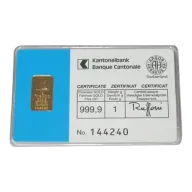
About the 1g Swiss Kantonalbank Gold Bar
The 1g Swiss Kantonalbank Gold Bar
At one gram, this is the smallest standard gold bar weight: a thin wafer holding 0.03215 troy ounces of 999.9 fine gold, typically priced around $100 to $120 depending on spot. That price point makes 1g bars the lowest-cost physical gold purchase available, which is precisely their job. Nobody accumulates serious gold weight a gram at a time; the format exists for gifting, for first-time gold buyers testing the experience of physical ownership, and for anyone who wants maximum divisibility in small emergency-spendable units.
The economics are worth understanding before buying. Manufacturing, assaying, packaging, and distribution costs are roughly fixed regardless of bar size, and spread across a single gram of gold they dominate the price: 1g bars typically run 8 to 15 percent over spot, the highest premium-to-metal ratio of any bar weight. Buying a full ounce as thirty-one individual gram bars at a 12 percent premium costs roughly $280 more than one 1 oz gold bar at 3 percent. Because the percentage premium varies widely between dealers at this size, comparing prices makes a proportionally bigger difference on gram gold than on any larger format.
Storage is trivial: a 1g bar measures roughly 8mm by 15mm, and in its packaging is about credit-card sized. Resale is the weak point of the format generally. Buyback prices reflect the high acquisition premium, sealed original packaging is essential to a decent exit, and gram bars are more often given away or kept than sold back to dealers.
How 1g Gold Bars Are Taxed by Country
At 999.9 fine, this bar comfortably exceeds the 995 purity threshold that defines investment gold in most tax systems, so even at one gram it gets the favourable gold treatment.
- UK: VAT-exempt as investment gold. Bars are not CGT-exempt (only UK legal tender coins are), but a single gram bar will rarely generate a gain anywhere near the £3,000 annual CGT allowance.
- US: No federal sales tax; most states exempt bullion. Note the threshold states: California exempts bullion only above $2,000 and Florida above $500, so a single 1g bar falls below those floors and can attract sales tax where a larger purchase would not. Long-term gains are taxed at the 28% collectibles rate.
- EU: 0% VAT in all member states under the Investment Gold Directive, which covers gold bars and wafers of 995+ fineness with no minimum size.
- Canada: GST/HST exempt; gold in bar or wafer form qualifies at 99.5% purity or above.
- Australia: GST-free as investment-grade gold (99.5%+ purity).
- New Zealand: GST-exempt; the gold threshold is 99.5% purity.
- Singapore: 0% GST under the Investment Precious Metals scheme for gold of 99.5%+ purity in bar, ingot, or wafer form; no capital gains tax.
- Hong Kong: No sales tax, no import duty, no capital gains tax.
- UAE: 0% VAT on investment gold bullion, though gold jewellery carries 5%.
1g Bars Compared: Branded Wafers and CombiBars
The benchmark at this weight is the 1g PAMP Suisse Fortuna, the most recognised gram bar globally, with its Lady Fortuna design sealed in an assay card. Valcambi, the Perth Mint, the Royal Mint, Argor-Heraeus, and the Istanbul Gold Refinery all produce competing 1g bars, and Swiss refiner assay cards are the global standard for the format. Brand recognition matters disproportionately at this size: recognised bars in sealed cards are accepted by dealers, while unbranded or opened bars have poor resale prospects. Whichever bar is cheapest among recognised names is usually the right buy, since the gold content is identical.
For anyone buying multiple grams, the Valcambi CombiBar changes the calculation. It is a perforated sheet of fifty individual 1g segments that snap apart as needed, carries a lower per-gram premium than buying gram bars separately, and stores like a single bar. It delivers the divisibility that is the gram format's main argument without paying full freight on each unit.
Stepping up the scale is where real savings live. The premium on gram bars (8 to 15 percent) falls to roughly 2 to 4 percent at 100g and 1 to 2 percent on kilo bars, so each step up buys meaningfully more gold per dollar. The honest comparison is this: a 1g bar is a gift, an introduction, or a divisibility play. As a way to build a gold position, even a small one, a 1/10 oz coin or a larger bar bought less often beats a drawer full of gram wafers on cost every time.