1 listing
Filters
| Product | /oz | Premium | Price | |
|---|---|---|---|---|

 StoneX Bullion
|
$5,316.83 | +22.34% |
$170.94
€149
|
View Deal |
Prices are fetched automatically and may not reflect current merchant prices. Currency conversions and tax treatment are approximate. Rankings are based solely on price. We are not a dealer and accept no responsibility for transactions with listed merchants. Past performance is not indicative of future results. This site does not provide investment advice. Full disclaimer
About the 1g Kinebar Gold Bar
The 1g Argor-Heraeus Kinebar
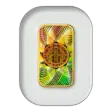
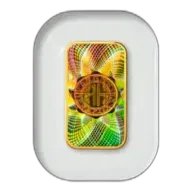
The Kinebar is a gold bar with a Kinegram, a diffractive optically variable image device embossed directly into the gold surface. The name is a portmanteau of "Kinegram" and "bar," and it represents one of the most distinctive anti-counterfeiting approaches in the bullion market. Produced by Argor-Heraeus SA in Mendrisio, Switzerland, the 1g Kinebar contains 1 gram of 999.9 fine gold and is carried by 23 dealers.
The Kinegram technology is manufactured by OVD Kinegram AG, a Swiss company that supplies the same optical security elements to governments worldwide for use on banknotes, passports, and identity documents. The Kinebar is an unusual commercial application of this government-grade security technology. The Kinegram is created by engravings less than 0.0015mm deep in the gold surface, producing dynamic, shifting patterns and colours when the bar is tilted in light. Critically, the Kinegram is not a sticker or applied hologram; it is embossed into the gold itself, meaning it cannot be peeled off, transferred, or worn away. The optical effect is permanent and is part of the bar's physical structure.
Argor-Heraeus introduced the Kinebar in December 1993 through Union Bank of Switzerland (UBS), which at the time owned the refinery. UBS retains the trademark. First retail Kinebars went on sale in 1994, initially in sizes from 1g to 1 oz, with 50g and 100g sizes added in 2012. Argor-Heraeus is one of the world's largest gold refiners, processing approximately 400 tonnes annually, and has been LBMA-accredited since 1961.
The Kinebar's key practical advantage is that its security feature is instantly verifiable without any equipment, app, or database access. A buyer can authenticate the bar by simply tilting it in light and observing the shifting holographic patterns. This contrasts with PAMP's VeriScan system, which requires a smartphone app and database lookup. For peer-to-peer transactions, emergency scenarios, or buyers in regions with poor connectivity, the Kinebar's self-verifying nature has clear value. The premium over standard Argor-Heraeus bars is modest, typically only a few dollars per ounce, making the Kinebar one of the cheapest security-enhanced gold products available.
1g Kinebar Specifications
| Attribute | Value |
|---|---|
| Weight | 1 gram |
| Purity | 999.9 fine gold (24 karat) |
| Manufacturer | Argor-Heraeus SA, Mendrisio, Switzerland |
| LBMA accredited | Yes (since 1961) |
| Production method | Minted |
| Edge | Smooth |
| Security | Kinegram diffractive optical element (embossed into gold surface) |
| Serialisation | Individual serial number |
| Packaging | Tamper-evident blisterpack assay card |
| Face value | None (not legal tender) |
The obverse carries the Argor-Heraeus logo, "Switzerland" country of origin, weight and purity markings, the melter/assayer marking, and a unique serial number. The reverse is dominated by the Kinegram holographic security element, which occupies the full surface. Each bar ships in a transparent blisterpack capsule that shows evidence of tampering if opened, alongside a signed assay card matching the bar's serial number.
The Kinebar range spans eight sizes from 1g to 100g. The design has remained consistent since 1994, with no annual variations. Kinebars are exclusively a gold product; no silver or platinum versions are produced.
Tax Treatment of the 1g Kinebar
The 1g Kinebar's 999.9 purity exceeds every jurisdiction's threshold for investment gold tax relief. As a bar from an LBMA-accredited refiner, it qualifies for standard investment gold treatment worldwide.
- United Kingdom: VAT-exempt as investment gold (995+ purity). Subject to Capital Gains Tax on disposal at 10 or 20 percent, with a £3,000 annual allowance. Gold bars are not CGT-exempt in the UK; that exemption applies only to legal tender coins such as the 1 oz Gold Britannia.
- United States: IRA-eligible. Argor-Heraeus is an LBMA/COMEX-approved refiner, and the 999.9 purity exceeds the IRS minimum of 99.5 percent for gold in a self-directed IRA. Must be held by an approved custodian. Outside an IRA, gains are taxed at the collectibles rate of up to 28 percent.
- European Union: VAT-exempt as investment gold under EU Council Directive 98/80/EC. In Germany, the Kinebar is popular in the domestic gold market, and gains on gold held for over one year are tax-free. In Switzerland (Argor-Heraeus's home market), investment gold is also VAT-exempt.
- Canada: GST/HST-exempt at 99.5+ purity. RRSP-eligible through approved custodians.
- Australia: GST-free as investment-grade gold at 99.5+ purity. Subject to CGT on disposal with a 50 percent discount for holdings over 12 months.
- Singapore: GST-exempt under the Investment Precious Metals scheme (gold at 99.5+ purity). No capital gains tax.
- Hong Kong: No sales tax, import duty, or capital gains tax.
From Banknote Security to Gold Bars
The Kinebar's origins trace to 1993, when Union Bank of Switzerland (UBS) commissioned Argor-Heraeus to apply OVD Kinegram AG's optical security technology to gold bars. The Kinegram had already been established as a security feature on banknotes and government documents, where its diffractive optical properties made it extremely difficult to counterfeit. Applying this technology to gold was a novel idea: the sub-micron engravings that create the holographic effect had to be adapted to work on a gold surface rather than the polymer substrates used in banknotes.
The first Kinebars went on sale in 1994, initially in sizes from 1g through 1 oz. The product was marketed through UBS's banking network, which gave it immediate distribution across Switzerland and into the European precious metals market. Argor-Heraeus itself traces its origins to 1951, and the refinery had already built a strong reputation for standard gold bars before the Kinebar added the security dimension.
For 18 years, the range remained at its original six sizes (1g, 2g, 5g, 10g, 20g, 1 oz). In 2012, Argor-Heraeus extended the range upward with 50g and 100g sizes, responding to demand from investors who wanted the Kinegram security on larger bars where counterfeiting risk (particularly tungsten-core fraud) becomes more relevant. The Kinegram does not directly detect tungsten cores, but as a holographic element embossed into the gold surface itself, it provides an authentication baseline that is extremely difficult to replicate on a counterfeit bar.
The Kinegram technology has been refined over the years with advances in optical engineering, but the fundamental approach, sub-micron engravings in the gold surface creating diffractive colour-shifting patterns, has remained unchanged since 1994. "Kinegram" remains a registered trademark, and no other precious metals manufacturer uses this specific technology. The patent holder, OVD Kinegram AG, describes their technology as "exclusively provided to governments" for security applications, making the Kinebar a notable exception to that policy.
1g Kinebar vs Other 1g Gold Bars
The Kinebar occupies a distinct position in the 1g gold bar market: a security-focused product at a modest premium over standard bars. Its closest competitors for different buyer priorities are the 1g PAMP Suisse Fortuna (brand prestige and digital authentication), the 1g Valcambi (value and availability), and the 1g Perth Mint bar (government backing).
Against the PAMP Fortuna, the Kinebar offers a different authentication philosophy. PAMP's VeriScan is a digital system that scans the bar's microscopic surface topography and matches it against a database. This is thorough but requires a smartphone app and network access. The Kinebar's Kinegram is optically self-verifying: tilt it in light and the holographic pattern either shifts correctly or it does not. No app, no database, no electricity. For buyers who value independence from digital infrastructure, the Kinebar's approach is more robust. The Kinebar also carries a significantly lower premium than the Fortuna, which commands 15 to 25 percent over spot at 1g versus the Kinebar's more moderate pricing.
Against the Valcambi, the Kinebar's advantage is purely the Kinegram security element. Both are Swiss, both are LBMA-accredited, both are 999.9 fine. The Valcambi is stocked by 72 dealers versus 23 for the Kinebar, giving it a wider buying market and easier comparison shopping. For buyers who do not place a premium on holographic authentication, the Valcambi is the simpler, cheaper choice.
Against the Perth Mint bar, the comparison hinges on government backing versus security technology. Perth Mint bars carry the implicit guarantee of the Western Australian government, which some investors value as a sovereign-level assurance of authenticity. The Kinebar counters with a physical security feature that any holder can verify independently. Both carry comparable premiums in most markets.
The 1g GoldSeed, also from Argor-Heraeus, is worth noting as a related product: a round-format set of ten 1g bars designed for gifting and fractional use. The GoldSeed does not include a Kinegram, so buyers choosing between the two Argor-Heraeus products are deciding between individual holographic security (Kinebar) and divisible multi-bar convenience (GoldSeed).
1g Kinebar Gold Bar: frequently asked questions
-
The cheapest 1g Argor-Heraeus Kinebar we track is $170.94, sitting around 22.3% above the $4,408.10 gold spot price. Small bars like this carry a higher per-gram premium than larger sizes because fabrication and packaging costs are spread over very little metal.
-
A Kinebar is a 999.9 fine gold bar produced by Argor-Heraeus in Switzerland, distinguished by a Kinegram on its reverse. The Kinegram is a diffractive optical element embossed directly into the gold surface, producing shifting colours and patterns when tilted. Unlike a holographic sticker, it cannot be peeled off or transferred. The same technology secures banknotes and government identity documents.
-
Kinebars are produced by Argor-Heraeus, a Swiss precious metals refiner based in Mendrisio, Switzerland. Argor-Heraeus holds LBMA Good Delivery accreditation and processes hundreds of tonnes of gold annually. Each 1g Kinebar is 999.9 fine gold, accompanied by an assay card and sealed tamper-evident blisterpack packaging.
-
The 22.3% premium on a 1g bar reflects fixed fabrication, assay, and packaging costs being divided across just one gram of metal. The same costs spread over a 100g or 1oz bar result in a much smaller percentage premium per gram. Buyers who value divisibility accept this trade-off; those focused on minimising cost typically buy larger bars.