 StoneX Bullion


 Bullion Beasts
Prices are fetched automatically and may not reflect current merchant prices. Currency conversions and tax treatment are approximate. Rankings are based solely on price. We are not a dealer and accept no responsibility for transactions with listed merchants. Past performance is not indicative of future results. This site does not provide investment advice. Full disclaimer
About the 10g Kinebar Gold Bar
Banknote Security on a 10g Gold Bar
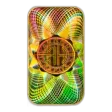
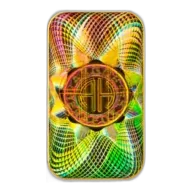
The 10g Kinebar is a minted gold bar from Argor-Heraeus, one of Switzerland's largest precious metals refiners, distinguished by a Kinegram embossed directly into the gold surface. The Kinegram is a diffractive optical element, the same technology used to secure banknotes and government identity documents, produced by OVD Kinegram AG exclusively for government and high-security applications. The Kinebar is a rare commercial exception to that exclusivity.
Unlike holographic stickers applied to some competing bars, the Kinegram is physically part of the gold itself. Sub-micron engravings less than 0.0015 mm deep create shifting colours and patterns when the bar is tilted. It cannot be peeled off, transferred, or worn away. This makes the Kinebar visually self-authenticating without requiring any equipment, smartphone app, or database lookup, a practical advantage for peer-to-peer transactions and quick verification at the point of sale.
At 10 grams of 999.9 fine gold, the Kinebar sits at a price point around $1,000-$1,100, comparable to a 10g PAMP Suisse gold bar or a 1/4 oz gold coin. The premium over a standard (non-Kinebar) Argor-Heraeus bar is modest, typically only a few dollars per ounce, making the Kinegram security feature an inexpensive addition rather than a luxury surcharge. Among security-enhanced gold products, the Kinebar consistently offers one of the lowest cost-of-authentication premiums available.
Each bar is individually serial-numbered, sealed in tamper-evident blisterpack packaging, and accompanied by an assay card signed by a certified Argor-Heraeus assayer. The serial number on the bar matches the assay card, providing a second layer of verification alongside the Kinegram. Argor-Heraeus has been refining precious metals since 1951 and processes approximately 400 tonnes of gold annually, making it one of the world's largest LBMA-accredited refiners.
10g Kinebar Specifications
| Specification | Detail |
|---|---|
| Weight | 10 grams (0.3215 troy oz) |
| Purity | 999.9 fine gold (24 karat) |
| Manufacturer | Argor-Heraeus SA, Mendrisio, Switzerland |
| Format | Minted bar |
| Edge | Smooth |
| Serialisation | Individual serial number engraved on obverse |
| Security feature | Kinegram diffractive optical element on reverse |
| Packaging | Tamper-evident blisterpack with assay card |
| Assay | Certified by Argor-Heraeus Sworn Assayer |
| Face value | None (not legal tender) |
| LBMA accredited | Yes |
Kinebar Size Range
The Kinebar series spans eight sizes, all in 999.9 fine gold. The original 1994 launch included sizes from 1g through 1 oz. The 50g and 100g sizes were added in 2012, eighteen years later, suggesting the smaller sizes remain the primary market.
| Size | Year introduced |
|---|---|
| 1g | 1994 |
| 2g | 1994 |
| 5g | 1994 |
| 10g | 1994 |
| 20g | 1994 |
| 1 oz (31.1g) | 1994 |
| 50g | 2012 |
| 100g | 2012 |
The 1 oz Kinebar measures 40.4 x 23.3 x 1.8-2.1 mm; the 100g bar measures 49.7 x 28.5 x 3.9 mm. Kinebars are produced exclusively in gold; there is no silver or platinum version.
10g Kinebar Tax Treatment by Country
As a 999.9 fine gold bar from an LBMA-accredited refiner, the 10g Kinebar qualifies for investment gold tax exemptions in most major markets. It is not legal tender in any jurisdiction, which has specific consequences in the UK and certain other countries.
- United Kingdom: VAT-exempt as investment gold (purity exceeds the 995 threshold). However, profits from selling gold bars are subject to Capital Gains Tax at 18% (basic rate) or 24% (higher rate), with a GBP 3,000 annual allowance. Gold bars are not CGT-exempt in the UK. Only UK legal tender coins such as the 1oz gold Britannia and Sovereigns carry CGT exemption.
- United States: No federal sales tax. Most states exempt investment bullion; a handful still tax it. IRA-eligible: the Kinebar's 999.9 purity and Argor-Heraeus's LBMA/COMEX accreditation meet the IRS Section 408(m) requirements for self-directed precious metals IRAs when held by an approved custodian. Outside an IRA, gains are taxed at the federal collectibles rate of up to 28%.
- European Union: VAT-exempt as investment gold under EU Council Directive 98/80/EC (gold bars of 995+ purity weighing 1g or more). This applies across all EU member states.
- Canada: GST/HST-exempt on investment gold of 99.5%+ purity. Eligible for RRSP and TFSA registered accounts through an approved custodian.
- Australia: GST-free as investment-grade gold (purity exceeds 99.5%). Subject to CGT on disposal, with a 50% discount for holdings over 12 months.
- Singapore: GST-exempt under the Investment Precious Metals (IPM) scheme. No capital gains tax.
- Hong Kong: No sales tax, no import duty, no capital gains tax.
- New Zealand: GST-exempt for fine gold of 99.5%+ purity.
- South Africa: Gold bars are subject to 15% VAT (the zero-rating applies only to gold Krugerrands, not bars).
From UBS Launch to Global Security Standard
The Kinebar was introduced in December 1993 through Union Bank of Switzerland (UBS), which at the time owned Argor-Heraeus. The first retail Kinebars went on sale in 1994, available in six sizes from 1g to 1 oz. The product name is a portmanteau of "Kinegram" and "bar," and the Kinebar trademark is held by UBS AG.
The Kinegram technology behind the bar predates its application to gold. OVD Kinegram AG, a Swiss company, developed diffractive optically variable image devices (DOVIDs) for securing banknotes, passports, and government documents. The technology creates optical effects through physical surface topology, sub-micron engravings that reflect light in precisely controlled ways, rather than through applied inks or materials. This means the holographic effect is permanent and inherent to the metal surface.
Applying this government-grade security technology to a commercial bullion product was unusual. OVD Kinegram describes its technology as "exclusively provided to governments" for security applications. The Kinebar represents a notable exception, bringing banknote-level authentication to the retail gold market. No other precious metals manufacturer uses Kinegram technology; it remains proprietary to the Argor-Heraeus partnership.
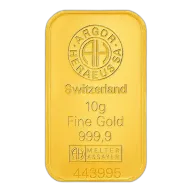
The basic Kinebar design has remained consistent since 1994. The obverse carries the Argor-Heraeus logo, "Switzerland" country of origin, weight and purity markings, the melter/assayer mark, and an individual serial number. The reverse is dominated by the Kinegram element. Unlike coins with annual date changes, Kinebars maintain a permanent design, with the Kinegram pattern refined over the years as optical technology has advanced but the layout unchanged.
The range remained at six sizes for eighteen years before the 50g and 100g options were added in 2012, expanding the Kinebar into the mid-weight bar market. The long gap before these additions suggests that smaller sizes, particularly the 1g to 1 oz range, constitute the core Kinebar market where the authentication premium is most justifiable relative to the gold value.
10g Kinebar vs PAMP Fortuna, Valcambi, and Perth Mint
The 10g gold bar market is dominated by Swiss and Australian refiners, all producing bars at 999.9 fine purity. The key differences are authentication technology, brand premium, and design.
The 10g PAMP Suisse Fortuna is the Kinebar's closest competitor in the security-enhanced category. PAMP uses VeriScan technology, a patented system that scans each bar's microscopic surface topography and stores it in a database. Buyers verify authenticity through a smartphone app. This is a fundamentally different approach: VeriScan is digital and database-dependent, requiring an internet connection and PAMP's servers to be operational. The Kinebar's Kinegram is optically self-verifying, working anywhere without equipment. PAMP bars generally carry higher premiums than Kinebars, driven by the Lady Fortuna design's brand recognition and collector appeal.
The 10g Valcambi gold bar represents the value end of the Swiss refiner spectrum. Valcambi is the world's largest precious metals refinery by volume, processing over 2,000 tonnes annually. Its bars carry lower premiums than both the Kinebar and the PAMP Fortuna, but have no equivalent holographic or digital verification system. Valcambi's distinctive product is the CombiBar, a divisible multi-gram bar, which serves a different purpose (divisibility rather than security). For buyers prioritising cost per gram over authentication features, Valcambi offers better value.
The 10g Perth Mint gold bar brings government backing from the Western Australian government, providing an implicit sovereign guarantee that no private refiner can match. Perth Mint bars carry a kangaroo security hologram on their CertiCard packaging and serial numbers, but no feature embossed into the gold itself. Perth Mint bars are typically priced between Valcambi and PAMP, and tend to be particularly competitive in Australian and Asian markets.
The 10g Metalor gold bar offers a different security approach through BullionProtect, a high-security ink developed with SICPA (a Swiss security ink company) applied directly to the bar surface. This provides smartphone-scannable verification without requiring a database query. Metalor's premiums tend to sit in line with other major Swiss refiners, slightly below PAMP but competitive with Argor-Heraeus standard bars.
For the 10g size specifically, premiums across all these brands tend to fall in the 8-12% range over spot, reflecting the fixed manufacturing costs that dominate at smaller bar sizes. The premium differences between brands are proportionally smaller at this weight than at 1g, where brand premiums can vary by several percentage points. Buyers stepping up to 50g gold bars will find premiums dropping sharply to 3-6%, representing the biggest efficiency gain in the gram bar range.
10g Kinebar Gold Bar: frequently asked questions
-
The cheapest 10g Kinebar tracked here is $1,474.44 from StoneX Bullion, around 5.5% above the $4,408.10 gold spot price for 10g of 999.9 fine gold. Use the comparison table above for current pricing across all listed dealers.
-
A Kinebar is a 999.9 fine gold bar produced by Argor-Heraeus in Mendrisio, Switzerland, carrying a Kinegram on its reverse. The Kinegram is a diffractive optical element embossed into the gold surface itself, creating shifting colours and patterns when tilted. It uses the same technology applied to banknotes and government identity documents and cannot be replicated with a sticker or overlay.
-
Each Kinebar has a unique serial number on the obverse that can be checked at argor-heraeus.com. The bar also comes in sealed tamper-evident blisterpack packaging with an assay card signed by a certified assayer. The Kinegram itself provides instant visual authentication: tilt the bar and the holographic pattern shifts in a way that is extremely difficult to replicate.
-
Argor-Heraeus holds LBMA Good Delivery accreditation for gold, the international benchmark for refinery standards. The company is based in Mendrisio, Switzerland, has operated since 1951, and processes hundreds of tonnes of gold annually. Its bars are accepted by major exchanges and depositories worldwide.
-
The current lowest premium on a 10g Kinebar is 5.5% above $4,408.10. Ten-gram bars carry a higher per-gram premium than 1oz or 100g bars because fixed production and packaging costs are divided across less metal. The Kinegram security feature typically adds a small additional premium over a standard Argor-Heraeus bar of the same size.