
1 listing
Filters
| Product | /oz | Premium | Price | |
|---|---|---|---|---|

 Ainslie Bullion
|
$5,130.21 | +17.94% |
$164.94
A$232
|
View Deal |
Prices are fetched automatically and may not reflect current merchant prices. Currency conversions and tax treatment are approximate. Rankings are based solely on price. We are not a dealer and accept no responsibility for transactions with listed merchants. Past performance is not indicative of future results. This site does not provide investment advice. Full disclaimer
About the 1g Ainslie Gold Bar
A 1g Gold Bar at the Entry Point of Physical Gold
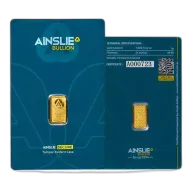
This bar contains 1 gram of 999.9 fine gold, equivalent to 0.03215 troy ounces. One gram is the smallest standard gold bar weight and the lowest-cost physical gold purchase available, with a price point of roughly $100-$120 depending on spot. Bars at this size are produced as small, thin wafers, typically around 8mm by 15mm, and are normally sealed in an assay card that documents weight, purity, and serial number.
The trade-off at this weight is premium. Manufacturing, assaying, and packaging costs are roughly fixed regardless of bar size, and spread over a single gram of gold they dominate the price: typical 1g premiums run 8-15% over spot, the highest premium-to-metal ratio of any bar weight. Buying 31.1 grams as individual 1g bars at a 12% premium costs roughly $280 more than a single 1 oz bar at 3%. The market for gram bars is accordingly driven by gifting, novelty, and ultra-low-budget entry rather than accumulation.
Where a gram bar earns its place is divisibility and accessibility. It lets a buyer start owning physical gold for the price of a dinner out, makes a practical gift, and stores anywhere. Anyone planning regular purchases for wealth building will get materially more metal per dollar from 1oz gold bars or larger sizes.
How Small Gold Bars Are Taxed
At 999.9 fine, a 1g bar comfortably exceeds the investment gold purity thresholds used in every major jurisdiction, so it receives the favourable gold treatment despite its small size.
- UK: Investment gold of 995+ purity is VAT-exempt. Bars are not CGT-exempt, though; only UK legal tender coins qualify. Gains above the £3,000 annual allowance are taxable, which matters little at this purchase size.
- US: No federal sales tax, and most states exempt bullion. Note that several states apply minimum-value thresholds to their exemptions (for example, California exempts only purchases over $2,000), which a single gram bar will not meet. Long-term gains fall under the 28% collectibles rate.
- EU: Investment gold bars at 995+ purity are VAT-exempt across all member states.
- Canada: GST/HST exempt at 99.5%+ purity.
- Australia and New Zealand: GST-free at 99.5%+ purity.
- Singapore: GST-exempt under the Investment Precious Metals scheme for gold of 99.5%+ purity; no capital gains tax.
- Hong Kong: No sales tax, no import duty, no capital gains tax.
For Australian buyers of a bar like this, the practical consideration is that the GST exemption requires investment-grade purity and a form commonly traded on commodity markets; a 999.9 fine gold bar meets both tests.
1g Bars vs CombiBars and Larger Sizes
At the gram scale, the global benchmarks are the Swiss refiners. The PAMP Suisse Fortuna is the most recognised 1g bar in the world, with its Lady Fortuna design and sealed assay card, and Valcambi, Perth Mint, Royal Mint, Argor-Heraeus, and Istanbul Gold Refinery all produce gram bars. Recognised-brand bars in sealed assay cards stay liquid and are accepted by dealers; unbranded bars or bars removed from their packaging have poor resale prospects, so the brand question matters more at this size than at most others.
The most direct alternative to buying individual gram bars is the Valcambi CombiBar, a perforated sheet of 50 or 100 individual 1g segments that snap apart when needed. The per-gram premium is lower than buying single gram bars separately, and the sheet stores like one bar while preserving full gram-level divisibility. For anyone buying multiple grams, it is usually the better structure.
Moving up the weight scale changes the economics quickly. Premiums on 1oz gold bars run around 1-4% over spot against 8-15% at one gram, and 100g bars drop to 2-4%. Buyback prices on gram bars also reflect the high acquisition premium; sellers should expect to recover less than spot from a dealer, though secondary markets sometimes pay a premium for sealed branded grams.
1g Ainslie Gold Bar: frequently asked questions
-
The 1g Ainslie gold bar contains 1g of 999.9 fine gold, so its metal value is $4,408.10 divided by 31.1. The cheapest listing we track is $164.94. Because the bar is small, the price includes a relatively high fabrication premium over the raw gold content.
-
Dealers are currently charging 17.9% over the gold spot price for the 1g Ainslie bar, with the cheapest offer from Ainslie Bullion. We compare prices from 1 dealer. Small gram bars carry higher percentage premiums than larger bars because the same minting costs are absorbed by less gold content.
-
Ainslie is a precious metals dealer that produces its own branded gold bars. Their 1g bars are made to 999.9 fine gold purity and are aimed at buyers looking for a low entry-point into physical gold ownership.
-
Yes. The 1g Ainslie gold bar is produced to 999.9 fineness, which is 24-carat gold and the standard purity for investment-grade gold bars. This means 99.99% of the bar's weight is pure gold, with no more than 0.01% other material.