1 listing
Filters
| Product | /oz | Premium | Price | |
|---|---|---|---|---|

 Suisse Gold
Out of Stock
Suisse Gold
Out of Stock
|
$5,678.88 | +30.67% |
$182.58
€159
|
View Deal |
Prices are fetched automatically and may not reflect current merchant prices. Currency conversions and tax treatment are approximate. Rankings are based solely on price. We are not a dealer and accept no responsibility for transactions with listed merchants. Past performance is not indicative of future results. This site does not provide investment advice. Full disclaimer
About the 1g UBS Gold Bar
The Smallest Standard Gold Bar Weight
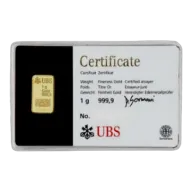
The 1g UBS gold bar contains one gram of 999.9 fine gold, which is 0.03215 troy oz. One gram is the smallest standard gold bar weight, and it occupies a specific niche: at roughly $100-$120 depending on spot, it is the lowest-cost physical gold purchase available. Bars at this size are produced as small, thin wafers, typically sealed in assay cards; the bar itself measures around 8mm x 15mm, while the card is roughly credit-card sized.
The economics deserve a clear-eyed look before buying. 1g gold bars typically run 8-15% over spot, the highest premium-to-metal ratio of any bar weight, because manufacturing, assaying, packaging and distribution costs are roughly fixed regardless of bar size and dominate the price at one gram. Buying 31.1 grams of gold as individual 1g bars at a 12% premium costs roughly $280 more than a single 1 oz bar at 3%. The market for gram bars is accordingly driven by gifting, novelty and ultra-low budget entry rather than accumulation.
That said, the format has genuine uses. It is an accessible introduction to gold ownership, a practical gift, and the most divisible form of physical gold for buyers who value the option of selling in very small increments. Keeping the bar sealed in its assay card is essential: the card carries the authentication that supports resale, and opened or unbranded gram bars have poor buyback prospects.
Tax on a 1g Gold Bar by Country
At 999.9 fine, this bar comfortably exceeds the 995 threshold that defines investment gold in most tax systems, so the headline treatment is favourable almost everywhere. The bar format does forfeit coin-specific breaks in some countries.
- UK: 0% VAT as investment gold. Bars are not CGT-exempt (only UK legal tender coins are), though at one gram per bar, gains within the £3,000 annual CGT allowance are the realistic scenario for most holders.
- EU: VAT-exempt as investment gold across all member states. In Germany, gains are tax-free after a 12-month holding period, for bars as well as coins.
- US: No federal sales tax; most states exempt bullion, while a few tax it or apply minimum-purchase thresholds (California exempts only transactions over $2,000, which a single gram bar will not reach). Long-term gains are taxed at the collectibles rate of up to 28%.
- Canada: GST/HST exempt, since gold refined to at least 99.5% purity in bar or wafer form qualifies federally.
- Australia and New Zealand: GST-free as investment-grade gold above 99.5% purity.
- Singapore and Hong Kong: No GST on qualifying investment gold in Singapore, no sales tax at all in Hong Kong, and no capital gains tax in either.
1g UBS Bar vs Other Gram Bars and Larger Sizes
The gram-bar market is dominated by Swiss refiner brands. The PAMP Suisse Fortuna is the most recognised 1g bar globally, with its Lady Fortuna design and assay-card packaging commanding a modest premium over generic refiner bars; Valcambi, Perth Mint, Royal Mint, Argor-Heraeus and Istanbul Gold Refinery all produce competing gram bars. Between brands the product is functionally identical 999.9 gold, so the comparison comes down to price on the day and how widely the brand is recognised by the dealer you eventually sell to.
A structurally different alternative at this scale is the Valcambi CombiBar, a perforated sheet of 50 or 100 individual 1g segments that snap apart. The per-gram premium is lower than buying gram bars separately, and the sheet stores like a single bar while preserving gram-level divisibility, which makes it the stronger choice for anyone planning to buy more than a few grams in this format.
The most important comparison is vertical. Moving up the weight ladder collapses the premium quickly: a 5g gold bar or 10g bar spreads the fixed production costs over more metal, and by 100g premiums fall to around 2-4%. A buyer with even a modest budget gets substantially more gold per pound or dollar one or two steps up the scale. The 1g bar earns its place as a gift or a first toe in the water; as a stacking unit, almost any larger size beats it.