
8 products · 133 deals
Filters
| Product | /oz | Premium | Price | |
|---|---|---|---|---|

52 deals
|
$4,451.32 | +2.44% |
$4,451.33
£3,336
|
Compare |
| $4,563.41 | +5.02% |
$4,563.40
£3,420
|
Compare | |

23 deals
|
$4,703.57 | +8.25% |
$2,351.78
£1,762
|
Compare |
| $4,711.28 | +8.42% |
$1,177.82
£883
|
Compare | |

23 deals
|
$4,747.31 | +9.25% |
$1,186.83
£889
|
Compare |

19 deals
|
$4,922.62 | +13.29% |
$492.25
£369
|
Compare |
| $5,016.66 | +15.45% |
$501.67
£376
|
View Deal | |

5 deals
|
$5,532.21 | +27.29% |
$221.28
€193
|
Compare |




Prices are fetched automatically and may not reflect current merchant prices. Currency conversions and tax treatment are approximate. Rankings are based solely on price. We are not a dealer and accept no responsibility for transactions with listed merchants. Past performance is not indicative of future results. This site does not provide investment advice. Full disclaimer
About the Philharmonic Gold
The Gold Philharmonic: Europe's Cultural Bullion Coin
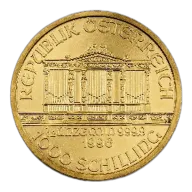
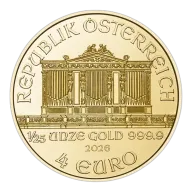
The Vienna Philharmonic gold coin, produced by Münze Österreich (the Austrian Mint), is one of the most distinctive sovereign bullion coins in the world. First struck on 10 October 1989, it celebrates the Vienna Philharmonic Orchestra by depicting the pipe organ of the Musikverein's Golden Hall on the obverse and an ensemble of orchestral instruments on the reverse. This cultural theme sets it apart from the heraldic national symbols used by virtually every other government mint.
The coin is struck in 999.9 fine gold (four nines), legal tender in Austria, and denominated in euros since 2002 (previously Austrian schillings). It was the world's best-selling gold coin in 1992, 1995, 1996, and 2000. From 1989 to 2012, the Austrian Mint sold 14 million gold Philharmonics, equivalent to approximately 329 tonnes of pure gold. Five denominations are produced: 1 oz, 1/2 oz, 1/4 oz, 1/10 oz, and the 1/25 oz (added in 2014 as an affordable entry point for new investors).
The Philharmonic consistently trades among the lowest-premium major sovereign gold coins, making it attractive for buyers who want government-backed 999.9 gold at a competitive price. This pricing advantage is particularly relevant in European markets, where the Philharmonic competes directly with the Britannia and Canadian Maple Leaf. The coin also has a strong historical following in Japan, where the Austrian Mint maintains established distribution relationships.
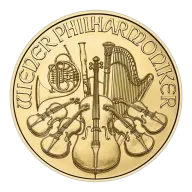
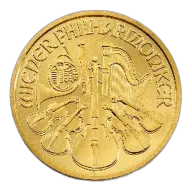
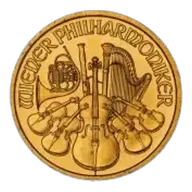
The design has remained unchanged since 1989, with the only variations being the year-date and the 2002 switch from schilling to euro denominations. The Musikverein Golden Hall, depicted on the obverse, was built in 1870 and is renowned for its acoustics. The annual New Year's Concert from this hall is broadcast to over 90 countries. The reverse instruments include a cello at centre, flanked by four violins, with a Vienna horn (Wiener Horn), bassoon, and harp behind. The Vienna horn is specifically a Wiener Horn, not a standard French horn, a detail reflecting the orchestra's commitment to historically informed performance.
Philharmonic Gold Denominations and Dimensions
| Denomination | Face Value | Weight | Diameter | First Year |
|---|---|---|---|---|
| 1 oz | 100 EUR | 31.103g | 37.0mm | 1989 |
| 1/2 oz | 50 EUR | 15.552g | 28.0mm | 1991 |
| 1/4 oz | 25 EUR | 7.776g | 22.0mm | 1991 |
| 1/10 oz | 10 EUR | 3.110g | 16.0mm | 1991 |
| 1/25 oz | 4 EUR | 1.244g | 13.0mm | 2014 |
All gold Philharmonics are 999.9 fine (24 karat). Face values were denominated in Austrian schillings until 2002 (2,000 ATS for the 1 oz) and converted to euros when Austria adopted the single currency. Face values are nominal; the gold content far exceeds them. Despite the euro denomination, the Philharmonic is legal tender only in Austria, not across the wider eurozone.
The coin was designed by Thomas Pesendorfer, an Austrian Mint engraver, for the 1989 launch. Both the obverse (the Rieger pipe organ of the Musikverein, built in 1907) and the reverse (orchestral instrument ensemble) are his work. The design's intricate detail, particularly the organ pipes and individual instrument rendering, provides inherent anti-counterfeiting protection through complexity.
Special editions have included a 20 oz gold Philharmonic (face value 100,000 EUR) created as a showcase piece, and the "Big Phil" from 2004: a 31 kg (1,000 troy ounce) gold coin with a face value of 100,000 EUR, of which only 15 were produced. At the time of manufacture, it was the largest gold coin in the world.
Philharmonic Tax Treatment by Country
- Austria and the European Union: Gold Philharmonics appear on the EU's annual list of investment gold coins and are VAT-exempt across all EU member states under Directive 98/80/EC. Silver Philharmonics are subject to local VAT rates. In Germany and the Netherlands, dealers commonly sell silver coins under the margin scheme (Differenzbesteuerung in German, margeregeling in Dutch), which charges VAT only on the dealer's profit margin rather than the full price. The effective VAT under the German margin scheme is roughly 7%, compared to the standard 19% rate.
- United Kingdom: Gold Philharmonics are VAT-exempt as recognised investment gold coins. They are not CGT-exempt because they are not UK legal tender. Silver and platinum Philharmonics are subject to 20% VAT. UK buyers who prioritise tax efficiency on gains should consider the Britannia or Sovereign, which offer CGT exemption.
- United States: IRA-eligible across all three metals. Gold at 999.9 fine exceeds the IRS 99.5% minimum, silver at 999 fine meets the 99.9% threshold, and platinum at 999.5 fine meets the 99.95% threshold. Capital gains outside an IRA are taxed at the collectibles rate of up to 28%.
- Canada: Gold Philharmonics are GST/HST-exempt (purity exceeds the 99.5% threshold). They are not eligible for RRSP or TFSA, as these programmes generally require coins from a Canadian mint. Standard capital gains treatment applies (50% inclusion rate).
- Australia: Gold meets the 99.5% purity threshold for GST exemption. Silver at 99.9% also qualifies. Platinum at 99.95% qualifies under the 99.0% threshold. Capital gains tax applies with a 50% discount for holdings exceeding 12 months.
- Singapore: Investment Precious Metals at 99.5% purity or above are GST-exempt. The gold Philharmonic qualifies. No capital gains tax.
- Hong Kong: No sales tax, import duty, or capital gains tax on bullion.
From Richard the Lionheart's Ransom to Modern Bullion
The Austrian Mint traces its lineage to 1194, when Duke Leopold V of Austria used 12 tonnes of silver from the ransom of Richard I of England (captured during the Third Crusade) to establish large-scale coin production in Vienna. This makes it one of the oldest minting institutions in the world, and the Philharmonic is its modern flagship product.
The coin launched on 10 October 1989, entering a market where the Krugerrand (1967), Maple Leaf (1979), American Eagle (1986), and Britannia (1987) were already established. The Philharmonic carved its niche through three attributes: 999.9 purity (matching the Maple Leaf and surpassing the 22-karat Eagle and Krugerrand), a distinctive cultural design, and competitive pricing that often undercut established competitors in European markets.
Commercial success was rapid. The coin claimed the title of world's best-selling gold coin in 1992, just three years after launch, and held that position again in 1995, 1996, and 2000. Annual production has fluctuated dramatically with market conditions: from a low of 54,700 coins in 2001 (post-dot-com market malaise) to a peak of 903,047 in 2009 (financial crisis-driven demand).
The silver Philharmonic followed on 1 February 2008, available only in a 1 oz denomination at 999 fine silver with a face value of 1.50 EUR. The silver version proved exceptionally popular, with over 54 million coins sold from 2008 to 2012 and more than 30 million sold in the three-year period 2021-2023 alone. The platinum Philharmonic arrived in 2016, initially in 1 oz and 1/25 oz denominations at 999.5 fine, making the Philharmonic a three-metal programme.
The 2004 "Big Phil" deserves mention as a singular object: a 31 kg gold coin (1,000 troy ounces) with a face value of 100,000 EUR, of which only 15 were produced. At the time, it was the largest gold coin ever minted, a record later surpassed by the Perth Mint's 1-tonne coin in 2011.
Philharmonic vs Britannia, Maple Leaf, and Krugerrand
The Britannia matches the Philharmonic's 999.9 purity (since its 2013 upgrade) and adds four layered security features introduced with the 2021 design refresh: a latent image, micro-text, tincture lines, and surface animation. The Philharmonic has no comparable anti-counterfeiting technology, relying instead on its detailed design complexity and the Austrian Mint's sovereign guarantee. The Britannia's decisive advantage for UK investors is CGT exemption as UK legal tender, a benefit the Philharmonic cannot match. In European continental markets, the Philharmonic often trades at slightly lower premiums than the Britannia, making it the more cost-effective option where CGT exemption is not a factor.
The 1oz Canadian Maple Leaf is the Philharmonic's closest specification match: both are 999.9 gold, 1 oz, and carry face values in major currencies. The Maple Leaf's MintShield anti-fingerprint technology and micro-engraved laser security mark give it an edge on authentication. The Royal Canadian Mint's Bullion DNA system offers digital verification that the Austrian Mint does not match. Global distribution favours the Maple Leaf, which is one of the largest bullion coin programmes worldwide. The Philharmonic competes most effectively in European and Japanese markets where it has established dealer networks.
The Krugerrand, at 22 karat (916.7 fine), has a different proposition entirely. It carries no face value, trades on its 1967-onward legacy as the original modern bullion coin, and typically offers the lowest premiums among sovereign coins due to its enormous cumulative production volume (over 60 million coins). The Philharmonic's higher purity appeals to investors who prefer 24-karat gold, and its euro face value provides legal tender status that the Krugerrand lacks. The Krugerrand's copper alloy makes it more durable for handling; the Philharmonic's pure gold is softer.
The American Gold Eagle, also 22 karat, dominates the US market with its eagle-and-shield design and specific IRA eligibility. The Philharmonic offers higher purity at generally lower premiums but has less penetration among US dealers. Both coins are IRA-eligible, but the Eagle's familiarity gives it a liquidity advantage in North America that the Philharmonic holds in continental Europe.
Philharmonic Gold: frequently asked questions
-
Philharmonic prices track the metal spot price for the relevant metal. Gold Philharmonics (1 oz, .9999 fine) typically carry modest premiums; silver and platinum versions follow their own metal prices. We track prices from 41 dealers so you can compare directly. Fractional gold sizes (1/4 oz, 1/10 oz) carry higher per-ounce premiums than the 1 oz.
-
The Vienna Philharmonic is a bullion coin produced by Münze Österreich (Austrian Mint), named after the Vienna Philharmonic Orchestra. The gold version has been minted since 1989, silver since 2008, and platinum since 2016. All are .9999 fine gold, .999 fine silver, or .9995 fine platinum, and carry legal tender status in Austria with euro face values.
-
The Austrian Mint issues the silver Philharmonic only in the 1 oz size, and dealers typically sell tubes of multiple coins at a discount over individual purchases. The exact tube size can vary by dealer and year, so check the product listing for the quantity before ordering.
-
Yes, Philharmonic coins are legal tender in Austria. The 1 oz gold coin carries a €100 face value, the 1 oz silver carries €1.50, and the 1 oz platinum carries €100. The face value is nominal given the metal content. Despite bearing euro denominations, the coins are only legal tender in Austria and cannot be spent at face value in other eurozone countries.