6 products · 188 deals
Filters
| Product | /oz | Premium | Price | |
|---|---|---|---|---|
| $4,362.33 | +0.39% |
$4,362.33
£3,269
|
Compare | |

100 deals
|
$4,419.60 | +1.71% |
$4,419.59
£3,312
|
Compare |

28 deals
|
$4,517.53 | +3.97% |
$2,258.77
£1,693
|
Compare |

25 deals
|
$4,626.68 | +6.48% |
$1,156.67
£867
|
Compare |

27 deals
|
$4,801.16 | +10.49% |
$480.12
£360
|
Compare |
| $4,951.02 | +13.94% |
$582.75
£437
|
Compare |


Prices are fetched automatically and may not reflect current merchant prices. Currency conversions and tax treatment are approximate. Rankings are based solely on price. We are not a dealer and accept no responsibility for transactions with listed merchants. Past performance is not indicative of future results. This site does not provide investment advice. Full disclaimer
About the SA Mint Krugerrand Gold
The Krugerrand: The Coin That Created the Modern Bullion Market
The Krugerrand, first struck on 3 July 1967, is the coin that invented the modern gold bullion market. Before it existed, individual investors had no standardised way to buy exactly one troy ounce of gold in coin form. Every sovereign gold coin since, from the Canadian Maple Leaf (1979) to the Britannia (1987) to the Philharmonic (1989), was a direct response to the Krugerrand's commercial success.
Produced by the South African Mint, the Krugerrand is struck in 22-karat gold (916.7 fineness), alloyed with 8.33% copper. Each 1 oz coin contains exactly one troy ounce (31.103 grams) of fine gold in a total coin weight of 33.93 grams. The copper alloy gives the Krugerrand its distinctive warm, orange-gold colour, a visual marker that immediately distinguishes it from the yellow hue of 24-karat coins. The alloy also makes the coin harder and more scratch-resistant than pure gold alternatives.
By 1980, the Krugerrand accounted for more than 90% of the global gold coin market. By 2017, over 53 million troy ounces of gold had been sold in Krugerrand form, comprising more than 60 million individual coins including fractional sizes. This cumulative volume makes it the most widely held gold bullion coin in the world, which in turn supports strong secondary-market liquidity and consistently low premiums over spot price.
The coin carries no face value. It is legal tender in South Africa based on its gold content value, a structure similar in principle to the British Sovereign. The name combines Paul Kruger (President of the South African Republic, whose portrait appears on the obverse) and "Rand" (South Africa's currency). Fractional sizes (1/2 oz, 1/4 oz, 1/10 oz) were added in 1980. Silver and platinum versions, both introduced in 2017 for the 50th anniversary, carry face values (R1 and R10 respectively), breaking with the gold coin's no-denomination tradition.
Krugerrand Denominations and Dimensions
Gold Krugerrand (22 Karat, 916.7 Fine)
| Size | Fine Gold | Total Weight | Diameter (mm) | Thickness (mm) | Introduced |
|---|---|---|---|---|---|
| 1 oz | 31.103g | 33.93g | 32.77 | 2.84 | 1967 |
| 1/2 oz | 15.552g | 16.965g | 27.07 | 2.215 | 1980 |
| 1/4 oz | 7.776g | 8.482g | 22.06 | 1.888 | 1980 |
| 1/10 oz | 3.110g | 3.393g | 16.55 | 1.35 | 1980 |
Edge serrations: 180 on bullion strikes, 220 on proof strikes. The different serration count helps distinguish the two finishes. All gold Krugerrands are 22 karat (91.67% gold, 8.33% copper). The total coin weight exceeds the fine gold weight because of the copper alloy, but the fine gold content in each denomination is an exact fraction of one troy ounce.
Silver Krugerrand (2017 onward, 999 Fine)
| Size | Fine Silver | Diameter (mm) | Thickness (mm) | Face Value |
|---|---|---|---|---|
| 1 oz | 31.1g | 38.7 | 2.84 | R1 |
The 2017 debut mintage was 1,000,000 Premium Uncirculated coins plus 15,000 Proof editions. Annual production continues. The Silver Krugerrand was the first in the series to carry a face value denomination.
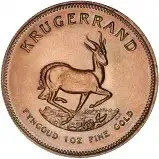
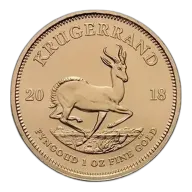
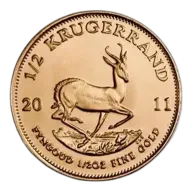
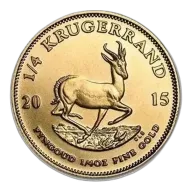
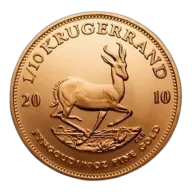
The obverse portrait is by Otto Schultz, depicting Paul Kruger. The reverse, a springbok antelope in mid-leap, was designed by Coert Steynberg. Both designs have remained essentially unchanged since 1967. The 2017 50th anniversary editions carry a discreet privy mark but otherwise maintain the classic design.
Krugerrand Tax Treatment by Country
The Krugerrand's 22-karat purity creates specific tax implications that differ from 24-karat coins in several jurisdictions. The coin contains one troy ounce of fine gold, but the overall composition is 91.67%, which falls below certain purity thresholds.
- South Africa: Gold Krugerrands are VAT-exempt as legal tender under Section 11(1)(k) of the Value-Added Tax Act, 1991. This has been in effect since 1995. Silver Krugerrands, despite also being legal tender (R1 face value), are subject to 15% VAT. Platinum Krugerrands likewise attract 15% VAT. Capital gains tax applies to all Krugerrand sales, with a 40% inclusion rate for individuals (effective maximum rate approximately 18%).
- United Kingdom: Gold Krugerrands are VAT-free as recognised investment gold coins. They are not CGT-exempt. Only UK legal tender coins (the Britannia and Sovereign) qualify for CGT exemption. This is the single most important tax fact for UK gold buyers comparing Krugerrands to domestic coins. The Krugerrand's lower purchase premium can be offset by CGT liability on disposal above the £3,000 annual allowance.
- United States: IRA-eligible, specifically approved under IRS regulations. Capital gains taxed at the collectibles rate of up to 28%. State sales tax varies by state.
- Canada: GST/HST-exempt. The test in Canada is on the precious metal content per coin (which is pure gold at 99.99%), not the overall alloy purity, so the Krugerrand qualifies despite its 91.67% overall composition.
- European Union: Listed on the annual EU investment gold coin list. VAT-exempt across all member states. Silver Krugerrands are subject to local VAT rates.
- Australia: Investment-grade gold is GST-free at 99.5% purity or above. The Krugerrand qualifies based on its fine gold content.
- Singapore: The 91.67% overall purity falls below Singapore's 99.5% threshold for IPM (Investment Precious Metals) GST exemption. The Krugerrand does not qualify for GST exemption in Singapore, and buyers would pay 9% GST. Investors in Singapore seeking GST-exempt gold should consider 999.9 fine coins instead.
- New Zealand: Gold below 99.5% purity attracts 15% GST in New Zealand. The Krugerrand's 91.67% overall composition falls below this threshold, meaning NZ buyers pay GST. This is a significant cost disadvantage compared to 999.9 fine coins like the Maple Leaf or Kangaroo.
From Apartheid-Era Dominance to Modern Competitor
The Krugerrand's 1967 launch was driven by a straightforward commercial objective: enable South Africa to market its gold production directly to individual investors worldwide. The first run comprised 40,000 bullion coins and 10,000 proof editions. The concept of a coin containing exactly one troy ounce of gold, with no numismatic premium intended, was genuinely novel. Previous gold coins were denominated by face value (like the Sovereign at £1), not by weight.
Through the 1970s, as gold ownership became legal again for US citizens (banned from 1933 to 1974) and gold prices rose dramatically, the Krugerrand became the vehicle through which millions of Western investors first bought gold. Aggressive international marketing, particularly in the United States and Europe, drove sales to volumes where the Krugerrand held over 90% of the global gold coin market by 1980.
The anti-apartheid movement changed everything. International sanctions against South Africa led to a US import ban on Krugerrands in 1985, with wider restrictions following from other countries. This opened the market for competitors: Canada had already launched the Maple Leaf in 1979 partly to capture investors concerned about South African sanctions, and the American Eagle (1986) and Britannia (1987) followed.
Sanctions were lifted in 1991, but the Krugerrand never regained its near-monopoly. The market had permanently diversified. The coin retained strong liquidity and recognition, particularly in Europe and the secondary market, but now competed alongside a field of sovereign alternatives. Its enduring advantage is cumulative volume: no other gold bullion coin has been produced in comparable quantities, and this depth of circulation supports the tightest secondary-market premiums of any sovereign coin.
The 22-karat composition was chosen to match the historic British Sovereign, providing durability for handling and storage. The copper alloy is responsible for the Krugerrand's distinctive warm orange colour, immediately identifiable against the paler yellow of 24-karat coins. The design, Paul Kruger on the obverse and a springbok on the reverse, has remained fundamentally unchanged for nearly 60 years.
Krugerrand vs Britannia, Maple Leaf, and Eagle
For UK investors, the comparison with the Britannia is the most consequential. The Britannia is 999.9 fine gold (24 karat), carries advanced security features (latent image, micro-text, tincture lines, surface animation since 2021), and is exempt from both VAT and Capital Gains Tax as UK legal tender. The Krugerrand is VAT-free but subject to CGT. For investors whose gains will remain below the £3,000 annual CGT allowance, the Krugerrand's lower purchase premium may make it the better buy. For investors expecting larger gains, the Britannia's CGT exemption can save thousands in tax. This calculation is specific to each buyer's circumstances.
The 1oz Canadian Maple Leaf at 999.9 purity offers more gold per gram of total coin weight (no copper alloy), advanced Bullion DNA digital authentication, and MintShield anti-tarnish technology on silver versions. The Maple Leaf was launched in 1979 specifically to offer an alternative to the Krugerrand for investors concerned about apartheid-era sanctions. Today, both are fully liquid sovereign coins, but the Maple Leaf's higher purity and security features appeal to buyers who prioritise authentication confidence. The Krugerrand's copper alloy makes it harder and more scratch-resistant, a practical advantage for coins that are handled or stored loosely.
The American Gold Eagle shares the Krugerrand's 22-karat composition (916.7 fine gold), though the Eagle uses a silver-and-copper alloy rather than pure copper. Both contain exactly one troy ounce of fine gold in a heavier total coin. The Eagle carries a $50 face value (the Krugerrand has no face value) and dominates the US market. Both are IRA-eligible. The Krugerrand is more popular internationally, particularly in Europe and Africa, while the Eagle leads in domestic US liquidity.
The Austrian Philharmonic at 999.9 fine gold, with its euro face value and cultural design theme, competes on purity and European market presence. The Krugerrand's advantages are its longer history, deeper secondary market, and typically lower premiums over spot. The Philharmonic's advantages are higher purity and EU investment gold coin list recognition. The choice often comes down to geography: European investors lean toward the Philharmonic, while global investors with an eye on resale breadth favour the Krugerrand.
SA Mint Krugerrand Gold: frequently asked questions
-
A Krugerrand's value is driven by the gold spot price. Gold Krugerrands trade close to spot because each 1 oz coin contains exactly one troy ounce of fine gold regardless of the 22-carat alloy. Silver and platinum Krugerrands are priced similarly against their respective spot values. Check the comparison table on this page for live dealer prices across all available sizes.
-
Gold Krugerrands are 22-carat (91.67% gold, 8.33% copper). The copper alloy was chosen for durability, making the coin harder and more scratch-resistant than softer .999 coins. Crucially, each 1 oz coin still contains exactly one troy ounce of fine gold; the total coin weight is 33.93 g to compensate for the copper. Silver Krugerrands are .999 fine silver and platinum versions are .999 fine platinum, both introduced in 2017.
-
Yes. The gold Krugerrand dates to 1967 and comes in four sizes (1 oz, 1/2 oz, 1/4 oz, 1/10 oz). Silver and platinum versions were introduced in 2017 for the coin's 50th anniversary and are currently available in 1 oz only. The silver coin carries an R1 face value and is .999 fine; the platinum version carries an R10 face value and is .999 fine platinum.
-
Krugerrands were subject to international sanctions during South Africa's apartheid era. The United States enacted an import ban in 1985, and other Western governments imposed similar restrictions. After South Africa's democratic transition, sanctions were lifted and US restrictions ended in 1991. Krugerrands are now fully legal to buy, sell, and import in all major bullion markets including the UK, US, EU, Canada, and Australia.
-
Gold Krugerrands are available in four sizes: 1 oz, 1/2 oz, 1/4 oz, and 1/10 oz, all at 22-carat (91.67%) gold purity. Fractional sizes were introduced in 1980. Silver and platinum Krugerrands are currently produced in 1 oz only. Each size contains the stated quantity of fine gold, silver, or platinum regardless of the alloy composition.