7 products · 365 deals
Filters
| Product | /oz | Premium | Price | |
|---|---|---|---|---|

13 deals
|
$4,464.83 | +2.75% |
$2,102.11
£1,575
|
Compare |

257 deals
|
$4,496.29 | +3.48% |
$1,058.46
£793
|
Compare |

13 deals
|
$4,517.49 | +3.96% |
$1,063.45
£797
|
Compare |
| $4,530.47 | +4.26% |
$2,133.01
£1,598
|
Compare | |

62 deals
|
$4,548.10 | +4.67% |
$535.33
£401
|
Compare |

10 deals
|
$4,562.84 | +5.01% |
$537.06
£402
|
Compare |

8 deals
|
$4,842.56 | +11.45% |
$285.07
£214
|
Compare |


Prices are fetched automatically and may not reflect current merchant prices. Currency conversions and tax treatment are approximate. Rankings are based solely on price. We are not a dealer and accept no responsibility for transactions with listed merchants. Past performance is not indicative of future results. This site does not provide investment advice. Full disclaimer
About the Sovereign Gold
The Gold Sovereign: The UK's Most Tax-Efficient Gold Coin
The Sovereign is the most tax-advantaged way to hold physical gold in the United Kingdom. As UK legal tender, it is exempt from both VAT on purchase and Capital Gains Tax on disposal, regardless of profit size. No other major investment gold product offers this double exemption in its home market. For UK-based investors making gains above the annual CGT allowance (currently £3,000), the Sovereign can save thousands in tax compared to gold bars or foreign coins like the Krugerrand.
The modern Sovereign was first issued in 1817 during the Great Recoinage of 1816, authorized by Parliament as a one-pound gold coin to replace the 21-shilling guinea. The name revives the original English gold sovereign first authorized by Henry VII in 1489. Struck in 22-karat "crown gold" (916.7 fineness), a standard established by Henry VIII in 1526, the full Sovereign contains 7.322 grams (0.2354 troy ounces) of fine gold in a total coin weight of 7.988 grams.
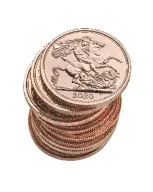
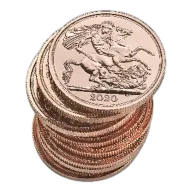
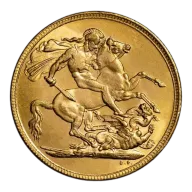
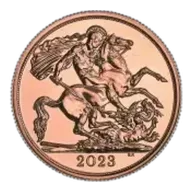
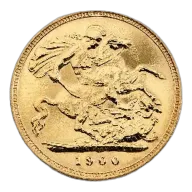
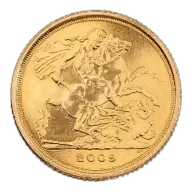
The reverse carries what many numismatists consider one of the finest coin designs ever created: Benedetto Pistrucci's depiction of St George slaying a dragon, first engraved in 1817. The neoclassical composition, possibly influenced by the Elgin Marbles which arrived at the British Museum in 1816, has been in near-continuous use for over 200 years. Five denominations span the range from the Quarter Sovereign (1.831g gold) to the Quintuple Sovereign (36.612g gold, slightly more than one troy ounce).
The Sovereign's lower gold content per coin compared to a 1 oz Britannia means higher percentage premiums over spot. Buyers pay more per gram of gold for a Sovereign than for a Britannia at 1 oz. The trade-off is the Sovereign's lower absolute cost per coin, its deep historical liquidity, and the same CGT exemption that the Britannia offers. For UK investors, the choice between Sovereign and Britannia is primarily about investment size per unit, not tax treatment.
Sovereign Denominations and Dimensions
| Denomination | Face Value | Total Weight | Gold Content | Diameter | Thickness |
|---|---|---|---|---|---|
| Quarter Sovereign | £0.25 | 1.997g | 1.831g (0.0589 oz) | 13.50mm | ~1.0mm |
| Half Sovereign | £0.50 | 3.994g | 3.661g (0.1177 oz) | 19.30mm | ~1.1mm |
| Full Sovereign | £1.00 | 7.988g | 7.322g (0.2354 oz) | 22.05mm | 1.52mm |
| Double Sovereign | £2.00 | 15.976g | 14.644g (0.4708 oz) | 28.40mm | ~1.9mm |
| Quintuple Sovereign | £5.00 | 39.940g | 36.612g (1.177 oz) | 36.02mm | ~2.8mm |
All denominations are 22 carat (916.7 fineness), composed of 91.67% gold and 8.33% copper. Each denomination is an exact weight multiple or fraction of the full Sovereign. The purity and alloy composition are identical across all sizes. Edges are milled (reeded), though some collector and proof versions have plain edges.
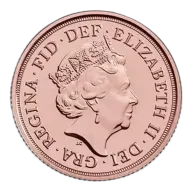
From 2026, the Royal Mint has introduced advanced security features for the first time: Garter motto text and an optical security image on the obverse. The 2026 issue also marks a return to traditional yellow crown gold, moving away from the slightly rose-gold toned alloy used in recent years. Previously, the Sovereign relied on the extreme detail of the Pistrucci St George design as inherent anti-counterfeiting protection, with the complex horse musculature, cape folds, and dragon scales being difficult to reproduce accurately.
Sovereign Tax Treatment by Country
- United Kingdom: The Sovereign's defining advantage. As UK legal tender under Section 21(1)(b) of TCGA 1992, Sovereigns are exempt from Capital Gains Tax on disposal regardless of the amount of gain. This applies to all denominations (quarter, half, full, double, quintuple) and to both modern and historic Sovereigns. Investment gold is also VAT-exempt. The combination of zero VAT and zero CGT makes the Sovereign uniquely tax-efficient for UK investors. One caveat: if HMRC determines that Sovereign trading constitutes a business (habitual buying and selling for profit), gains may be classified as income rather than capital gains, and the CGT exemption would not apply.
- United Kingdom (SIPP): Gold bullion meeting purity requirements is eligible for Self-Invested Personal Pensions. Sovereigns can be held in a SIPP, with tax relief at the investor's marginal rate (up to 45%). Gold held within a SIPP is also exempt from CGT. Physical bullion is not eligible for ISA investment.
- European Union: Sovereigns are recognised as investment gold coins under EU Directive 98/80/EC and are VAT-exempt throughout the EU.
- United States: No special tax status. Capital gains are taxed at the collectibles rate of up to 28%. The Sovereign is not IRA-eligible because its 916.7 purity falls below the IRS 99.5% minimum for gold IRA inclusion. (The American Eagle has a specific statutory exemption from this purity requirement; the Sovereign does not.)
- Canada: Not RRSP-eligible. Standard capital gains treatment applies.
- Australia: The 91.67% purity falls below Australia's 99.5% threshold for GST-exempt investment gold. Sovereigns may attract 10% GST in Australia, though the treatment depends on whether they qualify under the foreign legal tender coin exception (ATO guidance is nuanced on this point). Investors seeking clarity should consult their tax adviser or purchase 999.9 fine coins to be certain.
- New Zealand: The 91.67% purity falls below New Zealand's 99.5% threshold. Sovereigns attract 15% GST. NZ buyers seeking GST-exempt gold should consider 999.9 fine coins such as the Canadian Maple Leaf or Australian Kangaroo.
- Singapore: The 91.67% purity falls below the 99.5% IPM threshold. Sovereigns do not qualify for GST exemption and would attract 9% GST.
Two Centuries of the Pistrucci Sovereign
The modern Sovereign originated in the Great Recoinage of 1816, which replaced the guinea (worth 21 shillings) with a new gold coin valued at exactly one pound sterling. Benedetto Pistrucci, an Italian gem engraver recruited by the Master of the Mint, created the iconic St George and the Dragon reverse. The design depicts St George on horseback, barefoot with greaves, wearing a billowing cape and raising a sword above a fallen dragon. The neoclassical style may have been influenced by the Elgin Marbles, which were acquired by the British Museum in 1816, the year before the coin's debut.
Production has been nearly continuous since 1817, with 1933 the only year in which no gold coins were minted in the UK. The design has seen modifications over the centuries: the surrounding Garter ribbon was removed in 1821, the spear became a sword, plume details changed in 1887 and 1893, and the plume was eliminated entirely in 2009. Alternative reverses have appeared occasionally, including the Ensigns Armorial (Royal Arms) used from 1825 to 1870, and commemorative reverses for the Golden Jubilee (2002), Platinum Jubilee (2022), and other occasions.
During the height of the British Empire, Sovereigns were struck at branch mints across the world: Sydney (1855-1926), Melbourne (1872-1931), Perth (1899-1931), Ottawa (1908-1919), Bombay (1918), and Pretoria (1923-1932). By 1900, approximately 40% of Sovereigns circulating in Britain came from Australian mints. Branch mint marks (S, M, P, C, I, SA) create significant numismatic premiums today for identified coins.
Between 1957 and 1968, the Bank of England commissioned approximately 45 million Sovereigns struck with backdated dates. This unusual programme was designed to combat Middle Eastern counterfeits that were undermining confidence in British gold. These coins are indistinguishable from their dated originals except through expert die analysis.
In 2025, the Royal Mint introduced a 999 fine silver Sovereign for the first time (50,000 pieces), breaking the 500-year tradition of gold-only Sovereigns. The "Strike-on-the-Day" programme (2012-present) produces limited editions on specific dates, such as the Diamond Jubilee (2,012 pieces), Brexit day (1,500 pieces), and the Charles III coronation (1,250 pieces).
Sovereign vs Britannia, Krugerrand, and Eagle
The most important comparison for UK investors is between the Sovereign and the Britannia. Both are Royal Mint products, UK legal tender, VAT-free, and CGT-free. The differences are practical. The 1 oz Britannia contains 31.103 grams of 999.9 fine gold; the full Sovereign contains 7.322 grams of 916.7 fine gold, roughly a quarter of the Britannia's gold content. This means the Sovereign is a lower-cost entry point per coin but carries higher percentage premiums over spot (per gram of gold content) due to fixed manufacturing costs being spread across less metal. For building a position efficiently, the Britannia offers more gold per pound spent. For smaller, incremental purchases or gift-giving, the Sovereign's lower price per coin is attractive.
Against the Krugerrand, which shares the 22-karat (916.7 fine) composition, the critical difference for UK investors is CGT. The Krugerrand is VAT-free but subject to CGT, while the Sovereign is exempt from both. The 1 oz Krugerrand contains a full troy ounce of gold (31.103g) versus the Sovereign's 0.2354 oz, so direct weight comparison is not meaningful. The relevant question is tax efficiency: for UK investors expecting gains above the £3,000 annual CGT allowance, the Sovereign's CGT exemption justifies its higher per-gram premium. For investors whose gains stay within the allowance, the Krugerrand's lower percentage premium may deliver more gold for the same money.
The American Gold Eagle is also 22 karat but contains a full troy ounce of gold (total weight 33.93g). The Eagle has IRA eligibility (with a specific statutory exemption from the purity requirement that excludes the Sovereign). The Eagle dominates the US market; the Sovereign is primarily a UK and Commonwealth product. For US investors, the Sovereign offers no particular advantage over the Eagle. For UK investors, the Sovereign's CGT exemption is not available on the Eagle.
The French 20 Franc Napoleon occupies a similar niche as a historical European gold coin with numismatic premium potential. Both are 22-karat era coins popular in their respective home markets. The Napoleon is popular in France and across continental Europe; the Sovereign in the UK and Commonwealth countries. Neither has the pure 1 oz bullion format of modern coins, and both trade at premiums that reflect historical interest alongside metal content.
Sovereign Gold: frequently asked questions
-
A full gold Sovereign contains 7.32 g (0.2354 troy oz) of gold at 22 carat (916.7 fine), so its bullion value moves with the live $4,408.10 gold price. Dealer prices vary above that base. We track listings across 32 dealers, covering full Sovereigns and fractional sizes (quarter, half, double, quintuple). Check the comparison table above for current prices.
-
The gold Sovereign is struck in 22 carat gold (916.7 fine, sometimes written as 91.67%), not 24 carat or 999 fine. A full Sovereign has a gross weight of 7.988 g and contains 7.322 g (0.2354 troy oz) of fine gold. The 22-carat crown gold standard has been maintained since Henry VIII established it in 1526.
-
Yes, in the United Kingdom. The full Sovereign carries a face value of £1, the half Sovereign £0.50, and so on through the quarter, double, and quintuple denominations. The face value is far below the bullion value in practice. Outside the UK, Sovereigns are not generally legal tender, though they are widely accepted as bullion by dealers internationally.
-
As UK legal tender, Sovereigns are exempt from Capital Gains Tax for UK investors, regardless of the size of the gain. This applies to all denominations (quarter, half, full, double, and quintuple). US investors pay up to 28% on long-term gains on gold, and in Canada 50% of any gain is included in taxable income. Investment gold is VAT-free in the UK and throughout the EU.
-
The silver Sovereign is a modern Royal Mint product, first issued in 2025, struck in 999 fine silver at approximately 28.28 g. It is a distinct product from the traditional gold Sovereign and does not share its centuries-long history or 22-carat gold composition. The silver Sovereign carries a nominal face value but is produced as a bullion collectible, alongside the established gold Sovereign range.