1 listing
Filters
| Product | /oz | Premium | Price | |
|---|---|---|---|---|

 Monument Metals
|
$65.44 | +4.89% | $654.40 | View Deal |
Prices are fetched automatically and may not reflect current merchant prices. Currency conversions and tax treatment are approximate. Rankings are based solely on price. We are not a dealer and accept no responsibility for transactions with listed merchants. Past performance is not indicative of future results. This site does not provide investment advice. Full disclaimer
About the 10 oz Red River Mint Silver Bar
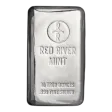
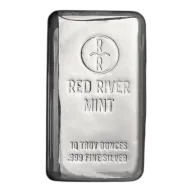
The 10 oz Red River Mint Silver Bar
This bar contains 10 troy ounces (311.04 g) of .999 fine silver in the weight class widely considered the most popular silver bar size. The 10 oz format earns that position by balancing the two things bar buyers care about most: premiums in the 3-6% range under normal conditions, far below the 5-15% typical of 1 oz bars, and a unit price that stays manageable for regular purchases and staged selling.
The single biggest premium drop in the silver bar market happens between 1 oz and 10 oz, typically a saving of four to five percentage points, or roughly $1 to $1.50 per ounce. Stepping up further to kilo or 100 oz bars saves comparatively little: the per-ounce premium difference between 10 oz and kilo bars is often under 1%, which is why dealer guidance for buyers spending a few hundred dollars at a time so often lands on the 10 oz bar as the core recommendation.
Liquidity at this weight is excellent. All major online dealers and local coin shops readily buy 10 oz bars, with the caveat that bars from widely recognised refiners command tighter spreads, while lesser-known brands remain saleable but may face slightly wider ones. Physically, a 10 oz bar measures around 84 x 49 x 8 mm, compact relative to its value, and many stackers find single bars more space-efficient than ten 1 oz pieces with their packaging and air gaps. As with all silver bars, dry storage and sealed packaging protect against tarnish and support resale.
10 oz Silver Bar Tax Treatment by Country
At .999 fineness this bar meets the silver purity thresholds in the exempting jurisdictions, but silver bars get markedly worse tax treatment than gold in several countries.
- US and Canada: The 10 oz bar's home market. In the US there is no federal sales tax and most states exempt bullion, though some tax it or apply purchase thresholds; IRA-eligible silver must be 99.9%+ from accredited refiners. In Canada, silver refined to at least 99.9% purity in bar form is GST/HST exempt.
- UK: 20% VAT on new bars and no CGT exemption on sale, since bars have no legal tender status. This double exposure makes bars the least tax-efficient silver form for UK buyers, who should weigh the premium saving against the CGT-exempt silver Britannia.
- EU: Full local VAT on new silver bars at each member state's standard rate; margin schemes apply mainly to second-hand stock.
- Australia: GST-free as investment-grade silver at 99.9%+ purity from accredited refiners.
- New Zealand: GST-exempt at 99.9%+ purity, with no capital gains tax.
- Singapore: GST exemption covers silver bars at 99.9%+ purity from LBMA-accredited refiners; qualification for any specific brand should be confirmed. No capital gains tax.
- Hong Kong: No sales tax, no import duty, no capital gains tax.
10 oz Bars vs 1 oz Bars, Kilo Bars, and 100 oz Bars
Against 1 oz silver bars, the 10 oz wins decisively on cost. At an illustrative $30 spot, a 10 oz bar at a 4% premium costs about $312 against $330 for the same weight in 1 oz bars at 10%, roughly $18 saved per 10 oz. What the 1 oz format keeps is divisibility: selling a bar is all-or-nothing, and ten small bars can be liquidated one at a time.
Against kilo bars (32.15 oz), the marginal premium saving from sizing up is small, often under one percentage point, while the unit cost roughly triples. For most retail buyers the 10 oz bar's flexibility outweighs the saving. The same logic applies more strongly to 100 oz bars: premiums of 2-5% are the lowest in the retail bar market, but each bar weighs about 3.1 kg, ties up thousands of dollars, and must be sold whole. The 100 oz format is more common in North America, while kilo bars are the international retail standard in Europe, Asia, and Australia.
Against 10 oz silver coins such as the Royal Mint Valiant or Perth Mint Lunar 10 oz, bars are simply cheaper; those coins carry collector premiums above bar pricing. Buyers at the 10 oz silver bar weight who want maximum metal for the money take the bar; those wanting sovereign design and legal tender status pay the difference.
10 oz Red River Mint Silver Bar: frequently asked questions
-
The cheapest Red River Mint 10oz silver bar tracked across 1 dealer is currently $654.40. That price reflects 10 oz of .999 fine silver, so it moves in step with the $62.22 silver spot price.
-
Dealers are currently charging around 4.9% over the $62.22 silver spot price for this bar. Monument Metals has the lowest price we track. The premium covers production, dealer margin, and distribution costs on top of the metal's intrinsic value.
-
Red River Mint is a private mint that produces silver and gold bullion bars sold through specialist bullion dealers. As a private mint, its bars carry no legal-tender status but are struck to .999 fine silver purity, the standard investment-grade specification.
-
Minted bars are typically cut from rolled silver sheet and pressed in a die, giving sharper edges and a cleaner surface than poured (cast) bars. They usually carry a slightly higher premium per ounce because of the additional production steps. Cast bars tend to be cheaper per ounce and are popular with buyers focused purely on metal content.
-
Silver bars are not legal tender, so no CGT exemptions apply. In the UK, gains above the £3,000 annual allowance are taxed at 18% (basic rate) or 24% (higher rate). US investors pay up to 28% on long-term gains. In Canada, 50% of the gain is included in taxable income.