
 Suisse Gold

Prices are fetched automatically and may not reflect current merchant prices. Currency conversions and tax treatment are approximate. Rankings are based solely on price. We are not a dealer and accept no responsibility for transactions with listed merchants. Past performance is not indicative of future results. This site does not provide investment advice. Full disclaimer
About the 1/2 oz Rand Refinery Krugerrand Gold Coin
The 1/2 oz Gold Krugerrand
The Krugerrand is the world's first modern bullion coin, introduced by the South African government in 1967, and the 1/2 oz version delivers the same coin in the largest fractional size. One point of confusion is worth clearing up at the start: a "Rand Refinery Krugerrand" and an "SA Mint Krugerrand" are the same product. Rand Refinery produces the gold blanks, the South African Mint strikes them, and Rand Refinery handles packaging and distribution. Dealers sometimes list the two names as if they were separate series, but for bullion Krugerrands they describe one shared production line.
The 1/2 oz weight is a practical middle ground. It offers meaningful gold content at roughly half the outlay of a 1 oz coin, and the premium penalty over the full ounce is modest compared with what buyers pay on 1/4 oz and 1/10 oz fractionals. Among gold coin weights, 1/2 oz ranks second only to 1 oz for liquidity, with tighter bid-ask spreads than the smaller fractions.
What distinguishes the Krugerrand itself is the 22-karat alloy. At 91.67% gold with an 8.33% copper balance, the coin is more scratch-resistant and durable than .9999 fine rivals like the 1/2 oz Gold Maple Leaf, and the copper gives it a distinctive orange-gold colour. The stated 1/2 oz refers to fine gold content; the alloy adds extra mass, so the coin weighs more than half a troy ounce in total. Brand recognition is the other draw: over 50 million ounces of Krugerrands have been struck since 1967, and every major dealer buys and sells them.
1/2 oz Krugerrand Specifications
| Attribute | Detail |
|---|---|
| Fine gold content | 1/2 troy oz (15.55 g) |
| Total weight | 16.965 g |
| Purity | 22 karat (91.67% gold, 8.33% copper) |
| Face value | None |
| Edge | Reeded |
The total weight exceeds the half-ounce gold content because the stated weight refers to fine gold only; the copper alloy adds extra mass on top. All fractional Krugerrands, from 1/2 oz down to 1/10 oz, share the same 22-karat composition as the 1 oz Gold Krugerrand.
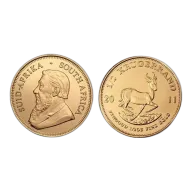
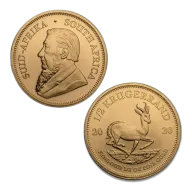
The absence of a face value is unusual among modern bullion coins. The Krugerrand is legal tender in South Africa, but by design its value floats with the gold price rather than being fixed to a denomination; most competitors carry a nominal face value alongside their metal value. The obverse carries Otto Schultz's portrait of Paul Kruger with the inscriptions "SUID-AFRIKA" and "SOUTH AFRICA"; the reverse shows Coert Steynberg's springbok antelope with the Krugerrand name, year of issue, and weight and purity markings. Authentication relies on weight, dimensions, the distinctive alloy colour, and the reeded edge; the coin carries no modern embedded security technology such as micro-engraving or holograms.
Krugerrand Tax Treatment by Country
As 22-karat (91.67%) post-1800 legal tender gold, the Krugerrand qualifies as investment gold in the jurisdictions that use that definition, so the headline purchase-tax treatment is favourable almost everywhere.
- United Kingdom: VAT-exempt as investment gold. However, the Krugerrand is NOT CGT-exempt, a common misconception. CGT exemption applies only to UK legal tender coins such as the Britannia and Sovereign; the Krugerrand is South African legal tender, so gains above the annual allowance are taxable.
- EU: VAT-exempt under the EU Investment Gold Directive.
- United States: no federal sales tax, and most states exempt gold coins (some apply thresholds, such as $1,000 in New York). Krugerrands are IRA-eligible. Long-term gains are taxed at the collectibles rate of up to 28%.
- South Africa: gold Krugerrands have been zero-rated for VAT since 1995, classified as financial instruments.
- Canada: the federal GST/HST exemption requires at least 99.5% purity, which the 91.67% Krugerrand does not meet, so the standard exemption does not apply on purity grounds.
- Australia: the GST-free definition of investment-grade gold also requires 99.5%+ purity; the research on this series notes the Krugerrand is subject to GST in Australia.
For UK buyers specifically, the trade-off is clear: the Krugerrand is cheaper to buy than CGT-exempt UK coins but can cost more on exit if gains are large.
The Coin That Started Modern Bullion
The Krugerrand was introduced on 3 July 1967 by the South African government to promote South African gold. It predates every other modern bullion coin: the Canadian Maple Leaf followed in 1979, the American Gold Eagle in 1986, and the Britannia in 1987, all building on the precedent it set. In 1966 the South African Reserve Bank authorised the division of labour that still defines production today, with Rand Refinery Ltd. manufacturing the blanks and the SA Mint striking them. Rand Refinery itself, established in 1920, is one of the world's largest gold refineries and has processed approximately 60% of all gold ever mined.
By 1980 the Krugerrand accounted for more than 90% of the global gold coin market. The apartheid era then reshaped its fortunes: Western nations imposed import bans through the 1970s and 1980s, making Krugerrand ownership illegal in many countries and pushing trade into a grey market. Most restrictions were lifted in 1991, and the coin remains one of the most widely held gold coins globally, though the Maple Leaf and Eagle have since overtaken it in annual sales volume.
The design has remained essentially unchanged since 1967, one of the most consistent records in modern bullion. The name combines Paul Kruger, president of the South African Republic from 1883 to 1900 and the face on the obverse, with the rand, South Africa's currency, itself named after the Witwatersrand gold reef. A silver Krugerrand joined the range in 2017 to mark the gold coin's 50th anniversary.
1/2 oz Krugerrand vs Maple Leaf, Eagle, and Britannia
Every major sovereign mint produces a 1/2 oz gold coin, so the Krugerrand competes directly with the 1/2 oz American Gold Eagle, the 1/2 oz Maple Leaf, the 1/2 oz Gold Britannia, the Philharmonic, and the Kangaroo at this weight.
Composition is the clearest dividing line. The Krugerrand's 22-karat alloy (91.67% gold) sits below the .9999 purity of the Maple Leaf, Kangaroo, Philharmonic, and Britannia, but the copper content makes the coin more durable and scratch-resistant than soft fine-gold rivals. Its closest peer is the American Gold Eagle, which uses the same 91.67% gold alloy. In every case the fine gold content is identical at half a troy ounce; purity affects handling and appearance, not how much gold you own.
Two other differences matter for buyers. First, face value: the Krugerrand has none, while the 1/2 oz Eagle carries $25 and the 1/2 oz Britannia £50. That matters most in the UK, where legal tender status of UK coins drives CGT exemption; the Britannia is CGT-exempt for UK sellers and the Krugerrand is not. Second, security features: the Krugerrand relies on its alloy colour, weight, and reeded edge for authentication, with none of the modern anti-counterfeiting technology found on some rivals. In its favour, the Krugerrand's historical brand recognition is unmatched, and its decades of production make it among the most familiar coins a dealer can be handed.