4 listings
Filters

 Chards

 Suisse Gold


Prices are fetched automatically and may not reflect current merchant prices. Currency conversions and tax treatment are approximate. Rankings are based solely on price. We are not a dealer and accept no responsibility for transactions with listed merchants. Past performance is not indicative of future results. This site does not provide investment advice. Full disclaimer
About the 1/10 oz Rand Refinery Krugerrand Gold Coin
The 1/10 oz Gold Krugerrand
The 1/10 oz Krugerrand packs the world's first modern bullion coin into its smallest standard size. It contains a tenth of a troy ounce of fine gold inside a 22-karat alloy, the same 91.67% gold and 8.33% copper composition used across the whole Krugerrand range since 1967. The copper gives the coin its distinctive orange-gold colour and makes it noticeably more scratch-resistant than .9999 fine fractional coins, a practical advantage at a size this small, where coins are handled, gifted, and carried more often than locked away.
A note on the name: "Rand Refinery Krugerrand" and "SA Mint Krugerrand" refer to the same coin, not two different products. Rand Refinery produces the gold blanks, the South African Mint strikes them, and Rand Refinery handles packaging and distribution. Some dealers attribute the bullion version to Rand Refinery and the proof version to SA Mint, but the coin itself is identical either way.
Tenth-ounce coins are the gateway size for gold buyers. The low price point suits gifts, first purchases, and stackers who want maximum divisibility. The trade-off is premium: 1/10 oz coins carry the highest relative premiums of any standard bullion weight, because minting costs are nearly the same as for a 1 oz coin but spread over a tenth of the gold. Buyers accumulating ounces should weigh the 1/10 oz Krugerrand against the quarter-ounce gold coins one step up the scale, where premiums ease.
1/10 oz Krugerrand Specifications
| Attribute | Value |
|---|---|
| Fine gold content | 1/10 troy oz (3.1103 g) |
| Total weight | 3.393 g |
| Purity | 22 karat (91.67% gold, 8.33% copper) |
| Face value | None (legal tender in South Africa, value floats with gold) |
| Edge | Reeded |
The total weight exceeds the stated 1/10 oz because the weight designation refers to gold content only; the copper alloy adds extra mass. This is true of every Krugerrand denomination, and it is the first thing to check when verifying one: a genuine 1/10 oz coin weighs 3.393 g, not 3.110 g. All four Krugerrand sizes (1 oz, 1/2 oz, 1/4 oz, 1/10 oz) share the same 22-karat alloy and the same Paul Kruger obverse and springbok reverse.
The absence of a face value is unusual among modern bullion coins. Most competitors carry a nominal denomination; the Krugerrand was designed so its value floats purely with the gold price. It carries no embedded security technology such as micro-engraving or holograms. Authentication relies on weight, dimensions, the distinctive alloy colour, and the reeded edge.
1/10 oz Krugerrand Tax Treatment by Country
As investment gold, the gold Krugerrand is VAT-exempt in the UK and across the EU under the Investment Gold Directive, which covers post-1800 legal tender gold coins of at least 900 fineness. The 22-karat Krugerrand qualifies comfortably.
- UK: No VAT. However, the Krugerrand is NOT exempt from Capital Gains Tax. CGT exemption applies only to UK legal tender coins such as the Britannia and Sovereign; the Krugerrand is South African legal tender. UK buyers wanting CGT-free fractional gold should compare the 1/10 oz gold Britannia.
- US: No federal sales tax; most states exempt bullion. Gold Krugerrands are IRA-eligible. Long-term gains are taxed at the collectibles rate of up to 28%.
- EU: VAT-exempt as investment gold. In Germany, gains are tax-free after a 12-month holding period.
- Canada: The GST/HST exemption requires 99.5%+ purity, which the 91.67% Krugerrand does not meet.
- New Zealand: 22-karat coins fall below the 99.5% GST threshold, so the Krugerrand attracts 15% GST there.
- South Africa: Gold Krugerrands are zero-rated for VAT, a status they have held since 1995.
The Coin That Started Modern Bullion
The Krugerrand was introduced on 3 July 1967 by the South African government to promote South African gold, making it the first modern bullion coin. Every major competitor followed its precedent: the Canadian Maple Leaf in 1979, the American Gold Eagle in 1986, and the Britannia in 1987. By 1980 the Krugerrand accounted for more than 90% of the global gold coin market, and over 50 million ounces have been struck since launch.
The production arrangement dates to 1966, when the South African Reserve Bank authorised a division of labour: Rand Refinery Ltd manufactures the blanks and the South African Mint strikes them. Rand Refinery, established in 1920, is one of the world's largest gold refineries and has processed approximately 60% of all gold ever mined.
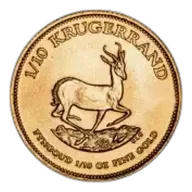
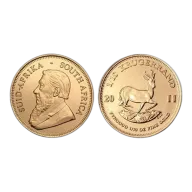
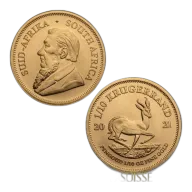
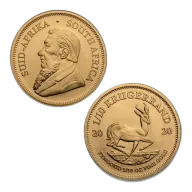
The design has remained essentially unchanged since 1967, one of the most consistent in modern bullion. The obverse carries Otto Schultz's portrait of Paul Kruger, president of the South African Republic from 1883 to 1900, with "SUID-AFRIKA" and "SOUTH AFRICA" inscriptions. The reverse shows Coert Steynberg's walking springbok, South Africa's national animal, adapted from a design first used on the 5-shilling coin. The name itself combines "Kruger" with "Rand", the South African currency named after the Witwatersrand gold reef.
The coin's history has a darker chapter: Western nations banned Krugerrand imports during apartheid in the 1970s and 1980s, creating a grey market. Most restrictions were lifted in 1991, and the coin remains one of the most widely held gold coins globally.
1/10 oz Krugerrand vs Eagle, Britannia, and Maple Leaf
Every major mint produces a tenth-ounce coin, so the Krugerrand competes directly with the 1/10 oz American Gold Eagle, the 1/10 oz Britannia, the 1/10 oz Maple Leaf, the Philharmonic, and the Kangaroo. All contain exactly 1/10 troy oz of fine gold; the differences are alloy, tax status, and regional liquidity.
On composition, the American Gold Eagle is the Krugerrand's closest peer: both are 22-karat at 91.67% gold, alloyed for durability, and both weigh more than their stated gold content. The Maple Leaf, Britannia, Kangaroo, and Philharmonic are all .9999 fine. The purity difference does not change the gold content, but it does change tax outcomes in some countries: in New Zealand, 22-karat coins attract 15% GST while .9999 coins are exempt, and in Canada the GST/HST exemption requires 99.5%+ purity. Buyers in those countries have a concrete reason to prefer a .9999 coin.
For UK buyers the decisive factor is Capital Gains Tax. The 1/10 oz Britannia is CGT-exempt as UK legal tender; the Krugerrand is not. Where the Krugerrand competes well is recognisability and durability: its brand recognition is historically unmatched, all major dealers buy and sell it, and the copper alloy resists the scratches that show readily on pure gold coins this small. At roughly 16.5mm for comparable tenth-ounce coins, these are smaller than a UK 5p piece, so handling wear is a genuine consideration.