 Chards




Prices are fetched automatically and may not reflect current merchant prices. Currency conversions and tax treatment are approximate. Rankings are based solely on price. We are not a dealer and accept no responsibility for transactions with listed merchants. Past performance is not indicative of future results. This site does not provide investment advice. Full disclaimer
About the 1 oz Rand Refinery Krugerrand Gold Coin
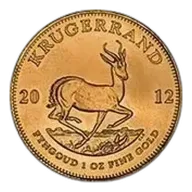
The 1 oz Gold Krugerrand from Rand Refinery
The Krugerrand is the original modern bullion coin, introduced by the South African government on 3 July 1967 to promote South African gold. Every one ounce coin that followed, from the Maple Leaf to the Britannia, copied its formula. Buyers see "Rand Refinery Krugerrand" and "SA Mint Krugerrand" listed as if they were different products. They are the same coin: Rand Refinery produces the gold blanks, the South African Mint strikes them, and Rand Refinery handles final packaging and distribution. This division of labour was authorised by the South African Reserve Bank in 1966, before the first coin was struck.
The practical case for the Krugerrand over its rivals rests on durability and cost. The coin is 22 karat, 91.67% gold alloyed with 8.33% copper, which makes it noticeably more scratch-resistant than .9999 fine competitors like the 1 oz Gold Maple Leaf. It still contains a full troy ounce of fine gold; the copper simply pushes the total coin weight up to 33.93 g. Among 1 oz gold coins, the Krugerrand and Maple Leaf historically carry among the lowest premiums, and with over 50 million ounces struck since 1967 the secondary market is deep. Every dealer recognises it, and government-minted 1 oz coins command the tightest bid-ask spreads of any bullion format.
The trade-offs are specific. The Krugerrand carries no face value, unusual among modern bullion coins, and it is not UK legal tender, so UK sellers pay capital gains tax that gold Britannia owners avoid. In New Zealand its 22 karat purity falls below the 99.5% GST exemption threshold, so it attracts 15% GST there. For buyers in the US, EU, or South Africa, where those issues do not apply, it remains one of the cheapest and most liquid ways to hold a troy ounce of gold.
1 oz Gold Krugerrand Specifications
The 1 oz Krugerrand contains exactly one troy ounce (31.103 g) of fine gold, but the coin itself weighs 33.93 g because the stated weight refers to gold content only. The 8.33% copper alloy adds roughly 2.83 g of extra mass and gives the coin its distinctive orange-gold colour.
| Specification | Detail |
|---|---|
| Fine gold content | 1 troy oz (31.103 g) |
| Total weight | 33.93 g |
| Purity | 22 karat (91.67% gold, 8.33% copper) |
| Diameter | 32.77 mm |
| Thickness | 2.84 mm |
| Edge | Reeded, 160 serrations (bullion); 220 (proof) |
| Face value | None (legal tender in South Africa, valued by metal content) |
The edge serration count is a working authentication marker: bullion strikes carry 160 serrations while proofs carry 220, so the two versions can be told apart without grading equipment. Beyond the reeded edge, the coin has no modern embedded security technology, no micro-engraving, holograms, or DNA markers. Authentication relies on weight, dimensions, the alloy's colour, and edge characteristics, all of which are tightly documented and easy to check.
The series also includes fractional sizes sharing the same 22 karat alloy: 1/2 oz (16.965 g total), 1/4 oz (8.482 g total), and 1/10 oz (3.393 g total). All carry the same Kruger portrait and springbok design as the full ounce.
Gold Krugerrand Tax Treatment by Country
The gold Krugerrand qualifies as investment gold in most jurisdictions, but its 22 karat purity and South African legal tender status create two notable exceptions worth checking before you buy.
- UK: VAT-exempt as investment gold (post-1800 legal tender coins of at least 900 fineness qualify). It is not CGT-exempt: only UK legal tender coins such as the Britannia and Sovereign escape capital gains tax, so UK sellers face CGT at 18% or 24% above the £3,000 annual allowance.
- EU: VAT-exempt under the EU Investment Gold Directive, which covers post-1800 legal tender gold coins of at least 900 fineness sold near their gold value.
- US: IRA-eligible. No federal sales tax; state treatment varies, with around 35 states exempting bullion and several applying thresholds (for example, California exempts purchases over $2,000). Long-term gains are taxed at the collectibles rate of up to 28%.
- South Africa: Gold Krugerrands have been zero-rated for VAT since 1995 under s11(1)(k) of the Value-Added Tax Act. CGT applies on disposal, with 40% of the gain included in an individual's taxable income.
- Canada: The GST/HST exemption requires 99.5%+ purity, which the 91.67% Krugerrand does not meet on a purity basis; the exemption covers coins refined to that standard.
- New Zealand: attracts 15% GST because gold below 99.5% purity is not exempt. NZ buyers wanting GST-free gold need .9999 coins instead.
- Australia: the GST exemption likewise applies to gold of at least 99.5% purity, so the 22 karat Krugerrand falls outside the investment-grade definition.
- Hong Kong: no sales tax, no import duty, and no capital gains tax.
If CGT exemption matters, UK buyers should compare it against the 1 oz gold Britannia before deciding; the Krugerrand's lower premium can be outweighed by tax on a large gain.
From Sanctions-Era Icon to Global Standard
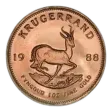
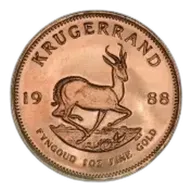
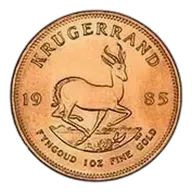
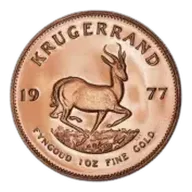
The Krugerrand's name combines "Kruger", for Paul Kruger (1825-1904), president of the South African Republic from 1883 to 1900, and "Rand", the South African currency, itself named after the Witwatersrand gold reef. Otto Schultz designed the obverse portrait of Kruger, flanked by "SUID-AFRIKA" and "SOUTH AFRICA". The reverse springbok, South Africa's national animal in a walking pose, was designed by Coert Steynberg and adapted from a design originally used on the 5-shilling coin. The design has remained essentially unchanged since 1967, making it one of the most consistent coin designs in modern bullion.
Commercially, the coin's history is dramatic. By 1980 the Krugerrand accounted for more than 90% of the global gold coin market. Then Western nations imposed import bans during apartheid in the 1970s and 1980s, and owning Krugerrands became illegal in many Western countries. The bans created a grey market and gave the coin an edgy reputation; most restrictions were lifted in 1991. The sanctions window is also why the Maple Leaf (1979), American Gold Eagle (1986), and Britannia (1987) exist: each was launched to capture demand the Krugerrand could no longer serve.
Despite that interruption, over 50 million ounces have been struck since 1967, and the Krugerrand remains one of the most widely held gold coins globally, though the Maple Leaf and Eagle have overtaken it in annual sales volume. Rand Refinery itself, established in 1920, is one of the world's largest gold refineries and has processed approximately 60% of all gold ever mined. The series marked its 50th anniversary in 2017 by introducing the first silver Krugerrands, a million-coin premium uncirculated issue with an anniversary privy mark.
Krugerrand vs Eagle, Maple Leaf, and Britannia
The Krugerrand's closest peer in composition is the American Gold Eagle: both are 22 karat (91.67% gold) coins containing a full troy ounce of fine gold, with alloy added for durability. The Eagle typically commands a slight premium above the Krugerrand due to US demand, and it holds a unique statutory exemption that makes it IRA-eligible despite falling below the usual 99.5% IRA purity rule. The Krugerrand is also IRA-eligible, so for US retirement accounts the choice between them mostly comes down to premium.
Against the .9999 fine coins, the trade is purity versus toughness. The 1 oz Gold Maple Leaf was the first .9999 gold coin and carries Bullion DNA micro-engraving since 2014; the Britannia (.9999 since 2013) adds picosecond-laser tincture lines and micro-text. The Krugerrand offers none of that modern security technology, relying instead on its distinctive copper-gold colour, documented dimensions, and reeded edge with 160 serrations. What the 22 karat alloy does deliver is scratch resistance: pure gold coins mark easily, while Krugerrands shrug off handling, which matters if coins will be stored loose or traded hand to hand.
Tax draws the sharpest lines. In the UK, the 1 oz gold Britannia is both VAT-exempt and CGT-exempt; the Krugerrand is VAT-exempt only. In New Zealand the Krugerrand and Eagle attract 15% GST while .9999 coins are exempt. In South Africa the position reverses: the Krugerrand is the home coin, zero-rated for VAT since 1995 and culturally dominant. On price alone, the Krugerrand and Maple Leaf historically sit among the lowest-premium 1 oz sovereign coins, so buyers outside the UK and NZ who want maximum gold per pound spent usually shortlist these two first.