3 listings
Filters

 Suisse Gold


Prices are fetched automatically and may not reflect current merchant prices. Currency conversions and tax treatment are approximate. Rankings are based solely on price. We are not a dealer and accept no responsibility for transactions with listed merchants. Past performance is not indicative of future results. This site does not provide investment advice. Full disclaimer
About the 1/4 oz Rand Refinery Krugerrand Gold Coin
The 1/4 oz Krugerrand: Fractional Gold from the Original Bullion Coin
The 1/4 oz Krugerrand delivers 7.776 grams of fine gold in the world's most recognisable bullion coin family. The Krugerrand was the first modern bullion coin, introduced by South Africa in 1967, and by 1980 it accounted for more than 90% of the global gold coin market; over 50 million ounces have been struck since launch. The quarter-ounce fraction shares the full-size coin's 22-karat alloy, in which 8.33% copper hardens the gold and produces the distinctive orange-gold colour, so the coin still contains its full stated quarter ounce of fine gold within a slightly heavier total weight of 8.482 grams.
The case for the quarter-ounce size is accessibility and divisibility. Fractional gold coins around this weight carry premiums of roughly 7-12% over spot, against 3-5% for 1 oz gold coins, but the lower outlay per coin suits regular monthly buying and allows partial liquidation that a single large coin cannot offer. Among quarter-ounce options the Krugerrand benefits from unmatched name recognition: dealers everywhere know it on sight, which supports tight spreads at resale.
A note on the name: "Rand Refinery Krugerrand" and "SA Mint Krugerrand" are the same product, not separate series. Rand Refinery produces the gold blanks, the South African Mint strikes them, and Rand Refinery handles packaging and distribution, a division of labour authorised by the South African Reserve Bank in 1966. Some dealers simply attribute the bullion coins to Rand Refinery.
1/4 oz Gold Krugerrand Specifications
| Specification | Value |
|---|---|
| Fine gold content | 1/4 troy oz (7.776 g) |
| Total weight | 8.482 g |
| Purity | 22 karat (91.67% gold, 8.33% copper) |
| Face value | None (value floats with gold content) |
| Issuer | South Africa (legal tender) |
The coin weighs more than its stated quarter ounce because the weight refers to gold content only; the copper alloy adds the extra mass. That alloy is functional, making the coin more scratch-resistant and durable than 24-karat competitors, a genuine advantage for coins that are handled rather than vaulted. The absence of a denominated face value is unusual among modern bullion coins and deliberate: the Krugerrand's value was designed to float with the gold price rather than be anchored to a denomination.
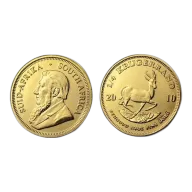
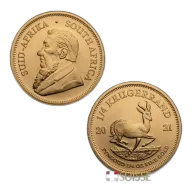
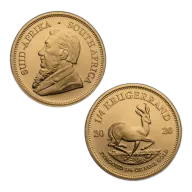
The design matches the 1 oz original: Paul Kruger's portrait by Otto Schultz on the obverse with "SUID-AFRIKA" and "SOUTH AFRICA" inscriptions, and Coert Steynberg's walking springbok on the reverse with the year and weight markings. The Krugerrand carries no modern embedded security technology, so authentication relies on weight, dimensions, the distinctive alloy colour, and edge characteristics. The fractional range also includes 1/2 oz and 1/10 oz sizes, all in the same 22-karat alloy.
Quarter Krugerrand Tax Treatment by Country
As investment gold, the quarter Krugerrand is free of sales tax in most major markets, with one notable exception driven by its 22-karat alloy.
- UK: 0% VAT as investment gold (post-1800 legal tender coins at 900+ fineness qualify). Not CGT-exempt: that relief covers only UK legal tender coins such as the Britannia and Sovereign, and the Krugerrand is South African legal tender. Gains above the £3,000 annual allowance are taxable.
- EU: 0% VAT under the Investment Gold Directive.
- South Africa: Zero-rated for VAT since 1995 under s11(1)(k) of the Value-Added Tax Act; CGT applies on disposal at a 40% inclusion rate for individuals.
- US: No federal sales tax; most states exempt bullion. Long-term gains are taxed at the 28% collectibles rate.
- Canada: The federal GST/HST exemption requires 99.5%+ purity, so the 91.67% Krugerrand falls outside it.
- New Zealand: 22-karat coins fall below the 99.5% gold threshold and attract 15% GST, a meaningful penalty against four-nines alternatives.
- Australia: The GST exemption for investment-grade gold specifies 99.5%+ purity, which the Krugerrand's alloy does not meet.
- Hong Kong: No sales tax and no capital gains tax.
The pattern is clear: in jurisdictions that define investment gold by legal tender status and 900+ fineness (UK, EU) the Krugerrand is tax-free to buy, while in those that set a 99.5% purity floor (Canada, Australia, New Zealand) the 22-karat alloy costs it the exemption. Buyers in the latter group should compare the 1/4 oz Britannia or Maple Leaf before defaulting to the famous name.
From 1967 Innovation to Sanctions and Back
The Krugerrand was introduced on 3 July 1967 by the South African government to promote South African gold, creating the template every modern bullion coin follows: legal tender status, guaranteed gold content, and a price that tracks the metal rather than a denomination. The name fuses Paul Kruger, president of the South African Republic from 1883 to 1900 and the face on the obverse, with the rand, South Africa's currency, itself named after the Witwatersrand gold reef. Rand Refinery, established in 1920 and one of the world's largest gold refineries, has processed approximately 60% of all gold ever mined.
The coin's dominance was extraordinary: by 1980 it held more than 90% of the global gold coin market. Then politics intervened. Western nations imposed import bans on the Krugerrand during the apartheid era of the 1970s and 1980s, making ownership illegal in many countries, creating a grey market, and opening the door for the competitors the Krugerrand had inspired, the Canadian Maple Leaf in 1979 and the American Gold Eagle in 1986 among them. Most restrictions were lifted in 1991.
The design has barely changed since 1967, making it one of the most consistent in modern bullion: Otto Schultz's Kruger portrait and Coert Steynberg's springbok, the latter adapted from a design first used on the 5-shilling coin. The fractional sizes, including this quarter ounce, extended the brand down the price scale, and a silver Krugerrand followed in 2017 for the 50th anniversary. The Maple Leaf and Eagle have since overtaken it in annual sales, but no coin matches the Krugerrand's historical footprint.
Quarter Krugerrand vs Britannia, Eagle, and Sovereign
At the quarter-ounce price point the Krugerrand faces three principal rivals, and the right choice depends heavily on where you pay tax.
The 1/4 oz Gold Britannia is the UK buyer's default: 999.9 fine, CGT-exempt as UK legal tender, and carrying a £25 face value. The Krugerrand offers no CGT shelter in the UK, so British investors expecting meaningful gains usually pay the Britannia's premium. The Britannia's four-nines purity also keeps it GST-free in New Zealand, Australia, and Canada, where the 22-karat Krugerrand is taxed.
The 1/4 oz American Gold Eagle is the Krugerrand's closest relative, the only other major coin sharing the 91.67% gold alloy, with a $10 face value and IRA eligibility in the US. The two compete on regional recognition: the Eagle dominates US resale demand, while the Krugerrand's brand travels further internationally.
The Gold Sovereign is the subtler alternative. It contains 7.32 grams of 22-karat gold, close to but slightly less than a quarter ounce, sits at a similar price point, and is CGT-exempt in the UK. UK buyers around the £700-800 mark often choose between the Sovereign and quarter Britannia; elsewhere, the Krugerrand's combination of durable alloy, deep liquidity, and typically modest premiums keeps it the pragmatic pick where purity thresholds don't penalise it.