3 listings
Filters

 A Coin Shop

Prices are fetched automatically and may not reflect current merchant prices. Currency conversions and tax treatment are approximate. Rankings are based solely on price. We are not a dealer and accept no responsibility for transactions with listed merchants. Past performance is not indicative of future results. This site does not provide investment advice. Full disclaimer
About the 1 oz Gold Kiwi Gold Coin
New Zealand's Heritage Bullion Coin: In Production Since 1944
The 1 oz Gold Kiwi from the New Zealand Mint is one of the oldest continuously produced bullion coin designs in the world. The series dates back to 1944, predating the 1 oz Krugerrand (1967), 1 oz Canadian Maple Leaf (1979), 1 oz American Gold Eagle (1986), and essentially every other modern bullion programme. Struck in .9999 fine gold, the coin features artist Rick Lewis's depiction of the kiwi bird, New Zealand's national symbol, and is issued as Niue legal tender.
The New Zealand Mint is a private company based in Auckland, operating since 1967, and is not a government mint. New Zealand's Reserve Bank does not operate a coin-minting facility; circulation coins are struck overseas by the Royal Canadian Mint and others under contract. The NZ Mint partners with the Government of Niue, a self-governing territory in free association with New Zealand that uses the New Zealand dollar, to provide legal tender status for its bullion products.
The .9999 purity was adopted early in the mint's history, at a time when .900 or .9167 (22 karat) was the standard for gold coins. This puts the Gold Kiwi on parity with the Maple Leaf, Britannia (post-2013), Philharmonic, and Kangaroo for gold content, meeting or exceeding investment gold thresholds in every major jurisdiction.
The coin's market position is regional. It has strong recognition in New Zealand and Australia but lower global liquidity than the major sovereign mint coins. For NZ-based buyers, the Gold Kiwi is the domestic bullion coin, available directly from the NZ Mint and through local dealers. For international buyers, it is an accessible .9999 gold coin from a well-established private mint, though resale will be easier through dealers who specifically stock NZ Mint products than through generalist bullion dealers.
Gold Kiwi Technical Specifications
| Attribute | Value |
|---|---|
| Weight | 1 troy oz (31.1035 g) |
| Purity | .9999 fine gold (24 karat) |
| Diameter | 32 mm |
| Thickness | 2.8 mm |
| Edge | Reeded |
| Face value | Niue legal tender (NZD-denominated) |
| Designer | Rick Lewis |
| Mint | New Zealand Mint (Auckland) |
| Packaging | Serial-numbered tamper-proof Certi Card assay card |
The reverse features the kiwi bird with its head held high, described by the mint as reflecting New Zealand's optimistic and proud spirit. The kiwi is depicted in its characteristic posture: a small, round-bodied, flightless bird with a long beak. The design has remained consistent over time, providing the brand continuity expected of a bullion series. A 2026 proof coin series launched with a refreshed design concept, suggesting periodic updates within the established theme.
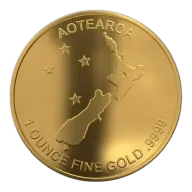
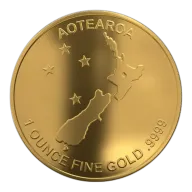
The obverse features the four stars of the Southern Cross constellation and the word "Aotearoa," the traditional Maori name for New Zealand, meaning "land of the long white cloud." The Niue legal tender elements (coat of arms or King Charles III effigy) also appear on this side. The bilingual character of the coin reflects the official English and Te Reo Maori language status in New Zealand.
The Gold Kiwi is available in multiple sizes: 1/4 oz, 1/2 oz, 1 oz, 2 oz, and 5 oz. The 1/4 oz version has been issued since 2022. A silver Kiwi series also exists from the same mint.
Gold Kiwi Tax Treatment by Country
As Niue legal tender struck in .9999 fine gold, the Gold Kiwi qualifies as investment gold in all major markets:
- New Zealand: GST-exempt as fine gold bullion above the .9950 purity threshold. The NZ Mint operates from Auckland as a domestic retailer. New Zealand has no formal capital gains tax, though gains may be taxable as income if the IRD determines the bullion was acquired for the purpose of resale.
- Australia: GST-free as investment-grade gold meeting the .9950 purity criterion. Standard capital gains rules apply, with a 50% CGT discount for assets held longer than 12 months. The Gold Kiwi is a natural complement to the 1 oz Australian Kangaroo for Australasian buyers.
- United Kingdom: VAT-exempt as investment gold (.9999 purity exceeds the 995 threshold). Not CGT-exempt, as Niue is not the UK. UK buyers seeking CGT exemption should consider the 1 oz Britannia or Gold Sovereign.
- United States: No federal sales tax. State-level bullion exemptions vary. IRA eligibility depends on custodian acceptance of Niue legal tender coins at .9999 purity, which meets the IRS .9950 threshold. Not as widely recognised for IRA purposes as the American Eagle or Maple Leaf.
- EU: VAT-exempt as investment gold under Directive 98/80/EC.
- Canada: GST/HST exempt as investment gold at .9999 purity.
- Singapore: GST-exempt as an Investment Precious Metal at .9999 purity.
- Hong Kong: No sales tax, no import duty, no capital gains tax.
New Zealand's lack of a formal capital gains tax gives NZ-resident buyers an advantage not available in most other countries. Gold purchased and later sold at a profit within New Zealand is typically not subject to CGT, provided it was held as a personal investment rather than as trading stock.
Gold Kiwi vs Kangaroo, Maple Leaf, and ABC Southern Cross
The 1 oz Australian Kangaroo is the Gold Kiwi's most direct competitor in the Australasian region. Both are .9999 fine gold from mints in the Pacific. The Kangaroo benefits from the Perth Mint's global distribution network, annual reverse design changes that attract collectors, and far higher production volumes giving it superior liquidity. The Gold Kiwi's advantage is its heritage (production since 1944) and its domestic status in the New Zealand market.
The 1 oz Canadian Maple Leaf is the global benchmark .9999 gold coin, with the widest dealer network, Bullion DNA anti-counterfeiting technology, and the lowest premiums of any major sovereign coin. The Gold Kiwi matches its purity but cannot compete on global liquidity or premium pricing. For buyers outside New Zealand and Australia, the Maple Leaf is the more practical .9999 gold acquisition.
The ABC Southern Cross from ABC Refinery is a newer Australian .9999 gold coin, also issued as Niue legal tender. It targets the same Australasian market and shares the Niue legal tender arrangement. The Gold Kiwi has the heritage advantage (decades of production versus a recent launch), but the ABC product benefits from ABC Refinery's established position in the Australian market.
The Gold Kiwi's strongest appeal is to New Zealand-based buyers who want a domestic bullion coin from their own market, with local dealer availability and GST-exempt status. It also appeals to collectors who value the series' long production history, the Aotearoa and Southern Cross design elements, and the distinction of owning one of the world's oldest continuously produced bullion coin designs. For pure cost efficiency in global markets, the Kangaroo and Maple Leaf remain the dominant choices in the .9999 gold segment.
1 oz Gold Kiwi Gold Coin: frequently asked questions
-
A fineness of 999.9 means the coin is 99.99% pure gold, with only trace amounts of other metals. This is the highest purity commercially practical for bullion coins and is equivalent to 24-karat gold. It meets the investment-grade threshold required for VAT exemption in the UK and EU, and GST exemption in New Zealand and Australia.
-
Yes. Each coin contains exactly 1 oz of 999.9 fine gold, struck by the New Zealand Mint in Auckland. The coins are issued as legal tender of Niue and come in tamper-proof serial-numbered Certicard packaging with an individual assay certificate confirming weight and purity.
-
Common checks include the ping test (genuine gold rings clearly when tapped), a rare-earth magnet (gold is not magnetic), and comparing weight and diameter against the official specification (1 troy oz / 32 mm for the Gold Kiwi). A professional XRF assay gives definitive purity confirmation. Buying from established dealers listed on BullionFerret significantly reduces the risk of encountering fakes.