 SD Bullion
1 listing
Filters
| Product | /oz | Premium | Price | |
|---|---|---|---|---|
| $4,780.11 | +8.44% | $4,780.11 | View Deal |

Prices are fetched automatically and may not reflect current merchant prices. Currency conversions and tax treatment are approximate. Rankings are based solely on price. We are not a dealer and accept no responsibility for transactions with listed merchants. Past performance is not indicative of future results. This site does not provide investment advice. Full disclaimer
About the 1 oz World's Wildlife Gold Coin
The 1 oz World's Wildlife Gold Coin
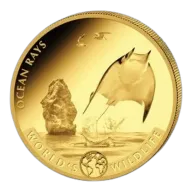
The 1 oz World's Wildlife gold coin is the flagship gold issue of an annual wildlife series issued by the Republic of Congo and struck by Geiger Edelmetalle, the German precious metals firm, in cooperation with the Bavarian Main Mint. The series launched in 2019 with the Giraffe and features a different animal each year, rotating between land, air, and water creatures: Whale (2020), Bald Eagle (2021), Brown Bear (2022), Manta Rays (2023), Peregrine Falcon (2024), Lion (2025), and Shark (2026).
What separates the gold version from mainstream 1 oz coins is scarcity. The 1 oz gold coin is capped at a mintage of just 1,000 pieces per year, a tiny figure against the effectively unlimited striking of an Eagle, Maple Leaf, or Britannia, and modest even next to the series' own 30,000-cap silver coin. Combined with .9999 fine gold and an annually changing design, that positions the coin as a collector-leaning bullion product with built-in set-completion appeal from the land/air/water rotation.
The candid caveat: despite Republic of Congo legal tender status, the coin has no connection to Africa beyond the licensing arrangement. It is designed, struck, and primarily distributed in Germany, where Geiger Edelmetalle's name carries real weight and low-mintage annual series are a popular niche between stacking and collecting.
World's Wildlife Gold Specifications
The coin contains 1 troy ounce (31.1 g) of .9999 fine gold in uncirculated finish.
| Attribute | Detail |
|---|---|
| Weight | 1 troy oz (31.1 g) |
| Purity | .9999 fine gold |
| Finish | Uncirculated |
| Mintage | 1,000 per year |
| Issuer | Republic of Congo (legal tender) |
| Mint | Geiger Edelmetalle with the Bavarian Main Mint |
The common obverse across all years carries the coat of arms of the Republic of Congo, a prominent leopard's head with a spear and an elephant's tusk, alongside the face value and country name. The reverse changes annually, showing that year's animal in a naturalistic habitat setting. The wider gold programme also includes a 0.5g proof coin (mintage 5,000) at the micro-gold end of the market and a 1/10 oz size. No dedicated anti-counterfeiting technology has been documented for the series; authentication rests on Geiger's production quality, the detailed engraving, and the numbered certificate of authenticity supplied with capsule packaging.
Tax Treatment of the World's Wildlife Gold Coin
As a post-1800 legal tender gold coin at .9999 fineness, the World's Wildlife qualifies as investment gold in jurisdictions that use that definition.
- Germany and the EU: VAT-exempt as investment gold across all member states. Germany is the coin's primary market, and German residents holding gold coins for longer than twelve months pay no tax on gains.
- United Kingdom: VAT-exempt as investment gold, but NOT CGT-exempt, since the exemption covers only UK legal tender coins. UK availability is niche; mainstream dealers do not commonly stock the series.
- United States: Most states exempt bullion from sales tax. Long-term gains are taxed at the 28 percent collectibles rate. The .9999 purity qualifies for precious metals IRAs with approved custodians.
- Canada: GST/HST exempt as gold refined to 99.5 percent or higher purity.
- Australia and New Zealand: GST-free as investment-grade gold above the 99.5 percent threshold; the .9999 fineness clears it comfortably, unlike 22ct coins which fail New Zealand's purity test.
- Singapore and Hong Kong: GST-exempt in Singapore for qualifying legal tender gold coins; Hong Kong levies no sales tax, import duty, or capital gains tax.
A German Series Under a Congolese Flag
World's Wildlife began in 2019 when Geiger Edelmetalle, a firm better known for its distinctive security-line silver bars than for coinage, launched its most prominent coin programme under licence from the Republic of Congo. The arrangement is a common one: a small nation lends legal tender authority to a foreign mint in exchange for seigniorage revenue, without operating a mint of its own. Production happens entirely in Germany with the Bavarian Main Mint.
The design programme follows a deliberate structure. Each year features one animal, and the series rotates through land, air, and water categories: Giraffe (2019), Whale (2020), Bald Eagle (2021), Brown Bear (2022), Manta Rays (2023), Peregrine Falcon (2024), Lion (2025), and Shark (2026). The rotation gives collectors a reason to complete three-coin cycles rather than cherry-pick designs.
The series is also notable for its purity standard. Four-nines metal is typically associated with Canadian, Australian, and some Austrian products; World's Wildlife applies it across both the silver and gold issues. Beside the standard bullion coins, the programme produces colourised and gilded silver variants capped at 5,000 pieces, and the deliberately low mintages throughout (30,000 silver, 1,000 for this gold coin) are central to its positioning in the German market, where annual-design series with modest mintages are particularly popular among collectors who stack bullion.
World's Wildlife vs Silverback Gorilla, Somali Elephant, and Mainstream Gold
The most frequent confusion is with the Congo Silverback Gorilla, and the distinction matters: World's Wildlife is issued by the Republic of Congo (Congo-Brazzaville) and struck by Geiger in Germany, while the Silverback Gorilla is issued by the Democratic Republic of Congo and struck by Scottsdale Mint in the US. They are different countries, different mints, and different series. The closer structural rival is the Somali Elephant, another African-licensed annual wildlife series struck by the Bavarian Mint, matching the .9999 purity and a 30,000 silver mintage cap. The Perth Mint Kookaburra shows what the opposite end looks like: an annual-design sovereign series with a 500,000 mintage and the liquidity to match.
Against mainstream 1 oz gold coins, the calculus is scarcity versus liquidity. An 1oz gold Britannia, Maple Leaf, or Philharmonic can be sold to any dealer on earth at a tight spread; a 1,000-mintage Congo coin needs a buyer who knows what it is, which in practice means the German collector market where the series is strongest. The reward for that risk is the collector dynamic: annual designs with hard caps can hold or grow premiums in a way unlimited bullion never does. Buyers should be clear which game they are playing before choosing this coin over the liquid giants.
1 oz World's Wildlife Gold Coin: frequently asked questions
-
The lowest price tracked on this page is $4,780.11, currently offered by SD Bullion. That sits around 8.4% over the gold spot price. With a mintage of 1,000 coins per year, the gold version is a low-mintage release within the bullion market.
-
World's Wildlife is an annual bullion coin series struck by Geiger Edelmetalle (a German precious metals firm) in cooperation with the Bavarian Main Mint, issued as legal tender of the Republic of Congo. Each year features a different animal, rotating between land, air, and water creatures. The 1oz gold coin contains .9999 fine gold and carries a mintage of 1,000 pieces per year, making it a low-mintage series within the bullion market. The series launched in 2019.
-
Store gold coins in individual capsules or flips to prevent contact marks, then keep them in an airtight container away from humidity and direct light. Avoid handling the faces directly; hold coins by the edge. For larger holdings, a home safe or allocated storage at a professional vault provides security and, in some cases, insurance coverage. Never clean gold coins, as abrasion reduces their condition and resale value.