5 products · 164 deals Prices & premiums exclude tax to compare across countries
Filters






Prices are fetched automatically and may not reflect current merchant prices. Currency conversions and tax treatment are approximate. Rankings are based solely on price. We are not a dealer and accept no responsibility for transactions with listed merchants. Past performance is not indicative of future results. This site does not provide investment advice. Full disclaimer
About the Maple Leaf Silver
Four-Nines Silver with Coin-Level Authentication
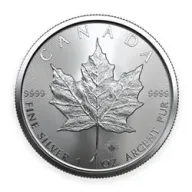
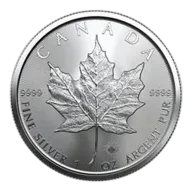
The Silver Maple Leaf from the Royal Canadian Mint is the purest standard silver bullion coin in production at .9999 fine, exceeding the .999 purity used by the American Silver Eagle, the Silver Britannia, and most other sovereign silver coins. The RCM has maintained this four-nines standard since the Silver Maple Leaf's introduction in 1988, and it remains a meaningful differentiator for buyers who prioritise purity.
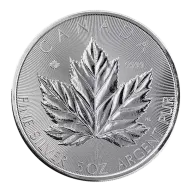
The coin's security features are the most sophisticated in the silver bullion market. From 2015 onwards, every Silver Maple Leaf carries a micro-engraved laser mark with the last two digits of the production year, radial lines across both faces that create a light-diffracting pattern unique to each die, and enrollment in the Bullion DNA digital authentication system. Bullion DNA allows dealers to photograph the coin's mark and match it against the Royal Canadian Mint's encrypted database, providing individual coin-level verification. No other sovereign mint offers this degree of authentication on a standard bullion product. From 2018, the MintShield surface coating was added to combat milk spots, the white calcium deposits that had plagued silver coins industry-wide.
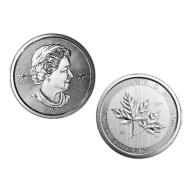
The 1 oz Silver Maple Leaf is the core product, with a C$5 face value and legal tender status in Canada. Peak production reached 28,222,061 coins in 2013, placing it among the highest-volume silver coins in the world. Additional sizes include 10 oz and the 1.5 oz companion piece. The range is smaller than some competing series but the 1 oz coin is the volume product that accounts for the vast majority of sales.
The Silver Maple Leaf's premiums sit between the lower-cost Austrian Philharmonic and the higher-premium American Silver Eagle, typically running 15-20% over spot in normal markets. This positions it as a mid-range sovereign coin: cheaper than the Eagle, more expensive than the cheapest European alternatives, and carrying security and purity credentials that justify the middle ground.
Silver Maple Leaf Denominations and Dimensions
| Size | Weight (g) | Diameter (mm) | Thickness (mm) | Face Value (CAD) | Purity |
|---|---|---|---|---|---|
| 1 oz | 31.39 | 38.0 | 3.15 | $5 | .9999 |
| 1.5 oz | 46.65 | -- | -- | $8 | .9999 |
| 10 oz | 311.03 | 76.25 | 4.50 | $50 | .9999 |
All coins have a reeded edge. The iconic sugar maple leaf reverse design has remained essentially unchanged since the series began in 1988, with minor refinements over the decades. The background field was plain until 2015 when radial lines were added as part of the security feature suite.
Obverse Portraits
- 1988-1989: Queen Elizabeth II, Arnold Machin portrait
- 1990-2003: Queen Elizabeth II, Dora de Pedery-Hunt portrait
- 2004-2023: Queen Elizabeth II, Susanna Blunt portrait
- 2024 onwards: King Charles III, Steven Rosati portrait
Security Features
- Micro-engraved laser mark (2015+): Textured maple leaf privy mark with last two digits of the production year, visible only under magnification
- Radial lines (2015+): Precisely machined lines across both faces creating a light-diffracting pattern
- Bullion DNA (2015+): Encrypted image of each die's micro-engraved mark stored in a secure database, verifiable by dealers through a dedicated reader device
- MintShield (2018+): Proprietary surface coating that reduces formation of milk spots on silver coins
Silver Maple Leaf Tax Treatment by Country
United Kingdom: Gold Maple Leafs are VAT-exempt as investment-grade gold. Silver Maple Leafs carry 20% VAT on purchase. On disposal, the Maple Leaf is not CGT-exempt because it is not UK legal tender. Only UK legal tender coins (Silver Britannias, Sovereigns) qualify for CGT exemption. This is the key tax disadvantage of the Silver Maple Leaf for UK investors: it combines 20% VAT on purchase with CGT liability on sale, making it less tax-efficient than Silver Britannias despite its superior purity and security features.
United States: All Silver Maple Leafs are IRA-eligible. The .9999 purity exceeds the IRS .999 minimum for silver in a self-directed IRA. Must be held by an IRS-approved custodian. Capital gains on silver are taxed at the collectibles rate of up to 28%. Sales tax varies by state, with approximately 35 states exempting bullion. Silver Maple Leafs are among the most commonly held coins in precious metals IRAs, alongside American Silver Eagles.
Canada: Silver bullion at .995+ purity is exempt from GST/HST. The Silver Maple Leaf at .9999 comfortably qualifies. Capital gains are taxed at a 50% inclusion rate (50% of the gain is added to taxable income). Physical bullion cannot be held in RRSPs or TFSAs. Only mining stocks and precious metals ETFs qualify for registered Canadian retirement accounts. This limitation surprises many Canadian investors who assume Maple Leafs are RRSP-eligible.
Australia: Silver at 99.9% purity qualifies as investment-grade and is GST-free. The .9999 Maple Leaf exceeds this threshold. CGT applies with a 50% discount for holdings over 12 months.
European Union: Silver Maple Leafs are subject to the standard VAT rate in each EU country. Germany and the Netherlands offer margin scheme taxation on pre-owned silver coins. The gold version is VAT-exempt across the EU under the investment gold directive.
New Zealand: Silver at 99.9% purity is GST-exempt. No formal capital gains tax, though IRD may tax gains as income if acquired for resale.
Singapore: Investment Precious Metal silver at 99.9% purity in qualifying coin form is GST-exempt. No capital gains tax.
Hong Kong: No sales tax, import duty, or capital gains tax on silver.
From Apartheid Sanctions to Five-Nines Purity
The Gold Maple Leaf was introduced in 1979 as a direct response to apartheid-era sanctions against South Africa, which had restricted the availability of the Krugerrand in Western markets. The gold coin effectively filled a global vacuum for sovereign bullion coins, and the Royal Canadian Mint's decision to strike at .999 purity (upgraded to .9999 in November 1982) set a standard that would eventually push competitors to raise their own purities.
The Silver Maple Leaf followed in 1988, at .9999 fine from the outset. Peak production came in 2013 with over 28 million coins struck. The RCM stopped publishing detailed annual mintage figures for the gold version after 2013, a decision that reduced transparency but had no practical effect on the coin's market standing.
Two persistent quality issues drove major innovations in the 2010s. Milk spots, white calcium deposits that form on silver coin surfaces over time, had been a recurring complaint across the industry but affected Maple Leafs conspicuously because of their high-polish finish. The MintShield surface coating introduced in 2018 was the first dedicated solution by any mint, using a proprietary treatment that significantly reduces spot formation without altering purity or composition. The second issue was counterfeiting, which the Bullion DNA system addressed from 2014 (gold) and 2015 (silver). Developed in partnership with Signoptic, the system captures and encrypts high-resolution images of each die's micro-engraved mark, enabling dealer-level authentication through a dedicated reader. This remains the most sophisticated anti-counterfeiting technology on any standard bullion coin.
Notable special editions include the 2007 "Big Maple Leaf," a 100 kg coin of .99999 purity (five nines) measuring 50 cm in diameter. Only six were produced. One was stolen from Berlin's Bode Museum in 2017 in a case that drew international attention. The five-nines purity achieved for special editions is the highest ever struck by a government mint. The 2018 30th anniversary Silver Maple Leaf featured an incuse (recessed) design, the first double-incuse version, showing the design pressed into the surface rather than raised above it.
Silver Maple Leaf vs Eagle, Britannia, and Philharmonic
The American Silver Eagle is the Silver Maple Leaf's most direct competitor by volume. The Eagle is .999 fine (lower purity) and carries the highest premiums of any sovereign silver coin, typically 20-30% over spot compared to the Maple Leaf's 15-20%. This premium gap exists because the US Mint's pricing to authorised purchasers sets a high floor, and domestic American demand keeps Eagles consistently expensive. The Maple Leaf offers more silver per dollar spent and higher purity, with more advanced security features. The Eagle's advantage is pure liquidity: it is the most widely traded silver coin in the world, with recognition in every market. US buyers face a choice between patriotic familiarity and better technical specifications.
The Silver Britannia at .999 purity competes on a different axis in the UK market. The Britannia's CGT exemption as UK legal tender is a structural advantage that no foreign coin can match. UK buyers who expect to sell at a gain should consider this tax difference before choosing the Maple Leaf. The Britannia's 2021+ security features (latent image, surface animation, micro-text, tincture lines) are visually impressive but take a different approach than the Maple Leaf's digital authentication. The Britannia's features are verified by eye; the Maple Leaf's features are verified against a database. Both approaches are effective, but the Maple Leaf's Bullion DNA provides a definitive machine-readable result.
The Austrian Silver Philharmonic consistently offers the lowest premiums among major sovereign silver coins, making it the natural choice for buyers maximising ounces per dollar. The Philharmonic is .999 fine with a fixed design and EUR 1.50 face value. It lacks any advanced security features and has a static design with no annual variation. Against the Maple Leaf, the Philharmonic trades the entire security and purity package for a lower purchase price. For cost-conscious buyers outside the UK (where Britannia CGT exemption dominates) and outside the US (where Eagle liquidity dominates), the choice between Maple Leaf and Philharmonic often comes down to whether the security features and .9999 purity justify the premium difference.
The Perth Mint Silver Kangaroo matches the Maple Leaf's .9999 purity and adds annual design changes. The Kangaroo was introduced in 2016 and produced over 10 million coins in its debut year, establishing immediate market presence. Perth Mint's micro-laser engraved security feature is less sophisticated than Bullion DNA. The Kangaroo has stronger recognition in Asia-Pacific markets; the Maple Leaf dominates North America and Europe. Both are strong choices for buyers seeking high-purity sovereign silver.
Maple Leaf Silver: frequently asked questions
-
A Maple Leaf coin's value is anchored to the live spot price of its metal: $67.63 per troy ounce is the floor for a 1 oz coin. Dealers add a premium above spot that varies by metal and supplier. We track 164 listings from 54 dealers across gold, silver, and platinum, so the comparison table on each metal page shows current offers side by side.
-
Gold and silver Maple Leafs are both .9999 fine (four nines), making them among the purest standard bullion coins struck anywhere. Gold reached this standard from late 1982, and the silver coin matched it when it launched in 1988. The platinum Maple Leaf is .9995 fine. All three metals meet the IRS purity requirements for IRA-eligible bullion.
-
The Royal Canadian Mint uses several layers of security. Coins dated 2014 (gold) and 2015 (silver) onward carry a micro-engraved maple leaf privy mark with the year, visible under magnification, alongside precisely machined radial lines across both faces that diffract light in a way counterfeits cannot match. The Bullion DNA programme, developed with Signoptic, lets authorised dealers verify each coin individually against the RCM's encrypted database using a dedicated reader.
-
Silver Maple Leafs have been prone to milk spots: white calcium deposits that form on the coin surface over time. They are cosmetic and do not affect silver content, but they reduce resale appeal. Early production runs were particularly susceptible. The RCM introduced MintShield in 2018, an invisible surface treatment applied during minting that significantly reduces spot formation on coins dated from that year onward. Proper airtight storage also helps slow toning.
-
The Maple Leaf is the Royal Canadian Mint's flagship bullion programme. Gold launched in 1979, with silver and platinum both added in 1988. Each coin is Canadian legal tender and struck at .9999 fine (gold and silver) or .9995 fine (platinum). We currently track 164 Maple Leaf listings across 54 dealers, covering multiple weights and metals. The series is widely traded internationally and is IRA-eligible in the United States.