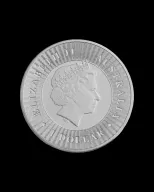
3 products · 65 deals Prices & premiums exclude tax to compare across countries

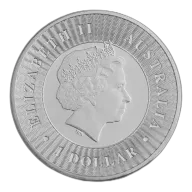

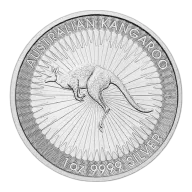

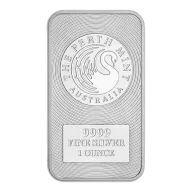
Prices are fetched automatically and may not reflect current merchant prices. Currency conversions and tax treatment are approximate. Rankings are based solely on price. We are not a dealer and accept no responsibility for transactions with listed merchants. Past performance is not indicative of future results. This site does not provide investment advice. Full disclaimer
About the Perth Kangaroo Silver
Perth Mint's High-Volume Silver Entry
The Silver Kangaroo is the Perth Mint's newest silver bullion coin, introduced in 2016 as a mass-market complement to the collectible-oriented Kookaburra and Koala series. The debut was commercially significant: 11,245,615 coins were produced in the first year, a record for a contemporary Australian precious metal coin, signalling Perth's intention to compete directly with the high-volume Silver Maple Leaf and American Silver Eagle.
The Silver Kangaroo is struck at .9999 fine, matching the Maple Leaf's purity and exceeding the .999 standard used by the Silver Britannia and most other sovereign silver coins. It carries a face value of A$1 and is Australian legal tender. Like the gold Kangaroo (which launched in 1986 as the "Australian Gold Nugget"), the silver version features an annually changing reverse design depicting a kangaroo in various poses against stylised Australian landscapes. This annual design change adds mild numismatic interest, though the unlimited mintage means no single year is likely to become scarce.
The 1 oz Silver Kangaroo is the primary product. The Perth Mint also produces Kangaroo-branded silver minted bars featuring the Perth Mint's swan logo and kangaroo motifs. A micro-laser engraved letter on the reverse, detectable only under magnification, provides a security feature introduced with the 2016 debut.
The Kangaroo's unlimited mintage and high initial production volume place it in the same competitive tier as the Maple Leaf and Philharmonic: accessible, liquid, and priced with moderate premiums over spot. It is not designed to compete with the lower-mintage Kookaburra or Koala on collectibility. For Australian buyers, it is the most accessible locally minted silver bullion coin. For international buyers, it offers four-nines purity, annual design variety, and government-backed quality from a mint with strong recognition in both Western and Asian markets.
Silver Kangaroo Specifications
| Size | Weight (g) | Diameter (mm) | Thickness (mm) | Face Value (AUD) | Purity |
|---|---|---|---|---|---|
| 1 oz | 31.10 | 40.60 | 4.00 | $1 | .9999 |
The silver bullion version is produced in 1 oz only (unlimited mintage). A high-relief proof version is produced annually in limited quantities (20,000 per year). The coin has a reeded edge.
Gold Kangaroo (.9999 Au)
| Size | Diameter (mm) | Thickness (mm) | Face Value (AUD) |
|---|---|---|---|
| 1/20 oz | 14.10 | 1.40 | $5 |
| 1/10 oz | 16.10 | 1.50 | $15 |
| 1/4 oz | 20.10 | 2.00 | $25 |
| 1/2 oz | 25.10 | 2.40 | $50 |
| 1 oz | 32.10 | 2.65 | $100 |
Gold Kangaroos have been in production since 1986 with unlimited mintage. Larger sizes (2 oz, 10 oz, 1 kg) were introduced in 1991.
Security Features
- Micro-laser engraved letter: A small letter engraved on the reverse, detectable only under magnification. Applied to all gold, silver, and platinum Kangaroo bullion coins from 2016.
- "P" mintmark: Perth Mint identification on all coins.
- Tamper-evident packaging (silver): Tubes of 25 coins sealed with a tamper-evident security seal.
The Perth Mint does not offer a coin-level digital authentication system comparable to the Royal Canadian Mint's Bullion DNA. Authentication relies on the micro-engraving, mintmark, and physical verification of weight and dimensions.
Silver Kangaroo Tax Treatment
Australia: The Silver Kangaroo is Australian legal tender and qualifies as investment-grade precious metal. Silver at 99.9% purity sold for no more than 110% of its precious metal value is GST-free under the A New Tax System (Goods and Services Tax) Act 1999. The .9999 Kangaroo comfortably meets this standard. Capital gains tax applies on disposal, with a 50% CGT discount for individuals who hold the asset for more than 12 months.
United States: The .9999 silver purity exceeds the IRS .999 minimum for precious metals IRAs. The gold, silver, and platinum versions all meet their respective IRA purity thresholds. Capital gains are taxed at the collectibles rate of up to 28%. Sales tax varies by state.
United Kingdom: Silver Kangaroos carry 20% VAT on import and purchase. No VAT exemption applies to silver bullion in the UK. On disposal, CGT applies at the individual's rate. The Kangaroo is not UK legal tender and does not qualify for the CGT exemption available to Silver Britannias.
Canada: Silver at .999+ purity is exempt from GST/HST. Capital gains follow the 50% inclusion rate. Not RRSP/TFSA eligible.
European Union: Silver coins attract the standard VAT rate (17-27% depending on country). Margin scheme taxation may apply on secondary-market coins in Germany and the Netherlands.
New Zealand: Silver at 99.9% purity is GST-exempt. No formal capital gains tax. The Perth Mint is the nearest major sovereign mint for New Zealand buyers, and the Kangaroo's availability through Australian dealers makes it particularly accessible.
Singapore: Investment Precious Metal silver at 99.9% purity qualifying as legal tender is GST-exempt. No capital gains tax. Perth Mint products have strong recognition in Asian markets due to geographic proximity.
Hong Kong: No sales tax, import duty, or capital gains tax.
From Gold Nuggets to Silver Kangaroos
The Kangaroo series began in 1986 under the name "Australian Gold Nugget," with reverse designs featuring famous Australian gold nuggets including the Welcome Stranger and Hand of Faith. In 1989, the proof edition transitioned to kangaroo motifs, and the series gradually became known as the "Australian Kangaroo" as the kangaroo proved to be a more internationally recognisable Australian symbol than gold nuggets.
The gold series established the pattern of annual design changes that carries through to the silver version. The reverse typically shows a bounding or resting red kangaroo against stylised sunlight and landscape elements. The obverse has carried four monarch portraits: Raphael Maklouf's Elizabeth II (1986-1998), Ian Rank-Broadley's Elizabeth II (1999-2018), Jody Clark's Elizabeth II (2019-2023), and Dan Thorne's King Charles III (2024 onwards).
The silver bullion Kangaroo arrived comparatively late. Canada introduced its Silver Maple Leaf in 1988, the US Mint launched the Silver Eagle in 1986, and even the Perth Mint's own Silver Kookaburra series had been running since 1990. The 2016 silver Kangaroo debut was an immediate commercial success, with over 10 million coins sold in the first year. The high-volume launch signalled the Perth Mint's commitment to competing in the mass-market silver bullion segment rather than relying solely on the mintage-capped Kookaburra and Koala series.
The 2011 gold series produced a one-tonne gold coin: 80 cm in diameter, 12 cm thick, containing 1,012 kg of .9999 gold. It carries legal tender status at a face value of A$1,000,000, though its gold value has always been vastly higher. It remains on permanent display at the Perth Mint in Perth, Western Australia, and holds the record for the largest gold coin in the world, surpassing the Royal Canadian Mint's 100 kg Big Maple Leaf.
The 2026 edition marks the 40th anniversary of the series, with gold coins carrying a special nugget privy mark that pays homage to the original Gold Nugget origins.
Silver Kangaroo vs Maple Leaf, Kookaburra, and Britannia
The Silver Maple Leaf is the most direct competitor. Both coins are .9999 fine silver with legal tender status and unlimited mintage. The Maple Leaf has been in production since 1988 (vs 2016 for the Silver Kangaroo) and has deeper global liquidity, wider dealer availability, and significantly more advanced security features. The Bullion DNA system provides individual coin-level digital authentication that the Kangaroo's micro-laser engraving does not match. The Maple Leaf also has MintShield anti-tarnish coating (from 2018). The Kangaroo's advantages are its annual design changes (the Maple Leaf has a fixed design) and its stronger presence in Asia-Pacific markets through Perth Mint's established distribution network.
Against the Perth Mint Kookaburra, the distinction is between Perth's two market segments. The Kookaburra has a 500,000-coin annual mintage cap (since 2013), annual design changes, and a 30-year heritage that drives collector premiums on low-mintage vintage years. The Kangaroo's unlimited mintage and newer history mean it lacks the collectibility premium that early Kookaburra years command. The Kookaburra is aimed at buyers who want design variety with scarcity-driven appreciation potential; the Kangaroo is aimed at buyers who want the maximum amount of Perth Mint .9999 silver at the lowest available premium.
The Silver Britannia at .999 purity competes primarily on the basis of tax treatment for UK buyers. The Britannia's CGT exemption as UK legal tender is a decisive advantage for UK investors concerned about capital gains on disposal. The Kangaroo's higher purity (.9999 vs .999) is a technical advantage, but the practical difference is marginal. The Britannia's 2021+ security features are more visually elaborate than the Kangaroo's micro-engraving. For UK buyers, the tax advantage dominates; for buyers in Australia, New Zealand, and Asia-Pacific, the locally minted Kangaroo is the more accessible and practical choice.
The Austrian Silver Philharmonic offers consistently lower premiums than the Kangaroo but at .999 purity (not .9999) with no annual design variation and no security features beyond the standard strike quality. For cost-focused buyers who do not require four-nines purity or annual design variety, the Philharmonic remains the cheapest major sovereign silver coin.
Perth Kangaroo Silver: frequently asked questions
-
Kangaroo coin prices track the live $67.63 spot price for the metal you choose, with a fabrication premium on top. 30 dealers list 65 Kangaroo products across gold, silver, and platinum. Use the comparison table to see current prices by weight and dealer, as premiums vary. Larger sizes (1 oz and above) typically carry lower per-ounce premiums than fractional coins.
-
The Perth Kangaroo is a bullion coin series produced by the Perth Mint, a government-owned refinery established in 1899 and LBMA-accredited. The coins are Australian legal tender. The series launched in 1986 as the 'Australian Gold Nugget' and was redesigned with kangaroo motifs from 1989. Like the Chinese Panda, the reverse design changes annually. Gold and silver coins are .9999 fine; platinum is .9995 fine.
-
Gold Kangaroos are available from 1/20 oz to 1 kg, with the most common sizes being 1/10 oz, 1/4 oz, 1/2 oz, and 1 oz. The silver Kangaroo is produced in 1 oz (.9999 fine), introduced in 2016. The platinum Kangaroo is currently offered in 1 oz (.9995 fine). In total, 65 products across all three metals are tracked on this page.
-
Tax treatment depends on your country. In the UK, Australian legal-tender coins do not qualify for the CGT exemption that applies to UK legal-tender coins; gains are taxed at 18% or 24% above the £3,000 annual allowance. In Australia, CGT applies on disposal, though individuals holding for more than 12 months qualify for a 50% discount. US investors face collectibles CGT of up to 28% on long-term gains. In Canada, 50% of any gain is included in taxable income.
-
Yes, in general. Coins carry fabrication costs from minting individual pieces, legal-tender production standards, and the design refresh each year. Cast bars are produced at lower per-unit cost and typically trade closer to spot. The Kangaroo's annual design change also creates mild collector demand that can widen the gap versus bars. If minimising premium is the priority, large minted or cast bars are usually cheaper per ounce.