 SD Bullion
1 listing
Filters
| Product | /oz | Premium | Price | |
|---|---|---|---|---|
| $90.48 | +33.79% | $2,908.99 | View Deal |

Prices are fetched automatically and may not reflect current merchant prices. Currency conversions and tax treatment are approximate. Rankings are based solely on price. We are not a dealer and accept no responsibility for transactions with listed merchants. Past performance is not indicative of future results. This site does not provide investment advice. Full disclaimer
About the 1 Kilo Aztec Calendar Silver Coin
The 1 Kilo Aztec Calendar Silver Coin
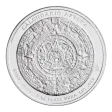
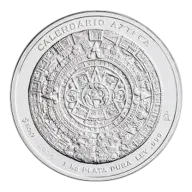
The 1 Kilo Aztec Calendar silver coin is a large-format piece from Golden State Mint (GSM) featuring their popular reproduction of the Aztec Sun Stone on one side and a portrait of Cuauhtemoc, the last Aztec emperor, on the reverse. At 1,000 grams of .999 fine silver, it is the heaviest coin-format product in the Aztec Calendar range, which spans from 1/10 oz through to this kilo denomination.
Golden State Mint has produced the Aztec Calendar design since the company's early decades, making it one of the longest-running private mint designs in the US market. The kilo version scales up the intricate calendar imagery to a diameter that reveals details lost at smaller sizes: the twenty day-sign glyphs, the directional arrows, and the central face of Tonatiuh (the solar deity) are all clearly legible. Unlike annual series from sovereign mints, the Aztec Calendar carries no date and no mintage cap, meaning pieces from any production year are interchangeable.
The key distinction for potential buyers is that this is a silver round, not a coin in the legal sense. It carries no face value and no sovereign backing, which affects both its tax treatment in some jurisdictions and its liquidity profile compared to legal tender kilo coins. The tradeoff is price: private mint rounds at kilo weight typically carry lower premiums than sovereign kilo coins, making them attractive for buyers focused purely on silver content per dollar spent.
Aztec Calendar 1 Kilo Specifications
| Attribute | Value |
|---|---|
| Weight | 1 kilogram (32.15 troy oz) |
| Purity | .999 fine silver |
| Manufacturer | Golden State Mint (GSM) |
| Legal tender status | None (private mint round) |
| Mintage | Unlimited (continuously produced) |
| Edge | Reeded |
| Obverse | Aztec Sun Stone (Piedra del Sol) reproduction |
| Reverse | Portrait of Cuauhtemoc in feathered headdress |
The design reproduces the 25-ton basalt Sun Stone currently displayed at the National Museum of Anthropology in Mexico City. The original artifact was carved during the late Postclassic period (c. 1502-1521) and rediscovered in December 1790 beneath Mexico City's central plaza. Despite being commonly called a calendar, modern scholarship interprets it as a solar disk symbolising rulership rather than a timekeeping device.
Golden State Mint, founded in 1974 by Jim Pavlakos, operates from facilities in Southern California and Central Florida. The company is one of the oldest continuously operating private mints in the United States. Special anniversary editions (such as the 10th Anniversary Antiqued version from 2017) have appeared as limited variations on the standard design.
Tax Considerations for the Aztec Calendar Round
As a privately minted silver round without legal tender status, the Aztec Calendar's tax treatment differs from sovereign coins in several jurisdictions.
- United States: The .999 purity meets the IRS fineness requirement for precious metals IRA accounts. Golden State Mint states the product is "IRA Approved," though specific custodian acceptance should be confirmed. Capital gains are taxed at the 28% collectibles rate. No 1099-B reporting exemption applies (unlike certain sovereign coins). Sales tax varies by state; approximately 35 states exempt bullion regardless of form.
- United Kingdom: Subject to 20% VAT on purchase. Not legal tender, so no CGT exemption. The margin scheme may apply to secondary market purchases. Rounds are treated identically to bars for tax purposes.
- Canada: GST/HST exemption requires the item to be in "bar, ingot, coin or wafer form" at 99.9%+ purity. Silver rounds meeting this description may qualify, though the exemption is more clearly established for legal tender coins.
- Australia: GST-free if classified as investment-grade precious metal (99.9% purity in a form commonly traded on commodity markets). Rounds from recognised producers generally qualify.
- European Union: Subject to local VAT rates. No investment gold exemption applies. The German margin scheme may apply to secondary market pieces.
- Singapore: IPM exemption requires the silver to be in "bar, ingot, or wafer form" or a qualifying coin on the MAS list. Rounds may not qualify under the coin category if they lack legal tender status.
Aztec Calendar 1 Kilo vs Alternative Kilo Silver
The kilo Aztec Calendar competes in two markets simultaneously: the private mint round market (where price per ounce is the primary differentiator) and the collectible design market (where aesthetic and cultural appeal drive demand).
Against other private mint kilo rounds, the Aztec Calendar's premium is typically in line with or slightly above generic rounds, reflecting the design's popularity. Buyers can find plain kilo rounds or bars from major refiners at lower per-ounce costs, but the Aztec Calendar offers an artistically interesting piece for a modest premium increment. The continuous production (no mintage limits, no year dates) means the design itself does not accumulate scarcity value over time.
Against sovereign kilo coins like the 1 Kilo African Wildlife Leopard or Perth Mint's Lunar series kilo coins, the Aztec Calendar trades at substantially lower premiums. The tradeoff is legal tender status, sovereign mint backing, limited mintages, and potentially better international liquidity. For buyers focused on maximising silver content per dollar, the private mint round wins. For buyers who want a coin that holds its premium on resale and benefits from scarcity-driven appreciation, sovereign options are stronger.
The Mexican Libertad offers a thematic comparison: both feature Mexican/Mesoamerican cultural imagery, but the Libertad is a sovereign coin from Casa de Moneda de Mexico with legal tender status, lower mintages, and substantially higher premiums. The Aztec Calendar round provides similar cultural aesthetics at a fraction of the Libertad's per-ounce premium.
1 Kilo Aztec Calendar Silver Coin: frequently asked questions
-
The cheapest 1kg Aztec Calendar silver round we track is $2,908.99 from SD Bullion, sitting around 33.8% over the $67.63 silver spot price. As a privately minted .999 silver piece, it typically trades closer to spot than sovereign bullion coins.
-
The obverse reproduces the Aztec Sun Stone (Piedra del Sol), a massive carved basalt disk created in the late 15th century and now housed at the National Museum of Anthropology in Mexico City. Its central figure is Tonatiuh, the solar deity, surrounded by 20 day-sign glyphs. The reverse portrays Cuauhtemoc, the last Aztec ruler, in a feathered headdress.
-
Golden State Mint, a private US mint founded in 1974, produces the Aztec Calendar series. It is not a coin in the legal sense: there is no face value and no sovereign backing. The series runs from 1/10 oz to 10 oz in silver, plus copper versions.
-
Tax treatment depends on where you buy. In the UK, silver rounds from private mints attract 20% VAT. In Canada, silver bullion is subject to GST/HST. US buyers face state-level sales tax rules rather than a federal rate. On gains, US investors may pay up to 28% as the IRS treats silver rounds as collectibles.