 Bullion Standard



Prices are fetched automatically and may not reflect current merchant prices. Currency conversions and tax treatment are approximate. Rankings are based solely on price. We are not a dealer and accept no responsibility for transactions with listed merchants. Past performance is not indicative of future results. This site does not provide investment advice. Full disclaimer
About the 100 oz Engelhard Bar Silver Bar
The Engelhard 100 oz Silver Bar: A Discontinued Classic
The Engelhard 100 oz silver bar is a .999 fine silver product from one of the most recognised names in American precious metals history. Charles W. Engelhard Sr. founded the company in 1902 in Newark, New Jersey. By the 1950s, Engelhard was the world's largest precious metals smelter, refining gold for the US Treasury and producing retail bullion bars that became staples of the North American silver market.
Engelhard exited the retail bullion market in the late 1980s, shifting focus to industrial catalysts and materials. BASF acquired the company in 2006 for $5 billion, renaming it BASF Catalysts LLC. No new Engelhard bars have been produced since the mid-1980s, which is precisely what drives the collector premium attached to surviving bars. An Engelhard 100 oz bar costs more than a current-production bar of identical silver content from Asahi Refining or Sunshine Minting, and the extra cost reflects brand nostalgia and limited supply rather than any difference in metal quality.
Buyers should approach the Engelhard 100 oz bar with awareness of two distinct considerations. First, the collector premium means the bar is not the most cost-effective way to buy 100 ounces of silver. Second, the 100 oz size is one of the most commonly counterfeited Engelhard products, because the high value per fake justifies the counterfeiter's effort. Authentication is essential for secondary-market purchases.
Engelhard 100 oz Silver Bar Specifications
| Attribute | Detail |
|---|---|
| Weight | 100 troy oz (3,110.35 g) |
| Purity | .999 fine silver |
| Manufacturer | Engelhard (ceased production mid-1980s) |
| Country of origin | United States |
| Serial number | Yes (letter-prefix formats: P, S, W, C series) |
| Production methods | Cast (poured), pressed, extruded |
| Production era | Late 1960s to approximately 1986 |
| Current status | Discontinued; secondary market only |
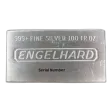
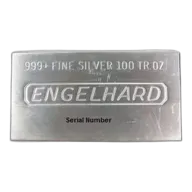
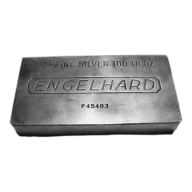
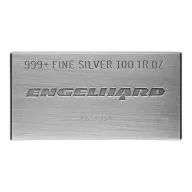
Engelhard 100 oz bars carry serial numbers with letter-prefix formats (P, S, W, C). The serial number is the primary authentication marker, as genuine bars follow consistent formats documented by the AllEngelhard collector community. The bars were produced using multiple methods, including casting (pouring) and pressing, resulting in varying finishes across production eras. Weight and purity stamps, the distinctive Engelhard hallmark, and era-specific fonts are all authentication reference points.
The bar's .999 purity meets modern investment-grade standards for tax-exempt treatment in Canada (99.9%+), Australia (99.9%+), New Zealand (99.9%+), and Singapore (99.9%+), and satisfies IRS fineness requirements for precious metals IRA inclusion (99.9%+), though specific custodian approval is needed for secondary-market bars. Authentication is essential before IRA inclusion, as the 100 oz weight is the most commonly counterfeited Engelhard product. Fakes typically fail on font details, serial number format consistency, and edge quality when compared against the AllEngelhard definitive pages for the specific variety claimed.
Tax Treatment of the Engelhard 100 oz Silver Bar
The Engelhard 100 oz bar is taxed as a private-mint silver bullion product. It has no legal tender status in any jurisdiction, and its discontinued status does not change its tax classification.
- United States: No federal sales tax. Approximately 35 states exempt investment-grade silver from state sales tax. Capital gains taxed at the collectibles rate (up to 28% for long-term holdings). The bar meets IRS purity requirements (.999) for IRA eligibility, though custodian approval for secondary-market Engelhard bars varies.
- United Kingdom: 20% VAT on purchase. Subject to CGT at 18-24% on disposal. No VAT or CGT exemption applies to silver bars.
- Canada: GST/HST exempt (purity exceeds 99.9%). Capital gains at 50% inclusion rate.
- Australia: GST-free (meets 99.9% purity threshold). Capital gains with 50% discount after 12 months.
- New Zealand: GST-exempt (99.9% purity met). No formal capital gains tax.
- Singapore: GST-exempt as IPM. No capital gains tax.
- Hong Kong: No sales tax, duty, or capital gains tax.
- South Africa: 15% VAT on all silver products.
An additional consideration for Engelhard bars is the collector premium. If a buyer pays $5-$20 per ounce above spot for the Engelhard brand premium, and later sells the bar at a time when Engelhard premiums have compressed, the capital gain for tax purposes is based on the difference between purchase and sale prices, not on silver content alone. The collector premium component introduces a risk that does not exist with current-production bars trading near spot.
From Newark Refinery to Bullion Market Icon
Engelhard's history in precious metals spans the entire 20th century. Charles W. Engelhard Sr. entered the business in 1902 by purchasing the Charles F. Croselmire Company in Newark, New Jersey. He expanded through the acquisition of Baker & Co., a platinum smelter, in 1904, and the establishment of Hanovia Chemical and Manufacturing Company in 1905. His son, Charles Engelhard Jr., consolidated the family holdings into Engelhard Industries, Inc. in 1958, listing the company on the New York Stock Exchange.
Retail silver bar production began in the late 1960s and continued through approximately 1986. This period included the Hunt Brothers silver crisis of 1979-1980, when the Hunt family attempted to corner the silver market and drove prices to $49.45/oz in January 1980 before the COMEX changed its rules and the price collapsed. A significant number of Engelhard bars were melted during this spike as holders sold into the record prices, which paradoxically increased the rarity and collector value of surviving bars.
The Engelhard name carries cultural weight beyond the bullion market. Charles Engelhard Jr. is widely cited as the inspiration for Ian Fleming's James Bond villain Auric Goldfinger. The company processed gold for the US Treasury, was involved in South African gold refining during the apartheid era, and grew to become the world's largest precious metals smelter by the 1950s.
After exiting retail bullion in the late 1980s, Engelhard focused on industrial catalysts and engineered materials. BASF's $5 billion hostile acquisition in 2006 ended Engelhard as an independent entity. The bars that survive from its production years have become the most collected vintage silver bars in the North American market, with the AllEngelhard.com community maintaining the definitive catalogue of varieties, serial number formats, and known counterfeits.
Engelhard 100 oz vs Other 100 oz Silver Bars
The comparison between an Engelhard 100 oz bar and current-production alternatives depends entirely on the buyer's motivation. For investors buying purely for silver content at the lowest cost, current-production bars are superior in every practical measure. For collectors valuing brand heritage and scarcity, the Engelhard bar occupies a category of its own.
The Asahi Refining 100 oz bar is the closest functional successor. Asahi acquired Johnson Matthey's precious metals refining operations in 2015, and Johnson Matthey was Engelhard's primary competitor during the era when both produced retail silver bars. The Asahi bar offers identical .999 purity, LBMA accreditation, and serialisation at current-production pricing, without the collector markup. Buyers seeking the refining pedigree without the brand premium should consider Asahi first.
The Johnson Matthey 100 oz bar is also discontinued and carries a brand premium, though typically less than the Engelhard equivalent. JM bars from the 1980s are well documented and have a strong secondary market. Both JM and Engelhard bars trade above current-production prices for brand value alone.
The Royal Canadian Mint 100 oz bar represents the opposite end of the spectrum: a currently produced, government-backed, .9999 fine product with no collector premium and the tightest buyback spreads in the 100 oz market. For maximum silver per dollar spent, the RCM bar is the rational choice. The Engelhard bar's appeal is emotional and historical, not economic.
Authentication is the Engelhard-specific risk that does not apply to current-production bars. The 100 oz size is the most counterfeited Engelhard product, and fakes can be sophisticated enough to require sigma testing or specific gravity measurement to detect. AllEngelhard.com maintains detailed reference pages on known counterfeits, serial number formats, and font characteristics for each production era. Buying from established dealers who guarantee authenticity significantly reduces this risk.
100 oz Engelhard Bar Silver Bar: frequently asked questions
-
The cheapest 100 oz Engelhard silver bar tracked here is $6,802.00 from Bullion Standard, sitting around 0.6% over the $67.63 silver spot price. At 100 troy oz of .999 fine silver, the melt value alone is substantial, though Engelhard bars typically carry a collector premium above generic equivalents.
-
Engelhard exited the retail bullion market in the late 1980s and was absorbed by BASF in 2006, so no new bars are being produced. That discontinued status, combined with strong brand recognition among collectors and the fact that a significant number were melted during the 1979-1980 silver price spike, keeps demand for surviving bars higher than for comparable generic silver.
-
The 100 oz size is among the most counterfeited Engelhard bars. Key checks: verify the weight (approximately 3,110 g), inspect the font consistency and serial number format against the documented P, S, W, and C prefix series, and examine edge quality for the production method. The AllEngelhard.com community maintains a definitive reference on known counterfeits, covering font, spacing, and hallmark detail variations specific to each era.
-
Engelhard exited the retail bullion market in the late 1980s, with retail silver bar production running from the late 1960s through approximately 1986. The company was later acquired by BASF in 2006 and renamed BASF Catalysts LLC. No original Engelhard-branded silver bars have been produced since then, making all available bars secondary-market pieces.
-
There is no official public registry for Engelhard serial numbers. The number itself indicates the production batch and sequence rather than a unique ownership record. On the 100 oz bars, serial prefixes such as P, S, W, and C denote production series. The AllEngelhard.com reference site catalogues the known prefix formats and can help date a bar and verify its serial number falls within the expected range for that series.