1 listing
Filters
| Product | /oz | Premium | Price | |
|---|---|---|---|---|

 IDC Coin and Bullion
|
$126.88 | +87.61% | $634.40 | View Deal |
Prices are fetched automatically and may not reflect current merchant prices. Currency conversions and tax treatment are approximate. Rankings are based solely on price. We are not a dealer and accept no responsibility for transactions with listed merchants. Past performance is not indicative of future results. This site does not provide investment advice. Full disclaimer
About the 5 oz Engelhard Bar Silver Bar
A Discontinued Classic with Collector Value
The 5 oz Engelhard silver bar is a product of a company that no longer exists, and that scarcity is precisely why it commands premiums that current-production bars cannot. Engelhard was founded in 1902 by Charles W. Engelhard Sr. in Newark, New Jersey, and by the 1950s had become the world's largest precious metals smelter. The company produced retail silver bars from the late 1960s through approximately 1986, spanning the era of the Hunt Brothers silver price spike, before exiting the retail bullion market to focus on industrial catalysts. BASF acquired Engelhard in 2006 for $5 billion, and the name was retired.
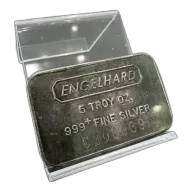
Engelhard's 5 oz bars were produced in multiple varieties across the company's two decades of retail bar production. The bars are .999 fine silver, individually serial-numbered, and produced in cast (poured), pressed, and extruded formats. Unlike modern bars that come in sealed packaging with assay cards, Engelhard bars are bare metal with stamped hallmarks, weight, purity, and serial number. Authentication relies on the specific characteristics of each variety: font details, serial number formats, edge finishing, and hallmark placement.
The collector market for Engelhard bars is active and well-documented. AllEngelhard.com maintains the definitive catalogue of Engelhard bar varieties, with rarity ratings and known counterfeit identification guides. The 5 oz size is less extensively catalogued than the 1 oz (which has over 40 documented varieties), but multiple distinct types exist across the production span.
The 1979-1980 silver price spike, when silver briefly reached roughly $50 per ounce, led to mass meltdowns of Engelhard bars. This paradoxically increased the long-term collector value of surviving bars, as the original production numbers overstate the current supply. Buyers of 5 oz Engelhard bars are purchasing a piece of American refining history as much as they are purchasing silver.
5 oz Engelhard Silver Bar Specifications
| Attribute | Value |
|---|---|
| Weight | 5 troy ounces (155.5g) |
| Purity | .999 fine silver |
| Manufacturer | Engelhard (Newark, NJ; acquired by BASF 2006) |
| Production Period | Late 1960s to approximately 1986 |
| Serial Number | Yes (nearly all Engelhard bars carry unique serial numbers) |
| Production Methods | Cast (poured), pressed, and extruded |
| Legal Tender | No (private refinery product) |
| Currently Produced | No (discontinued) |
Engelhard Silver Bar Size Range (Historical)
| Weight | Notes |
|---|---|
| 1 oz | 40+ documented varieties; most extensively collected size |
| 2 oz | Uncommon size; commands substantial collector premiums |
| 3 oz | Uncommon size |
| 5 oz | Multiple varieties across production span |
| 10 oz | Popular collector and investment size |
| 25 oz | Less common |
| 100 oz | Institutional size; most heavily counterfeited Engelhard product |
| 1,000 oz | LBMA Good Delivery format |
The hallmarks and design elements evolved across Engelhard's production history. Early bars (late 1960s) used elongated octagon hallmarks. The 1970s introduced the bull-and-bear commercial logo. Portrait-orientation bars from 1981-1986 feature the distinctive 'E' globe logo. The final 1986 production run used an Eagle logo design. Charles Engelhard Jr. is widely cited as the inspiration for Ian Fleming's James Bond villain Auric Goldfinger.
Tax Treatment for the 5 oz Engelhard Silver Bar
Engelhard bars receive the same tax treatment as any other .999 fine silver bar. The discontinued status and collector premium do not change the tax classification, which is based on metal content and form, not brand or vintage.
United States
No federal sales tax. State-level exemptions apply in approximately 35 states. Gains are taxed at the collectibles rate of up to 28%. The .999 purity meets IRS requirements for silver in a self-directed IRA. Some dealers list Engelhard bars as IRA-eligible, though specific custodian approval varies. The collector premium above melt value is part of the capital gain for tax purposes, meaning that a bar purchased for $200 and sold for $300 generates a $100 taxable gain, regardless of how much of that appreciation came from metal versus collector value.
United Kingdom
Silver bars carry 20% VAT on purchase. No CGT exemption applies (not UK legal tender). The annual CGT allowance of £3,000 applies. The collector premium makes the VAT hit proportionally larger in absolute terms than for a generic bar of the same weight.
Canada
GST/HST applies to silver. Coins with numismatic value above their metal content may face different treatment in some provinces. The bar format (not a coin) generally qualifies for the GST/HST exemption on silver at 99.9% purity or above.
European Union
Silver bars attract full local VAT rates. The margin scheme (Differenzbesteuerung in Germany) may apply to secondary-market Engelhard bars, as they are by definition second-hand products. This can meaningfully reduce the effective VAT burden compared to buying new silver bars.
Australia and Singapore
Investment-grade silver at 99.9% purity is GST-free in Australia and GST-exempt in Singapore under the IPM scheme. Engelhard bars qualify on purity grounds.
Hong Kong
No sales tax, no import duty, no capital gains tax.
Engelhard vs Other 5 oz Silver Bars
Comparing the 5 oz Engelhard bar to current-production bars requires separating two distinct value propositions: metal content and collector premium. On pure silver content, the Engelhard bar is identical to any other .999 fine 5 oz bar. The difference lies entirely in the brand, the history, and the finite supply.
Against the 5 oz PAMP Suisse Fortuna, the Engelhard bar trades at a higher total price due to collector demand but lacks PAMP's sealed packaging, Veriscan authentication, and current production availability. PAMP offers a known, verifiable product with global brand support. Engelhard offers historical provenance and a finite pool of survivors. The PAMP bar is the better choice for investment-focused silver accumulation; the Engelhard bar is for buyers who value the vintage aspect.
The closest historical parallel is to Johnson Matthey (JM) silver bars, produced in the same era by the other major North American refiner. Both Engelhard and JM bars are .999 fine, serial-numbered, and discontinued. Engelhard bars generally command higher collector premiums than equivalent JM bars, driven by the greater variety of documented types and the Goldfinger connection. JM's refining operations were sold to Asahi in 2015, but the vintage bars retain their own collector following.
Against current-production generic bars from mints like Sunshine Minting or Asahi, the Engelhard bar costs significantly more per ounce of silver. The premium above spot for a common Engelhard 5 oz bar can reach $5-20 per ounce, compared to 4-7% over spot for a generic bar. Buyers optimising for silver weight per dollar should choose current-production bars. Buyers who see value in owning a piece of American refining history, with the knowledge that no more will ever be produced, will accept the collector premium.
Counterfeiting is a concern with Engelhard products, particularly at larger weights. The AllEngelhard.com community provides the standard reference for authenticating bars by serial number format, font details, and variety-specific characteristics. Buying from established dealers with return policies reduces the risk.
5 oz Engelhard Bar Silver Bar: frequently asked questions
-
The cheapest 5oz Engelhard silver bar available across 1 dealer is $634.40 from IDC Coin and Bullion. The bar contains 5 oz of .999 fine silver, so its base metal value tracks the live $67.63 silver spot price. Engelhard bars are vintage secondary-market pieces and typically carry a collector premium above modern generic 5oz bars.
-
Engelhard's retail silver bar production ended in the mid-1980s. The company had been producing retail bars from the late 1960s but exited the bullion market to focus on industrial catalysts. BASF acquired Engelhard in 2006 and renamed it BASF Catalysts LLC on 1 August 2006. No new Engelhard silver bars have been made since the 1980s, and all bars in the market today are vintage secondary-market items.
-
Engelhard bars are a known counterfeiting target, with the 100oz size most frequently faked, though smaller sizes including 5oz are also targeted. Authentication steps: check that the serial number format matches the documented pattern for that size (Engelhard used specific prefix and digit-count conventions), weigh the bar on a calibrated scale against the stated weight, and inspect font consistency and edge finishing. AllEngelhard.com maintains a definitive counterfeiting reference. Acid or magnet tests add another layer of verification, and a dealer with XRF equipment can confirm .999 silver content.
-
Engelhard ceased retail bar production in the mid-1980s, making all surviving bars a fixed and shrinking pool. Collector demand is driven by the brand's historical significance as an American refinery, the variety of documented types (Engelhard produced 5oz bars across multiple eras and stampings), and the mass meltdowns during the 1979-1980 silver price spike, which reduced surviving inventory. Bars in better condition or featuring scarcer stampings command the highest premiums; even common examples typically sell above what an equivalent modern generic bar would fetch.