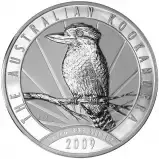
5 products · 101 deals Prices & premiums exclude tax to compare across countries
Filters
| Product | /oz | Premium | Price (ex. tax) | |
|---|---|---|---|---|

20 deals
|
$76.70 |
+15.06%
+38% inc.VAT
|
$2,465.97
£2,218 inc.VAT
|
Compare |

64 deals
|
$77.76 |
+16.64%
+40% inc.VAT
|
$77.76
£70 inc.VAT
|
Compare |

14 deals
|
$79.29 |
+18.92%
+42% inc.VAT
|
$792.87
€823 inc.VAT
|
Compare |
| $112.47 | +68.28% |
$224.94
S$288
|
View Deal | |
| $112.50 | +68.77% |
$112.50
£84
|
Compare |

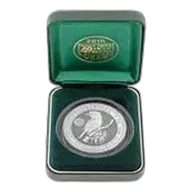

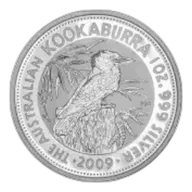
Prices are fetched automatically and may not reflect current merchant prices. Currency conversions and tax treatment are approximate. Rankings are based solely on price. We are not a dealer and accept no responsibility for transactions with listed merchants. Past performance is not indicative of future results. This site does not provide investment advice. Full disclaimer
About the Kookaburra Silver
Annual Designs and Capped Mintages from the Perth Mint
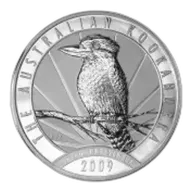
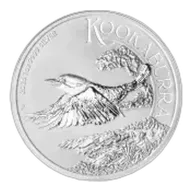
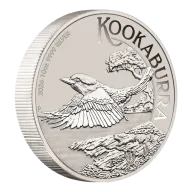
The Silver Kookaburra has been minted by the Perth Mint since 1990, making it one of the longest-running annual-design silver bullion series in the world. Each year's reverse features a new illustration of the kookaburra, the largest member of the kingfisher family and an icon of the Australian bush known for its distinctive call that sounds like human laughter. This annual design change, combined with a maximum annual mintage of 500,000 coins for the 1 oz size (since 2013), creates genuine year-over-year collectibility that most bullion coins lack.
The series was upgraded from .999 to .9999 fine silver starting with the 2018 edition, matching the purity of the Silver Kangaroo and the Silver Maple Leaf. This four-nines purity exceeds the .999 standard used by the Silver Britannia, the American Silver Eagle, and most other sovereign silver coins.
The 1 oz Silver Kookaburra is the primary bullion product, with additional sizes at 2 oz, 10 oz, and 1 Kilo. All are Australian legal tender with face values ranging from A$1 (1 oz) to A$30 (1 kilo). Earlier years of the series also included a 5 oz denomination, and numerous special editions with privy marks for international coin shows have been produced in small quantities.
The Kookaburra occupies a middle ground between pure bullion and semi-numismatic collecting. Current-year coins trade at moderate premiums over spot, competitive with other sovereign mint silver. Older vintages, particularly low-mintage years from the 1990s and the 2000 issue (84,000 coins), command premiums well above spot that reflect collector demand rather than metal value. Buyers seeking the lowest possible premium should focus on current-year issues; buyers interested in the collectibility dimension can target specific vintage years.
Kookaburra Denominations and Mintage Data
| Size | Face Value (AUD) | Weight | Diameter (mm) | Thickness (mm) | Purity |
|---|---|---|---|---|---|
| 1 oz | $1 | 31.135g | 40.6 | 2.98 | .999 (1990-2017), .9999 (2018+) |
| 2 oz | $2 | 62.77g | 50.3 | 4.5 | .999/.9999 |
| 10 oz | $10 | 312.35g | 75.5 | 8.7 | .999/.9999 |
| 1 Kilo | $30 | 1,002.5g | 101.0 | 14.6 | .999/.9999 |
All coins have a reeded edge. The 1 oz coin's face value changed from A$5 (1990-1991) to A$1 (1992 onwards), an unusual reduction. Gold Kookaburras have been issued in collector/proof/high-relief editions but are not standard bullion products.
Selected 1 oz Mintage Figures
| Year | Mintage | Notes |
|---|---|---|
| 1990 | 300,000 | Debut year, sold out |
| 1991 | 232,000 | |
| 1996 | 103,000 | Low mintage year |
| 2000 | 84,000 | Lowest early-era mintage |
| 2010 | 213,000 | |
| 2019 | 219,660 | |
| 2020 | 375,914 | |
| 2021 | 266,676 |
Maximum annual mintage for the 1 oz coin has been 500,000 since 2013. The 1 kilo coin is minted to order with no stated cap. Early-year coins with mintages under 250,000 carry premiums reflecting their relative scarcity.
Security
Each coin bears the Perth Mint's "P" mintmark. Individual coins ship in protective capsules. The annual design change itself provides a degree of counterfeit resistance, since counterfeiters must produce new dies for each year. No additional anti-counterfeiting technology (micro-engraving, DNA marks, or latent images) is applied to the Kookaburra series.
Silver Kookaburra Tax Treatment
Australia: The Kookaburra is Australian legal tender and qualifies as investment-grade precious metal. Silver bullion at .999+ purity is GST-free under the investment precious metals exemption. Capital gains tax applies on disposal, with a 50% CGT discount for individual investors holding for more than 12 months.
United States: The .999/.9999 silver purity meets the IRS fineness requirement for precious metals IRAs under the generic bullion provision. Some custodians specifically list Perth Mint products. Gains are taxed at the collectibles rate of up to 28%. Sales tax treatment varies by state, with approximately 35 states exempting bullion.
United Kingdom: Silver Kookaburras are subject to 20% VAT on import and purchase. No VAT exemption exists for silver bullion in the UK. On disposal, CGT applies at the individual's marginal rate. The Kookaburra is not UK legal tender and therefore does not qualify for the CGT exemption that applies to Silver Britannias.
Canada: Silver bullion at .999+ purity is exempt from GST/HST. Capital gains are taxed at a 50% inclusion rate. The Kookaburra is not specifically eligible for RRSP or TFSA inclusion through most custodians.
European Union: Silver coins attract the standard VAT rate in each EU country (17-27%). The margin scheme available in Germany and the Netherlands may apply to pre-owned Kookaburras on the secondary market.
New Zealand: Silver at 99.9% purity is GST-exempt. No formal capital gains tax, though gains may be taxable as income if the IRD determines the bullion was acquired for resale. The Perth Mint is the nearest major sovereign mint for New Zealand buyers.
Singapore: Investment Precious Metal silver at 99.9% purity is exempt from 9% GST. The MAS-approved list includes qualifying sovereign coins. No capital gains tax.
Hong Kong: No sales tax, import duty, or capital gains tax on silver bullion.
Three Decades of Laughing Kookaburras
The Silver Kookaburra launched in 1990, the same year the Perth Mint transitioned its flagship gold series from the Gold Nugget to the Gold Kangaroo design. Stuart Devlin, a distinguished Australian-born sculptor who also designed Australia's decimal coinage and created the Queen's personal Christmas gift each year, created the original 1990 reverse showing a kookaburra perched on a tree stump in right-profile relief. This design was reprised in 2015 to mark the series' 25th anniversary.
The series has produced a new reverse design every year since, always featuring one or more kookaburras in natural Australian settings: perched on branches, in eucalyptus trees, on fence posts, and in various poses. Four obverse portraits have appeared across the series: Raphael Maklouf's Elizabeth II (1990-1998), Ian Rank-Broadley's Elizabeth II (1999-2018), Jody Clark's Elizabeth II (2019-2023), and the King Charles III portrait from 2024 onwards.
Beyond the standard bullion releases, the Perth Mint has produced numerous special editions. European landmark designs appeared from 1996 to 1998, and US state quarter designs from 1999 to 2001. Privy-mark editions for international coin shows, including the Berlin World Money Fair and the Tokyo International Coin Convention, were produced in very small quantities and are now highly collectible. Zodiac and lunar design variations have also appeared, adding further depth to the series for date-specific collectors.
The face value change from A$5 to A$1 between 1991 and 1992 is unusual in bullion coinage; face values typically remain constant or increase. The purity upgrade from .999 to .9999 in 2018 aligned the Kookaburra with the Perth Mint's other silver coin, the Kangaroo (introduced in 2016 at .9999), and with the Canadian Silver Maple Leaf.
The 1 oz coin at 40.6 mm diameter is slightly larger than the common 38-39 mm diameter of Silver Eagles, Maple Leafs, and Britannias. This size, shared with the Silver Koala, gives both Perth Mint silver coins a distinctive visual presence.
Kookaburra vs Koala, Kangaroo, Maple Leaf, and Eagle
The Kookaburra's closest relative is the Silver Koala, also from the Perth Mint and also featuring annual design changes. The Kookaburra is the older series by 17 years (1990 vs 2007 for the silver Koala) and has a larger following. Since 2018, the Kookaburra has a higher mintage cap (500,000) than the Koala (300,000), which gives the Koala a slight scarcity advantage on current production. Both were upgraded to .9999 purity in 2018. Collectors often pursue both series in parallel, with the Kookaburra's longer history providing more vintage years to hunt.
The Silver Kangaroo is Perth's newest silver bullion coin (2016) and was introduced specifically as a mass-market silver bullion product with unlimited mintage. The Kangaroo's unlimited production and advanced security features (micro-laser engraved letter) position it as Perth's answer to the Maple Leaf and Eagle for volume buyers. The Kookaburra, with its capped mintage and longer history, is aimed at buyers who value the intersection of bullion and collectibility.
Against the Silver Maple Leaf, the Kookaburra matches on purity (.9999) but differs on nearly every other dimension. The Maple Leaf has far higher annual production (millions of coins), a fixed design, and the Bullion DNA digital authentication system. It is the more liquid coin in virtually every market. The Kookaburra offers annual design changes and production caps that the Maple Leaf does not, making it more interesting to collectors but less convenient for investors who prioritise fungibility and tight buy-sell spreads.
The American Silver Eagle has the highest production volumes of any silver coin (over 30 million some years) and the widest global liquidity. It also carries the highest premiums among sovereign silver coins, typically 20-30% over spot. The Kookaburra's premiums on current-year issues are lower than Eagle premiums, though vintage Kookaburras from low-mintage years can exceed Eagle pricing. The Eagle's fixed design (with the Type II redesign in 2021) makes it a pure bullion play; the Kookaburra's annual variety adds a collecting dimension that the Eagle lacks.
Kookaburra Silver: frequently asked questions
-
Kookaburra coins trade at a premium above the spot price for their metal per troy oz. The exact amount depends on the size and year, with older low-mintage dates commanding higher premiums than current-year bullion. We track 101 listings from 30 dealers, so you can compare current prices across the range.
-
The silver Kookaburra is available in 1 oz, 2 oz, 10 oz, and 1 kg sizes, with the 1 oz coin being the main bullion product. Earlier years also included a 5 oz format. Gold Kookaburra versions exist primarily as proof and collector editions in limited sizes and quantities. The 1 kg silver coin is struck to order with no stated mintage cap.
-
Yes. Perth Mint has issued a new kookaburra reverse design every year since the series began in 1990, always depicting the bird in an Australian natural setting. The obverse carries the reigning monarch's portrait, which has changed less frequently. This annual design rotation, combined with capped mintages, is the series' defining characteristic and part of its collector appeal.
-
We currently track 101 Kookaburra listings from 30 dealers. Silver Kookaburras are stocked by dealers across Australia, the UK, US, and Europe, though availability of specific years and sizes varies. The 1 oz current-year coin has the widest availability; older low-mintage dates are typically found through specialist dealers.