 Canadian PMX
4 listings
Filters

Prices are fetched automatically and may not reflect current merchant prices. Currency conversions and tax treatment are approximate. Rankings are based solely on price. We are not a dealer and accept no responsibility for transactions with listed merchants. Past performance is not indicative of future results. This site does not provide investment advice. Full disclaimer
About the 1 oz Panda Silver Coin
China's Annually Redesigned Silver Coin
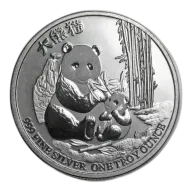
The Silver Panda is a .999 fine silver coin produced by the China Gold Coin Corporation (CGCC), a state-owned company under the People's Bank of China. The series launched in 1983 and is one of the few government bullion coins that changes its panda design every year, with the obverse Temple of Heaven remaining unchanged since 1982. It is legal tender of the People's Republic of China.
A critical specification change occurred in 2016: the standard size switched from 1 troy ounce (31.103 g) to 30 metric grams (0.9645 troy oz), making the post-2016 Panda 3.5% lighter than a full troy ounce. Physical dimensions (diameter, thickness) were kept identical, so the difference is not visually apparent. China's official reason was alignment with the domestic metric system, though the practical effect was slightly less metal per coin. This metric shift is unique among major bullion series and matters for direct premium comparisons: a post-2016 Panda at the same retail price as a 1 oz Maple Leaf or Britannia contains less silver.
The Silver Panda has a peculiar production history. No coins were struck in 1986 or 1988. Purity changed three times in the early years: .900 fine in 1983-1985 (proof only), .925 sterling in 1987, and .999 from 1989 onward. The series did not settle into a consistent bullion format until 1989, making earlier dates collector items in their own right. Modern silver Panda annual production reaches 10 million coins.
Counterfeiting is a substantially larger concern for Pandas than for other major bullion series. The combination of annually changing designs (making it harder to recognise fakes by visual comparison), relatively high premiums, and historically less sophisticated security features creates an environment that favours counterfeiters. NGC has flagged that skillful counterfeits are endangering the series' integrity. Buying from reputable dealers or purchasing NGC/PCGS-certified coins is strongly recommended.
Silver Panda Specifications
| Attribute | Pre-2016 | Post-2016 |
|---|---|---|
| Weight | 31.103 g (1 troy ounce) | 30 g (0.9645 troy oz) |
| Purity | .999 fine silver | .999 fine silver |
| Face value | 10 yuan | 10 yuan |
| Diameter | ~40 mm | ~40 mm |
| Mint | CGCC (multiple facilities) | CGCC (multiple facilities) |
| Design | Annual reverse changes | Annual reverse changes |
Early Purity Changes
| Period | Purity | Weight | Notes |
|---|---|---|---|
| 1983-1985 | .900 | 27 g | Proof quality only |
| 1987 | .925 (sterling) | 1 oz | No coins in 1986 |
| 1989-2015 | .999 | 1 oz (31.103 g) | No coins in 1988 |
| 2016-present | .999 | 30 g (0.9645 oz) | Metric switch |
Minting Facilities
Unlike most sovereign bullion coins, the Panda is struck at multiple facilities: Beijing, Shanghai, Shenyang, and Shenzhen. Standardised mintmarks are not used, making attribution to specific mints difficult. Some years have subtle die differences that specialists can identify, but this is not a formal system. The lack of a single identifiable mintmark contrasts with coins like the Perth Mint products (which carry the 'P' mark) or the Royal Canadian Mint's Bullion DNA system.
Silver Panda Tax Treatment by Country
United States
The Gold Panda's IRA eligibility is a common point of confusion. Gold Pandas are generally considered not IRA-eligible because the IRS does not recognise the Chinese mint as an approved foreign mint for IRA gold purposes. Silver Pandas are typically accepted for IRA inclusion, as they meet the .999 purity threshold under the generic bullion provision. This gold/silver distinction catches many investors off guard. Capital gains are taxed at the collectibles rate of up to 28%. Most states exempt bullion from sales tax.
United Kingdom
Gold Pandas are VAT-exempt as investment gold, meeting the 99.5% purity threshold for post-1800 legal tender coins. Silver Pandas carry 20% VAT. The Panda is not CGT-exempt in the UK. Only coins with a sterling face value, such as the 1oz Silver Britannia, qualify for UK Capital Gains Tax exemption.
European Union
Gold Pandas qualify as investment gold under the EU Gold Directive and are VAT-exempt. Silver is subject to VAT at local rates across member states (19% Germany, 21% Netherlands, 25% Sweden). Some countries apply margin scheme treatment on pre-owned legal tender silver coins.
China
No VAT on precious metal coins in China. Capital gains treatment is complex and varies by the structure of the investment. The Panda is a cultural icon domestically, popular as a gift item during Chinese New Year and other occasions.
Australia
Investment-grade gold at 99.5% purity is GST-free. Silver at 99.9% purity also qualifies. The Panda meets both thresholds. Capital gains apply with a 50% discount for holdings over 12 months.
Singapore and Hong Kong
Singapore's IPM scheme exempts gold at 99.5% and silver at 99.9% from GST. Hong Kong imposes no tax on bullion. Both jurisdictions are strong markets for the Panda given their proximity to China and cultural affinity with the series.
Silver Panda vs Maple Leaf, Perth Lunar, and Eagle
The Silver Panda occupies a hybrid space between pure bullion and numismatic product. Its annually changing designs, limited early mintages, and cultural significance in Chinese markets create collector premiums that most other bullion coins do not carry. This makes it attractive for collectors who value the combination of sovereign backing and design variety, but less ideal for buyers who prioritise lowest cost per ounce of silver.
The 1oz Silver Maple Leaf highlights the Panda's weaknesses on the technical side. The Maple Leaf is .9999 fine versus the Panda's .999, contains a full troy ounce versus the Panda's 30 grams (post-2016), and has the Bullion DNA digital authentication system that no Chinese coin matches. The Maple Leaf's unlimited production and consistent global availability give it tighter buy-sell spreads. Counterfeiting is a minimal concern for Maple Leafs due to the DNA verification system, whereas the Panda series has been disproportionately targeted. The Panda's annual design changes and collector premiums on older dates are its countervailing strengths, but buyers focused on pure silver accumulation will find the Maple Leaf delivers more metal, higher purity, and better authentication per dollar.
The 1oz Perth Mint Lunar is the Panda's closest thematic competitor. Both feature Chinese cultural themes and annual design changes. The Lunar is .9999 fine (Series III), contains a full troy ounce, and has micro-laser engraved security from 2020. The Perth Mint's 'P' mintmark and known production figures provide clearer provenance than the Panda's multi-facility production without standardised marks. The Lunar's structured 12-year zodiac cycle also creates a different collecting dynamic: each cycle is a defined set that can be completed, while the Panda's single-subject annual designs form an open-ended run. Dragon-year Lunars compete directly with the Panda for the Chinese cultural market, and Dragon years often sell out entirely.
The 1oz American Silver Eagle dominates the US market on liquidity and name recognition. The Eagle's annual production of 30+ million coins dwarfs the Panda's 10 million, and the Eagle recovers more of its premium on resale in the US domestic market. The Eagle's purity (.999) matches the Panda's, but the Eagle contains a full troy ounce. The Panda commands higher premiums on purchase and has wider buy-sell spreads. For US-based buyers, the Eagle is the straightforward choice for silver bullion; the Panda is for those who want the annually changing design and are willing to pay the collector premium.
The 2001-2002 design freeze, when China issued identical reverses for two consecutive years, and the resulting collector backlash that reversed the policy, illustrate how central the annual design change is to the Panda's identity. The series is inseparable from its design variation, and buyers should factor the resulting premiums into their cost calculations.
1 oz Panda Silver Coin: frequently asked questions
-
The lowest offer across the 2 dealers tracked on this page is CA$107.17 from Canadian PMX, currently at around 14.2% over silver spot. Silver Pandas typically carry a premium above most standard silver coins, reflecting the annually changing design and collector cross-over demand.
-
The Silver Panda is a .999 fine silver coin issued annually by China Gold Coin Group Co. under the authority of the People's Bank of China, with the series beginning in 1983. Each year's coin features a new panda reverse design while the Temple of Heaven obverse remains constant. It is legal tender in the People's Republic of China and is available through bullion dealers worldwide.
-
The Panda's reverse design changes every year, making each annual issue a standalone collectible with its own secondary market. That annual design cycle, combined with state-backed production and lower global distribution compared to major Western coins, creates overlapping demand from both bullion buyers and collectors. The current premium sits at around 14.2% over spot, reflecting that combined interest.
-
BullionFerret currently tracks 2 dealers listing the 1 oz Silver Panda. The comparison table above shows each dealer's price, premium over spot, and stock status in real time, so you can quickly find the most competitive offer available right now.