8 products · 87 deals
Filters
| Product | /oz | Premium | Price | |
|---|---|---|---|---|

2 deals
|
$4,853.47 | +16.31% |
$78.02
€68
|
Compare |

8 deals
|
$5,018.25 | +20.21% |
$80.67
£61
|
Compare |

3 deals
|
$5,030.72 | +20.67% | $81.00 | Compare |

3 deals
|
$5,134.25 | +23.01% |
$82.53
A$118
|
Compare |

14 deals
|
$6,231.65 | +50.05% |
$100.18
£76
|
Compare |
| $6,656.77 | +59.67% | $107.01 | View Deal | |
| $8,149.71 | +95.06% |
$131.01
£99
|
View Deal | |

55 deals
|
$8,213.10 | +97.59% |
$132.03
£100
|
Compare |
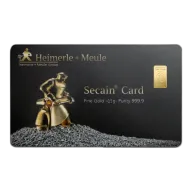
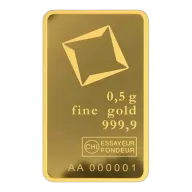
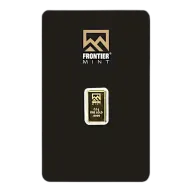
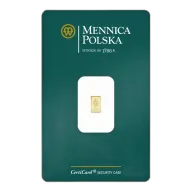
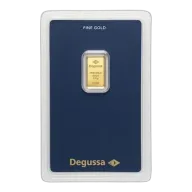

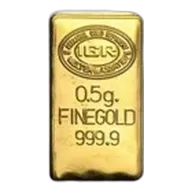

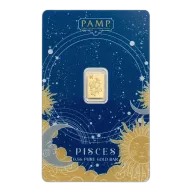
Prices are fetched automatically and may not reflect current merchant prices. Currency conversions and tax treatment are approximate. Rankings are based solely on price. We are not a dealer and accept no responsibility for transactions with listed merchants. Past performance is not indicative of future results. This site does not provide investment advice. Full disclaimer
About 0.5g Gold Bars
The Smallest Standard Gold Bar
At 0.5 grams, or 0.0161 troy ounces, this is the smallest standard bullion bar denomination produced. It exists only in gold; no other metal is made at this weight for bullion purposes. The standard purity is .9999 fine, matching the four-nines standard used for retail minted bars generally. The bar itself is physically tiny, roughly the size of a micro SIM card or postage stamp, and is dwarfed by the assay card it comes sealed in.
Buyers at this weight are rarely accumulating wealth in the conventional sense. The dominant use cases are gifting (stocking stuffers, party favours, an introduction to gold ownership), collecting, and ultra-portable holdings. Some buyers treat them as emergency barter pieces in preparedness scenarios. In the Middle East and India, where gram-denominated gold is the norm, 0.5g pieces are sold in gold souks as an entry-level purchase, and in Singapore and Hong Kong small gold bars are given as festival gifts for Chinese New Year and Diwali. In the US, UK, and Europe the half-gram bar sits firmly in the gift and novelty market rather than the investment market.
As a pure investment the economics are poor. With gold around $3,300 per ounce, a 0.5g bar carries roughly $53 of melt value, yet retails for substantially more once manufacturing, packaging, and dealer margin are added. A buyer gets less gold per dollar here than at any larger denomination, and the economics only begin to improve at 2.5g and above. Anyone whose goal is metal accumulation is better served by 1g gold bars or larger sizes, where the same money buys meaningfully more gold.
Premiums on 0.5g Gold Bars
Half-gram bars carry the highest premiums of any standard bullion denomination. Premiums of 30-50% or more over spot are common. In concrete terms, at current prices a 0.5g bar containing about $53 of gold might retail for $75-110, which means the buyer is paying $22-57 purely for manufacturing, packaging, and dealer margin.
The premium picture across the gold bar weight scale shows why this size is an outlier. Gold bars as a category carry the lowest premiums of any gold form, but premium scales inversely with size: 1g bars can run 15-25% over spot, 100g bars 2-4%, and 1kg bars 1-2%. A 1oz minted bar typically trades at 1-4% over spot. The 0.5g bar sits below even the 1g bar on that scale, and its premium is correspondingly steeper. Moving up to 1oz gold bars cuts the percentage premium by an order of magnitude.
The premium is also largely unrecoverable. Buyback prices on 0.5g bars are typically at or near spot value, so the premium paid at purchase is mostly lost on resale. The spread between buy and sell price can exceed 40%. That makes the half-gram bar suitable for purchases where the premium is part of the point, such as a gift in attractive assay card packaging, and unsuitable for anyone planning to sell the metal back later. Private mint products at this weight are often priced at lower premiums than the Swiss brands, though they come with weaker resale recognition.
Who Makes 0.5g Gold Bars
The recognised names at this weight are the Swiss refiners. PAMP Suisse produces 0.5g bars in Lady Fortuna and other designs, sealed in assay cards, and is the most recognised brand at this size. Valcambi offers 0.5g bars in assay card packaging, and 0.5g pieces also exist as segments broken from larger Valcambi CombiBar grids, the divisible bars designed to be snapped into smaller units. Argor-Heraeus, an LBMA-accredited refiner since 1961, also produces 0.5g bars in assay cards.
Below the Swiss tier sit various private mints. Frontier Mint and others produce 0.5g bars, often at lower premiums than the Swiss brands but with less resale recognition. For a bar this small, where the assay card and the name on it carry most of the resale value, that trade-off matters more than it does at larger weights.
One notable absence: the major sovereign mints do not go this small in bar form. The Royal Canadian Mint's smallest unit is the 1 gram coin, sold as the MapleGram8, a card of eight 1g coins. There is no 0.5g RCM product. Buyers wanting a government-mint product at the bottom of the weight scale have to step up to the gram level. Within the half-gram bracket itself, the practical choice is between a Swiss-brand bar with stronger buyback support and a private-mint bar at a lower asking price, a decision that mirrors the brand-recognition dynamics across gold bars generally but is amplified at this size.
Selling and Storing a 0.5g Bar
Liquidity at this weight is limited. Major dealers will buy back 0.5g bars, but the wide buy/sell spread, which can exceed 40%, makes frequent trading uneconomical. Expect to receive approximately spot value on sale, surrendering the premium paid at purchase. Brand recognition matters more at this size than at any other: PAMP and Valcambi bars in sealed assay cards are the only ones with reliable dealer buyback at competitive rates. The low absolute value of the bar also means shipping and insurance costs for a resale can be disproportionate to the amount recovered. These bars are better suited to being held long-term or given as gifts than traded actively.
The single most important handling rule is to leave the bar in its packaging. The assay card is the storage; removing the bar from its card destroys most of its resale value. This follows the general rule for minted bars, where breaking the tamper-evident seal can force re-assaying before a dealer will buy, but at 0.5g the consequence is more severe because the card and certificate are carrying most of the product's worth.
Beyond keeping the card intact and undamaged, there are no special storage considerations. Space requirements are negligible: dozens of 0.5g bars fit in a shirt pocket. Assay cards are flat and thin, and like other carded minted bars they should be stored flat rather than standing on edge, since the cards themselves are fragile even though the gold inside is protected. For UK buyers the bar is VAT-exempt as investment gold, though at this weight tax treatment is rarely the deciding factor in the purchase.
0.5g Gold Bars: frequently asked questions
-
A 0.5g gold bar contains half a gram of gold. At the current spot price of $4,171.00 per troy oz, the melt value of the metal is small, but actual bar prices from 24 dealers across 101 listings include a fabrication premium above melt. Prices last updated 2 minutes ago. Use the comparison table on this page to see live offers side by side.
-
A 0.5g gold bar is the smallest weight commonly retailed in the bullion market. It is typically produced to 999.9 fine (24-carat) purity and usually comes in a sealed assay card that certifies weight and purity. These bars are compact but carry a high per-gram premium relative to larger bars due to fabrication and packaging costs spread over very little metal.
-
Fabrication costs such as die production, assay certification, and packaging are relatively fixed per bar regardless of size. Spread across only half a gram of gold, those costs push the per-gram price well above spot. The smaller the bar, the higher that overhead-to-metal ratio. Buying a 1g or 5g bar typically brings the per-gram premium down considerably.
-
At this size, brand matters more than with larger bars. LBMA-accredited refiners are accepted by the widest range of dealers and buyers, making resale straightforward. Unknown or unaccredited brands can be harder to sell and may be refused by bullion dealers. An assay card from a recognised refiner provides independent weight and purity verification.