 BullionMart



 APMEX
APMEX
Prices are fetched automatically and may not reflect current merchant prices. Currency conversions and tax treatment are approximate. Rankings are based solely on price. We are not a dealer and accept no responsibility for transactions with listed merchants. Past performance is not indicative of future results. This site does not provide investment advice. Full disclaimer
About the 1/2 oz Johnson Matthey Gold Bar
A Legacy Refiner's Half-Ounce Gold Bar
The 1/2 oz Johnson Matthey gold bar contains 15.5517 grams of 9999 fine gold, produced by one of the most historically significant precious metals refiners in the world. Johnson Matthey operated as a London-based refinery from the 19th century until 2015, when its precious metals refining division was sold to Asahi Refining. No new Johnson Matthey bars are being produced, which means every bar on the market is a secondary-market piece from existing stock.
That discontinued status gives JM bars a particular character in the market. They carry the credibility of a former LBMA Good Delivery refiner with a refining history stretching back over 150 years, and the fixed supply creates a modest collector premium on some sizes. The half-ounce format is less commonly encountered than 1 oz or 10 oz JM bars, making it a somewhat scarce product that appeals to both investors and collectors of vintage refinery bullion.
For buyers focused purely on gold content and cost, a JM bar competes directly with current-production alternatives from Valcambi, Perth Mint, and other active LBMA refiners. The gold inside is identical in purity. The difference is provenance: a Johnson Matthey hallmark connects the bar to a specific chapter in London's refining history that ended in 2015. Some buyers value that; others will find better pricing on bars from active producers.
Resale liquidity is strong. The JM name is universally recognised by dealers worldwide, and the bars trade without difficulty on the secondary market. Buyers should look for bars in their original assay card packaging with intact serial numbers, as this simplifies authentication and preserves resale value.
1/2 oz Johnson Matthey Gold Bar Specifications
| Property | Detail |
|---|---|
| Weight | 1/2 troy oz (15.5517 g) |
| Purity | 9999 fine gold (24 karat) |
| Manufacturer | Johnson Matthey, United Kingdom |
| LBMA accredited | Formerly (refining operations sold to Asahi Refining in 2015) |
| Production status | Discontinued; secondary market only |
| Face value | None (bar, not legal tender) |
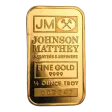
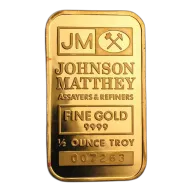
Johnson Matthey gold bars were produced in both minted and cast formats, depending on the size and production era. The minted bars feature the JM hallmark, weight, and purity stamp in a clean, utilitarian layout. Each bar carries a unique serial number. Bars from later production runs were typically sealed in tamper-evident assay card packaging, while earlier bars may come without cards.
The "9999" purity marking is equivalent to 999.9 millesimal fineness, denoting four-nines gold. This is the standard purity for modern investment gold bars and exceeds the 995 minimum required for LBMA Good Delivery status.
Johnson Matthey's refining operations were based in Royston, Hertfordshire, UK, and in Brampton, Ontario, Canada. Both facilities produced gold bars for the retail market. After the 2015 sale to Asahi Refining, the Brampton facility continued operating under the Asahi name.
Tax Position for the 1/2 oz Johnson Matthey Gold Bar
At 9999 fine (999.9 millesimal), this bar exceeds the purity thresholds for investment gold tax exemptions in all major jurisdictions. The discontinued production status has no bearing on tax treatment; the bar's purity and form are what determine eligibility.
Purchase Tax
- United Kingdom: VAT-exempt. Investment gold bars at 995+ purity are zero-rated.
- European Union: VAT-exempt under the EU Investment Gold Directive.
- United States: No federal sales tax. State-level exemptions vary; roughly 35 states exempt bullion. Johnson Matthey bars from the Canadian facility are sometimes marketed as "Canadian JM bars" but receive the same US tax treatment as any gold bar.
- Canada: GST/HST-exempt for gold at 99.5%+ purity.
- Australia: GST-free as investment-grade gold.
- New Zealand: GST-exempt for gold at 99.5%+ purity.
- Singapore: GST-exempt under the IPM scheme. Johnson Matthey was an LBMA-accredited refiner, and its bars remain recognised for IPM purposes.
- Hong Kong: No sales tax or duties.
Capital Gains and Resale
UK capital gains tax applies to gold bars at 18% or 24%, with a GBP 3,000 annual allowance. Bars are not legal tender and therefore not CGT-exempt. For CGT-free gold at a similar price point, UK buyers would need to consider the 1/2 oz Gold Britannia.
In the United States, gold is taxed as a collectible at up to 28% for long-term holdings. JM bars from the period when the refinery was LBMA-accredited should meet IRA custodian requirements, though buyers should confirm with their specific custodian. Germany exempts gold held for over one year from capital gains tax. Canada applies a 50% inclusion rate on gains.
From Victorian London to the End of an Era
Johnson Matthey's involvement with precious metals dates to 1817, when Percival Norton Johnson established an assaying business in London. George Matthey joined in 1851, and the firm became Johnson Matthey and Co. The company was appointed official assayer to the Bank of England and played a central role in London's gold market throughout the 19th and 20th centuries.
By the mid-20th century, Johnson Matthey was one of the five members of the London Gold Fix, the daily benchmark pricing mechanism that set the global gold price from 1919 onwards. The firm's hallmark on a gold bar was a guarantee recognised by banks and dealers worldwide.
The company's pivot away from precious metals refining came gradually. Johnson Matthey shifted its strategic focus toward catalytic converters, fuel cells, and specialty chemicals, where margins were higher and less tied to volatile commodity prices. In 2015, the company sold its gold and silver refining operations to Japan's Asahi Holdings, which rebranded them as Asahi Refining. The sale marked the end of nearly 200 years of JM-branded precious metals production.
Bars produced before the 2015 sale remain in circulation and are actively traded. The JM hallmark has not lost its recognition value, and some collectors specifically seek out vintage JM bars as artefacts of a now-closed chapter in London's bullion history. The half-ounce size, being less commonly produced than the 1 oz or 10 oz formats, is among the scarcer JM products on the secondary market.
Johnson Matthey vs Current-Production Half-Ounce Gold Bars
The most direct comparison is with bars from refiners that took over where Johnson Matthey left off, and with the Swiss refiners that dominate the current retail market.
vs Asahi Refining
Asahi acquired Johnson Matthey's refining operations in 2015 and produces bars from the same Brampton, Ontario facility. Asahi bars are current production, readily available, and carry LBMA accreditation. The gold content and purity are identical. The practical difference is brand recognition: the JM hallmark has decades more history behind it, which creates a modest premium on JM bars in some markets. For buyers who simply want half an ounce of gold at the best price, Asahi bars will typically be cheaper.
vs Valcambi and PAMP Suisse
The Swiss refiners are the most common half-ounce bars on the market today. Valcambi bars offer a clean, modern presentation with CertiPAMP or standard assay cards. PAMP Suisse bars feature the Fortuna design and Veriscan digital authentication. Both are actively produced and widely stocked by dealers globally. JM bars compete on heritage and scarcity rather than availability or technology.
vs Perth Mint
The 1/2 oz Perth Mint bar is government-backed (owned by the Western Australian Government) and benefits from strong brand recognition in Asia-Pacific markets. Perth Mint bars are current production with consistent availability. JM bars are better known in North American and European secondary markets.
For investors, the choice between a JM bar and any current-production equivalent comes down to whether the discontinued-refiner provenance justifies any price premium. The gold itself is fungible; the hallmark is what differentiates.
1/2 oz Johnson Matthey Gold Bar: frequently asked questions
-
The best price we track for a Johnson Matthey 1/2oz gold bar is $2,216.05. The bar contains 1/2 oz (15.5518g) of .9999 fine gold, so its intrinsic metal value moves directly with the $4,176.20 gold spot price. Dealer listings appear in the comparison table above.
-
Johnson Matthey exited precious metals refining and ceased production of its own-brand bars. These bars now trade on the secondary market. Because production has ended, availability depends entirely on what dealers currently hold in stock.
-
The Johnson Matthey 1/2oz gold bar weighs 1/2 oz (15.5518g) and is stamped to 999.9 fineness (99.99% pure gold). The bar carries the Johnson Matthey assay stamp confirming its weight and purity. No face value is assigned, as this is a private-mint product.
-
We currently track 2 dealers listing this bar, across 2 individual listings. Because Johnson Matthey no longer produces these bars, stock can be limited and availability changes frequently. The comparison table above shows current in-stock offers.