1 listing
Filters
| Product | /oz | Premium | Price | |
|---|---|---|---|---|

 BullionMart
|
$4,598.96 | +9.91% |
$1,149.78
CA$1,627
|
View Deal |
Prices are fetched automatically and may not reflect current merchant prices. Currency conversions and tax treatment are approximate. Rankings are based solely on price. We are not a dealer and accept no responsibility for transactions with listed merchants. Past performance is not indicative of future results. This site does not provide investment advice. Full disclaimer
About the 1/4 oz Johnson Matthey Gold Bar
The 1/4 oz Johnson Matthey Gold Bar
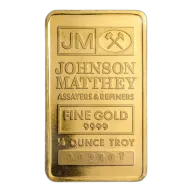
Johnson Matthey ceased retail bullion bar production in 2000, so every JM gold bar on the market today is a vintage piece trading on the secondary market. That changes the buying calculus. This is not a current product with a steady mint supply; it is a discontinued bar from one of the most storied names in refining, a London firm founded in 1817, appointed Official Assayers and Refiners to the Bank of England in 1852, and the longest-standing London Good Delivery gold refiner, accredited in 1961.
That pedigree matters for resale. Vintage JM bars and rounds are among the most recognised and liquid secondary-market bullion items, trading near spot with minimal dealer friction. From roughly 1971 to 2000, Johnson Matthey, Inc. was the largest manufacturer of minted bullion bars in North America, so dealers across the US and Canada know the pick-and-hammer hallmark on sight.
The 1/4 oz weight (7.78 g) is a niche size for gold bars; most fractional gold trades as coins, and bars at this weight carry premiums similar to coins rather than the discount bars usually enjoy. The price point of roughly $650-$800 at current gold prices makes it accessible for regular buying, with meaningfully lower premiums than 1/10 oz gold formats. Buyers here are typically paying for the JM name and fractional flexibility together.
1/4 oz Johnson Matthey Gold Bar Specifications
| Attribute | Detail |
|---|---|
| Weight | 1/4 troy oz (7.7758 g) |
| Purity | 9999 fine gold (99.99%) |
| Form | Minted bar |
| Refiner | Johnson Matthey |
| Production | Discontinued; retail bar production ended 2000 |
Johnson Matthey produced investment bars in multiple gold and silver sizes through to around 2000, alongside its institutional 400 oz LBMA Good Delivery cast bars made from 1961. As secondary-market items, individual vintage bars vary in packaging condition; bars in intact original packaging resell best, while loose bars from even a famous refiner can need re-verification. At 1/4 oz the gold content is small enough that standard checks (precise weight, dimensions) are straightforward, and the tungsten-core counterfeiting concern that hangs over large gold bars is far less relevant at fractional sizes. The bar carries the JM hallmark; the company's history of documented quality guarantees dates back to being the first London assayer to offer buy-backs on its assayed gold bars.
1/4 oz Johnson Matthey Gold Bar Tax Treatment
At 9999 fine, this bar clears every investment-gold purity threshold in use, and gold bars receive favourable sales tax treatment in most major markets.
- United Kingdom: Investment gold bars (995+ fine) are 0% VAT. Bars are never CGT-exempt, so gains above the £3,000 annual allowance are taxed at 18-24%; only UK legal tender coins escape CGT.
- United States: Most states exempt bullion from sales tax; a few tax it, and several exempt only above thresholds ($1,000 in New York and Massachusetts, $500 in Florida) that a single quarter-ounce gold bar may or may not meet depending on the gold price. Long-term gains are taxed at the collectibles rate of up to 28%. On IRAs, eligible bars must be 99.5%+ purity from LBMA/COMEX/NYMEX-accredited refiners; Johnson Matthey's Good Delivery accreditation transferred to Asahi in 2015, so custodian acceptance of vintage JM bars should be confirmed before purchase.
- Canada: Gold at 99.5%+ purity in bar form is GST/HST exempt.
- EU: Investment gold bars at 995+ purity are VAT-exempt across member states; capital gains treatment varies by country (Germany taxes nothing after a one-year hold).
- Australia and New Zealand: GST-free as investment-grade gold at 99.5%+ purity.
- Singapore and Hong Kong: Hong Kong has no sales tax or CGT; Singapore exempts qualifying investment gold under its IPM scheme, with the bar criteria referencing accredited refiners.
Two Centuries of Johnson Matthey
Percival Norton Johnson opened his assaying business at 79 Hatton Garden, London in 1817 with £150 of capital. George Matthey joined as an apprentice in 1838 and became a partner in 1851, and the firm's credentials accumulated from there: Official Assayers and Refiners to the Bank of England in 1852, a gold medal for platinum fabrication at the 1867 Paris International Exhibition, and manufacture of the international kilogram prototype in platinum-iridium for the Bureau International des Poids et Mesures in 1874. In 1919 the company co-founded the London Gold Fixing alongside N.M. Rothschild.
The North American bullion business that produced bars like this one grew through the 20th century, with a Toronto-based refining partnership from 1947, a Salt Lake City gold refinery opened in 1983, and operations in Brampton, Ontario. Through the 1970s and 1980s, JM and Engelhard were the two dominant producers of investment-grade bullion in North America.
The exit came in stages. Retail and investment bar production ceased in 2000, leaving only wholesale Good Delivery manufacture. In 2012 the JM name was licensed to Sunshine Minting for branded silver bars, and in March 2015 Asahi Holdings completed its $186 million purchase of JM's gold and silver refining businesses, taking the Salt Lake City and Brampton refineries and the LBMA Good Delivery status with it. Johnson Matthey PLC continues on the London Stock Exchange as a speciality chemicals company, no longer active in bullion, which is why its bars now exist only as vintage stock.