
 IDC Coin and Bullion
 Gold Stock Canada
Prices are fetched automatically and may not reflect current merchant prices. Currency conversions and tax treatment are approximate. Rankings are based solely on price. We are not a dealer and accept no responsibility for transactions with listed merchants. Past performance is not indicative of future results. This site does not provide investment advice. Full disclaimer
About the 10g Johnson Matthey Gold Bar
A Piece of British Refining History in 10 Grams
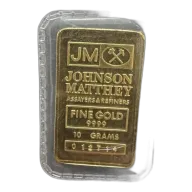
The 10g Johnson Matthey gold bar carries the hallmark of a refinery that no longer produces bullion. Johnson Matthey, founded in London in 1817, was one of the five members of the London Gold Fix for over a century and an LBMA Good Delivery refiner. The company sold its gold and silver refining operations to Asahi Refining in 2015, making every Johnson Matthey bar a finite product from a closed production line.
At 999.9 fine gold, the bar meets the universal standard for investment-grade bullion. It ships in a tamper-evident assay card with a serial number, weight, and purity certification. The 10g size sits at a price point around $1,000, comparable to a 1/4 oz gold coin, though with higher percentage premiums than larger bars due to fixed manufacturing costs per unit.
For buyers considering this bar, the key factor is provenance. Johnson Matthey bars trade on the secondary market at premiums that reflect both their metal content and their status as discontinued products from a historically significant refiner. Dealers worldwide recognise the JM hallmark, so liquidity is not a concern. The question is whether the heritage premium is worth paying compared to a current-production bar from an active LBMA refiner like 10g PAMP Fortuna or 10g Valcambi bar at a lower premium.
Collectors of refiner hallmarks and investors who value the historical connection will find the Johnson Matthey bar a distinctive holding. For pure cost efficiency, the premium over a generic or active-brand 10g bar is a real consideration.
10g Johnson Matthey Gold Bar Specifications
| Attribute | Value |
|---|---|
| Weight | 10 grams (0.3215 troy oz) |
| Purity | 999.9 fine gold (24 karat) |
| Manufacturer | Johnson Matthey (UK) |
| LBMA accredited | Yes (historic; refining sold to Asahi in 2015) |
| Packaging | Tamper-evident assay card with serial number |
| Face value | None (not legal tender) |
| Edge | Smooth |
Johnson Matthey operated refineries in Royston, Hertfordshire and Brampton, Ontario. The company held LBMA Good Delivery status and was one of the five members of the London Gold Fixing from 1919 until 2004, when the traditional twice-daily fix was conducted by telephone between five member firms. JM bars produced during this era carry the refiner's assay mark and a unique serial number. Bars in intact assay cards command the strongest resale values.
Tax Treatment of 10g Johnson Matthey Gold Bars
As a 999.9 fine gold bar from an LBMA-accredited refiner, the Johnson Matthey 10g bar qualifies for investment gold tax treatment across all major bullion markets. The bar is not legal tender in any jurisdiction.
- United Kingdom: VAT-exempt as investment gold (995+ fine, per HMRC rules). Subject to Capital Gains Tax on disposal at 18% or 24% depending on income, with a £3,000 annual CGT allowance. Not CGT-exempt because only UK legal tender coins (Britannias, Sovereigns) carry that exemption. SIPP-eligible for tax-relieved pension investment in physical gold.
- United States: No federal sales tax. State sales tax exemptions vary; approximately 35 states fully exempt bullion. Long-term capital gains taxed at the 28% collectibles rate. IRA-eligible at 99.5%+ purity from an LBMA refiner, though the bar must be held at an IRS-approved depository.
- Canada: GST/HST-exempt for gold bars at 99.5%+ purity. Capital gains taxed at a 50% inclusion rate (50% of the gain added to income).
- European Union: VAT-exempt as investment gold under Directive 98/80/EC for gold bars of 995+ fineness. Capital gains treatment varies by country; Germany exempts gains after a one-year holding period.
- Australia: GST-free for investment-grade gold at 99.5%+ purity. Capital gains tax applies on disposal, with a 50% CGT discount for holdings over 12 months.
- Singapore: GST-exempt under the Investment Precious Metals (IPM) scheme for gold at 99.5%+ purity. No capital gains tax.
- Hong Kong: No sales tax, no import duty, no capital gains tax.
- New Zealand: GST-exempt for fine gold at 99.5%+ purity in bar form.
- South Africa: Gold Krugerrands are zero-rated, but gold bars from private refiners carry standard 15% VAT.
Johnson Matthey vs Active LBMA Refiners at 10g
The 10g Johnson Matthey bar competes on the secondary market against current-production 10g bars from active refiners. Since JM ceased bullion production in 2015, every bar is pre-owned, which affects both pricing and availability.
The most direct comparison is the 10g PAMP Suisse Fortuna bar, the single most recognised minted gold bar globally. PAMP bars are in continuous production, widely stocked by dealers, and include Veriscan anti-counterfeiting technology that JM bars lack. For a buyer prioritising liquidity and ongoing dealer support, the Fortuna is the safer choice. The JM bar's advantage is its heritage appeal and the finite supply from a closed refinery.
Against the 10g Valcambi bar, the comparison is similar. Valcambi is Swiss, LBMA-accredited, and in active production. Valcambi bars tend to trade at slightly lower premiums than PAMP, making them the more cost-efficient option for stackers. JM bars will typically carry a higher premium than either Swiss refiner at this weight.
The 10g Perth Mint bar offers government-mint backing from Western Australia. Perth Mint bars come in CertiCard tamper-evident packaging and carry the kangaroo design. For Australian buyers, the Perth Mint bar has a home-market advantage; for international buyers, both JM and Perth bars are well recognised.
Buyers specifically seeking a British-made 10g gold bar might also consider the 10g Britannia bar from The Royal Mint, which is in current production, has sovereign-mint backing, and is equally VAT-exempt. The Britannia bar does not carry CGT exemption (that applies only to Britannia coins), but it offers active production and wider current availability than the discontinued JM product.
The practical question is straightforward: if you value the Johnson Matthey name and the history behind it, the modest premium over active-production bars is the price of owning a piece of British refining heritage. If your priority is lowest cost per gram of gold, an active LBMA refiner will serve you better.
10g Johnson Matthey Gold Bar: frequently asked questions
-
Johnson Matthey stopped producing retail and investment bullion bars in 2000. It continued wholesale LBMA Good Delivery bar production until selling its gold and silver refining businesses to Asahi Holdings in March 2015. The Johnson Matthey name was retained by the parent company and was not part of the sale, so all JM-branded bars circulating today are pre-owned secondary-market pieces.
-
Authentic JM bars carry the "Johnson Matthey" name, fineness stamp (999.9 or similar), weight, and a hallmark or assay mark. Verify weight against the stated specification with calibrated scales and confirm the bar is non-magnetic. For added assurance, use an ultrasonic thickness tester or have a dealer confirm with an XRF analyser.
-
The Johnson Matthey 10g bar contains 10g of 999.9 fine gold (effectively 24 carat). The gold content is 0.3215 troy ounces. All JM bars were produced to the stated fineness and weight, which are the definitive specifications to check when buying on the secondary market.