1 listing
Filters

 APMEX
APMEX
Prices are fetched automatically and may not reflect current merchant prices. Currency conversions and tax treatment are approximate. Rankings are based solely on price. We are not a dealer and accept no responsibility for transactions with listed merchants. Past performance is not indicative of future results. This site does not provide investment advice. Full disclaimer
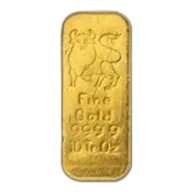
About the 10 oz Merrill Lynch Gold Bar
A 10 oz Gold Bar for Large Positions
The 10 oz Merrill Lynch gold bar contains 10 troy ounces of 999.9 fine gold, equal to 311.035 grams. Ten ounces is a substantial format: at recent gold prices a single bar of this size represents roughly $30,000 or more of metal, which puts it firmly in the territory of buyers building large positions rather than those accumulating gradually. The appeal is premium efficiency. Ten-ounce gold bars carry some of the lowest percentage premiums in retail bullion, typically 1 to 3 percent over spot, against 2 to 4 percent for 1 oz bars and 3 to 5 percent for 1 oz sovereign coins.
Physically the format is remarkable for its density. A 10 oz gold bar is roughly the size of a credit card, easy to store in any home safe or deposit box, yet it concentrates enormous value in one object. That concentration is also the main caution: selling a 10 oz bar is an all-or-nothing transaction. There is no way to liquidate part of the position without selling the whole bar, so buyers who anticipate selling in stages are usually better served by ten separate 1 oz gold bars.
The 10 oz weight is less common in gold than in silver, where it is the dominant retail bar size. Among gold bars it sits between the popular 100g format and the kilo bar, and fewer refiners produce it. Buyers comparing options at this scale should check the listed price per ounce against both the 100g gold bar and kilo alternatives before committing.
Tax Treatment of 10 oz Gold Bars by Country
At 999.9 fineness this bar exceeds every investment gold purity threshold in the markets BullionFerret tracks, so sales tax treatment is favourable almost everywhere. Capital gains rules are a separate matter and vary widely.
- UK: 0% VAT on investment gold bars at 995 fineness or above. Bars are never CGT-exempt in the UK; only UK legal tender coins qualify, so gains above the £3,000 annual allowance are taxed at 18% or 24% depending on income.
- EU: 0% VAT under the Investment Gold Directive for bars at 995 fineness or above. Capital gains rules differ by country: Germany taxes no gains on bullion held over a year, while France applies its own flat regimes.
- US: No federal sales tax. Roughly 35 states exempt bullion, and a purchase of this size clears every state threshold (the highest is California at $2,000). Long-term gains are taxed at the collectibles rate of up to 28%, plus the 3.8% Net Investment Income Tax for some taxpayers.
- Canada: 0% GST/HST on gold at 99.5% purity or higher.
- Australia: 0% GST on investment-grade gold at 99.5% purity or above. CGT applies on disposal, with a 50% discount for individuals holding longer than 12 months.
- New Zealand: GST-exempt at 99.5% purity or above.
- Singapore and Hong Kong: No GST on qualifying investment precious metals in Singapore, no sales tax of any kind in Hong Kong, and no capital gains tax in either.
10 oz Gold Bar vs 100g, Kilo, and Ten 1 oz Bars
The closest metric rival is the 100g gold bar, which at 3.215 troy oz is roughly a third of the size and one of the most popular gold bar formats in Europe. Premiums on 100g bars run 2 to 4 percent, slightly above the 1 to 3 percent typical of a 10 oz bar, so the larger format wins on cost per ounce. The 100g bar wins on flexibility: three 100g bars can be sold separately, while a 10 oz bar cannot.
Splitting the same outlay across ten 1 oz gold bars costs more in premium, since 1 oz minted bars run 2 to 4 percent over spot, but it gives complete divisibility and the widest possible pool of buyers at resale. Every dealer worldwide trades 1 oz gold products daily, whereas a 10 oz bar draws from a narrower buyer pool at its price point, even though institutional buyers and refiners accept large bars readily.
For brand-conscious buyers, the established refiners producing 10 oz gold bars include PAMP Suisse, Valcambi, the Royal Canadian Mint, and the Perth Mint. Bars from LBMA-accredited refiners in sealed packaging command tighter spreads at buyback. One further caution applies specifically to larger gold bars: gold-plated tungsten counterfeits are a documented risk at 100g and above, because tungsten's density nearly matches gold's. Buying from reputable dealers and favouring sealed bars with serial numbers addresses this; ultrasonic testing is the reliable non-destructive check for large bars bought on the secondary market.