 Compass Bullion


 APMEX
APMEX
Prices are fetched automatically and may not reflect current merchant prices. Currency conversions and tax treatment are approximate. Rankings are based solely on price. We are not a dealer and accept no responsibility for transactions with listed merchants. Past performance is not indicative of future results. This site does not provide investment advice. Full disclaimer
About the 1g East India Company Una and the Lion Gold Bar
The 1g East India Company Una and the Lion Gold Bar
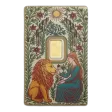
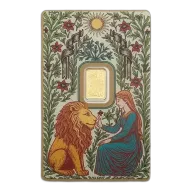
This 1 gram bar of .9999 fine gold puts one of the most celebrated images in British numismatics on the smallest standard gold bar weight. Una and the Lion comes from William Wyon's 1839 five-pound gold coin, widely regarded as one of the most beautiful coins ever produced, showing the young Queen Victoria as Lady Una from Spenser's The Faerie Queene guiding the British Lion. The modern East India Company revives that pairing across its St Helena bullion programme, and this bar makes the design available at the lowest possible entry price for physical gold.
Be clear about what a 1g product is for. Gram bars carry premiums of roughly 8-15% over spot, the highest premium-to-metal ratio of any bar weight, because manufacturing, assaying, packaging, and distribution costs are essentially fixed regardless of size and dominate the price of a gram. Buying a full ounce as individual 1g bars costs substantially more than a single 1 oz gold bar. The market for this weight is gifting, novelty, and low-budget entry into gold ownership, and a bar carrying a famous design with a literary pedigree fits the gifting role better than a plain refinery wafer.
The branding adds collector context that generic gram bars lack. The East India Company name is itself a licensed revival: the historic company was dissolved in 1874, and the modern entity, established in 2010, operates under licence from the UK government, producing coins and bullion for the Government of Saint Helena among others. You are buying a small piece of gold wrapped in a great deal of story.
Tax Treatment of 1g Gold Bars
At .9999 fineness this bar qualifies as investment gold in every jurisdiction that defines the category, so purchase taxes are rarely the issue; the small size mainly matters where exemption thresholds are price-based.
- United Kingdom: 0% VAT as investment gold (995+ fineness). Bars are never CGT-exempt, since that relief is reserved for UK legal tender coins, but at roughly the £100 scale of a gram bar, gains will sit comfortably inside the £3,000 annual CGT allowance for most buyers.
- United States: no federal sales tax; most states exempt bullion, but the threshold states are a real consideration at this price point. A single 1g bar falls below Florida's $500 exemption floor and the $1,000+ thresholds in New York, Massachusetts, and Louisiana, and California's $2,000 line, so small purchases can be taxable in states where a larger order would not be. Capital gains are taxed at the 28% collectibles rate.
- EU: VAT-exempt as investment gold under Directive 98/80/EC; in Germany, gains are tax-free after a one-year hold.
- Canada: 0% GST/HST for gold at 99.5%+ purity in bar or wafer form.
- Australia: 0% GST for investment-grade gold; pieces priced far above metal value can fall outside the exemption; designer bars are the products most affected.
- New Zealand: GST-exempt at 99.5%+ purity; no capital gains tax.
- Singapore: GST-exempt under the IPM scheme for qualifying gold bars; no CGT.
- Hong Kong: no sales tax, no duty, no CGT.
Una and the Lion: From 1839 to the Modern Series
The original Una and the Lion was created by William Wyon, Chief Engraver at the Royal Mint, for an 1839 five-pound gold coin. His decision to depict the reigning Queen Victoria as a fictional character, Lady Una from Book I of Edmund Spenser's 1590 epic The Faerie Queene, was unprecedented in British coinage. Una represents truth, protected by a lion standing for England, and the inscription "DIRIGE DEUS GRESSUS MEOS" ("May God direct my steps") circled the pair. Only a few hundred were struck for collector sets; a proof example has sold at auction for over £500,000.
The design's modern revival runs on two tracks. The Royal Mint issued a faithful reproduction of Wyon's reverse in 2019 under its Great Engravers series. Separately, from 2020 the East India Company began an annual bullion series for the Government of Saint Helena, designed by Glyn Davies, that reinterprets Una and her lion in a fresh pose each year rather than copying the original; the 2024 release is subtitled "Faerie Queene" in direct acknowledgement of the poem. The coin programme spans silver from 1 oz to 1 kg and gold from 0.5 g proofs upward, with deliberately low mintages, and this 1g gold bar extends the same design franchise into bar form.
Saint Helena itself adds a layer of history: a British Overseas Territory in the South Atlantic, one of the most remote inhabited islands in the world, and best known as the place of Napoleon's exile. Its coins and bullion carry the British monarch's effigy, Queen Elizabeth II through 2022 and King Charles III from 2023.
Una and the Lion Bar vs PAMP, Valcambi, and CombiBar Grams
The 1g gold market is dominated by Swiss refinery wafers. The most recognised is the 1g PAMP Suisse Fortuna, whose assay-card format is the global standard, with Valcambi, Perth Mint, Royal Mint, Argor-Heraeus, and the Istanbul Gold Refinery filling out the field. Those bars are pure utility: maximum brand recognition, dealer acceptance everywhere, and resale that depends on the sealed assay card staying intact. The Una and the Lion bar competes instead on design and story, putting a six-figure-auction coin motif and a 400-year-old literary reference on a product that usually carries nothing but a logo.
The trade-off is the usual one for designer bullion at tiny weights. Recognised refinery grams are the easier resale; unbranded or niche-brand gram bars have poorer prospects with dealers, and gram bars in general recover their high acquisition premiums badly when sold back, doing better on secondary collector markets than at the dealer counter. A buyer accumulating gold should not be at this weight at all; the premium mathematics favour larger bars decisively.
One alternative deserves specific mention for buyers who like the gram format but want efficiency: the Valcambi CombiBar, a perforated sheet of 50 or 100 individual 1g segments that snap apart as needed. Its per-gram premium is lower than buying gram bars separately, and it stores as a single piece. That is the rational gram-gold purchase; the Una and the Lion bar is the romantic one, and both descriptions are accurate.
1g East India Company Una and the Lion Gold Bar: frequently asked questions
-
The cheapest 1g Una and the Lion gold bar we track is $218.20 from Compass Bullion, around 62.0% over the $4,188.30 gold spot price. A 1g bar holds 1g of 999.9 fine gold, so the metal value is $4,188.30 divided by 31.1035. The dealer premium on 1g bars tends to be proportionally higher than on larger sizes.
-
Una is the heroine of Book I of Edmund Spenser's epic poem "The Faerie Queene" (1590), where she represents truth and is accompanied by a protective lion. In 1839, Royal Mint engraver William Wyon depicted the young Queen Victoria as Una on a gold five-pound coin, with a lion representing England walking beside her. The modern St Helena series by the East India Company creates annual reinterpretations of that pairing.
-
Wyon's 1839 original was unprecedented: it portrayed a reigning monarch as a fictional literary character, something no British coin had done before. Only a small number were struck for collector sets, making genuine examples rare and valuable at auction. The design's combination of classical portraiture, literary symbolism, and Wyon's exceptional engraving skill has made it widely admired. An original proof example has sold for over 500,000 GBP.
-
Weigh it on a precision scale: a genuine 1g gold bar should register exactly 1.000g. Check that the 999.9 purity mark and East India Company hallmark are present and cleanly struck. Proof and presentation versions come encapsulated with a certificate of authenticity. For any gold bar at this weight, buying from a reputable bullion dealer is the most reliable assurance, as counterfeits targeting small bars do exist.