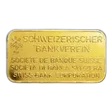
 APMEX
APMEX
1 listing
Filters
| Product | /oz | Premium | Price | |
|---|---|---|---|---|
| $4,469.29 | +6.89% | $4,469.29 | View Deal |

Prices are fetched automatically and may not reflect current merchant prices. Currency conversions and tax treatment are approximate. Rankings are based solely on price. We are not a dealer and accept no responsibility for transactions with listed merchants. Past performance is not indicative of future results. This site does not provide investment advice. Full disclaimer
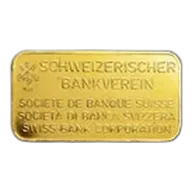
About the 1 oz Swiss Bank Corporation Gold Bar
A 1 oz Gold Bar Carrying a Vanished Swiss Banking Name
Swiss Bank Corporation was one of the big Swiss banks of the twentieth century and a significant presence in the bullion world: it owned the Metalor refinery, Switzerland's first LBMA-listed bullion producer, from 1918 until SBC's merger with UBS in 1998. That merger ended SBC's existence as an independent bank, so bars carrying the Swiss Bank Corporation name connect to a chapter of Swiss gold history rather than to a refinery you can buy from today. This bar contains 1 troy oz (31.1035 g) of .9999 fine gold.
As a gold position, the 1 oz bar is the sweet spot of the bar market: the best balance of premium efficiency and resale liquidity, with minted 1 oz bars typically running 1-4% over spot against 3-8% for sovereign 1 oz coins. The trade-off for any bank-branded or older bar is recognition. Current-production bars from LBMA-accredited refiners in sealed assay cards are the most liquid format; bars from names no longer in production can require a dealer to weigh, measure, or test before quoting, and packaging condition matters more.
The natural buyers here are those who like the Swiss banking provenance, or who find these bars priced competitively against current production. Buyers who just want the most liquid ounce of bar gold should compare against live-brand alternatives like a 1 oz PAMP Suisse bar before deciding.
1 oz Swiss Bank Corporation Gold Bar Specifications
| Attribute | Value |
|---|---|
| Weight | 1 troy oz (31.1035 g) |
| Purity | .9999 fine gold |
| Form | Minted bar |
| Brand | Swiss Bank Corporation (bank merged into UBS, 1998) |
The .9999 fineness is the four-nines standard for retail gold bars, comfortably above the 995 minimum that defines investment gold in the UK and EU and the 99.5% thresholds used in Canada, Australia, New Zealand, and Singapore. At one ounce the bar is compact, and gold's density (19.32 g/cm3) packs the full value into a piece that stores in any small safe.
Authentication deserves attention with any bar that trades on the secondary market. The tungsten-core substitution risk that exists for gold bars is mainly a concern at 100g and larger, where a plated core can pass weight and dimension checks; at 1 oz, electromagnetic verifiers such as the Sigma Metalytics unit are effective, and ultrasonic testing is definitive if ever needed. Where a bar survives in original sealed packaging, keeping it sealed protects resale value, since an opened bar may need re-assaying before a dealer pays full buyback. Loose bars should be stored so the soft gold surface avoids contact scratches, which reduce eye appeal even though they do not affect metal value.
Tax Treatment of a 1 oz .9999 Gold Bar
Investment-gold rules treat this bar generously in most jurisdictions; the main split is between sales-tax treatment (favourable nearly everywhere) and capital gains treatment (bars never get the legal tender exemptions coins sometimes enjoy).
- United Kingdom: VAT-free as investment gold at 995+ fineness. Bars are not CGT-exempt, so gains above the £3,000 annual allowance are taxed at 18-24%; only UK legal tender coins escape CGT.
- EU: 0% VAT on investment gold bars at 995+ fineness under Directive 98/80/EC. Capital gains vary by country; Germany taxes nothing after a one-year hold.
- United States: no federal sales tax; most states exempt bullion, and a 1 oz gold bar clears the dollar thresholds used by states like California ($2,000) and New York ($1,000). Long-term gains are taxed at the collectibles rate of up to 28%. IRA eligibility requires 99.5%+ purity from an LBMA/COMEX/NYMEX-accredited refiner, so eligibility for a discontinued bank brand depends on custodian acceptance.
- Canada: GST/HST exempt at 99.5%+ purity in bar form.
- Australia and New Zealand: GST-free at 99.5%+ gold purity.
- Singapore: 0% GST for qualifying investment gold bars; no capital gains tax.
- Hong Kong: no sales tax, no import duty, no capital gains tax.
SBC Bar vs Current-Production Swiss Bars and 1 oz Coins
The straightforward modern alternatives are the live Swiss refinery brands. PAMP Suisse's Fortuna, Valcambi 1 oz bars, and Argor-Heraeus bars are all current LBMA-accredited production, sold sealed in tamper-evident assay cards with serial numbers, and accepted by dealers globally with minimal friction. PAMP and Valcambi add VeriScan-style verification technology and Argor-Heraeus its kinebar holography, security layers a legacy bank-branded bar predates. A discontinued name competes instead on price and provenance: where an SBC bar can be had below the carded premium of the big current brands, the gold content is identical at .9999 fine.
The other comparison is form. A 1 oz sovereign coin, a Britannia, Maple Leaf, or Krugerrand, costs a few percentage points more over spot but brings the strongest brand recognition in the market, standardised appearance every dealer knows on sight, and tax perks in specific countries (CGT exemption for UK legal tender coins in the UK). Bars win on premium, coins on exit convenience.
Discontinued brands are not automatically a liability: in the silver bar market, discontinued names like Engelhard and Johnson Matthey trade at collector premiums years after production ceased. Whether any given legacy brand attracts that following is set by collector demand, so the prudent approach is to price an SBC bar against current production and let the discount, or premium, justify the choice.
1 oz Swiss Bank Corporation Gold Bar: frequently asked questions
-
The cheapest 1 oz Swiss Bank Corporation gold bar in our comparison is $4,469.29, at 6.9% over the $4,188.30 gold spot price. Because SBC no longer produces bars, prices on the secondary market can vary more than for current-production brands, so checking across multiple dealers matters.
-
SBC bars circulate on the secondary market and carry no modern digital authentication. Check that the hallmarks show 999.9 fineness, the refiner's stamp, and weight clearly struck. Bars issued with an assay card should have a matching serial number on both bar and card. A Sigma Metalytics or XRF tester can confirm metal content without damaging the bar. When in doubt, have the bar tested by an accredited assayer before purchase.
-
Swiss Bank Corporation (SBC) merged with Union Bank of Switzerland to form UBS in 1998 and ceased to exist as an independent entity. Both SBC and Credit Suisse commissioned gold bars manufactured by third-party refineries to their specifications. The two brands are distinct, though both circulate as secondary-market Swiss gold bars. Credit Suisse itself was acquired by UBS in 2023, so neither brand is in active production today.
-
No. Swiss Bank Corporation merged into UBS in 1998 and has not produced bars since. All SBC-stamped bars available today are secondary-market pieces. They remain valid 999.9 fine gold bullion, accepted by most dealers, but they carry no manufacturer warranty or assay card from a currently active refinery.