11 products · 144 deals
Filters
| Product | /oz | Premium | Price | |
|---|---|---|---|---|

28 deals
|
$4,701.15 | +11.98% |
$377.86
£286
|
Compare |

11 deals
|
$4,723.37 | +12.51% |
$379.65
£287
|
Compare |

29 deals
|
$4,727.66 | +12.61% |
$379.99
£287
|
Compare |

25 deals
|
$4,743.13 | +12.98% |
$381.24
£288
|
Compare |

8 deals
|
$4,785.11 | +13.98% |
$384.61
£291
|
Compare |

21 deals
|
$4,828.42 | +15.01% |
$388.09
£293
|
Compare |

9 deals
|
$4,828.42 | +15.01% |
$388.09
£293
|
Compare |

4 deals
|
$4,824.40 | +15.10% | $387.77 | Compare |
| $4,857.37 | +16.46% | $390.42 | Compare | |

5 deals
|
$5,319.05 | +26.65% |
$427.53
£323
|
Compare |

2 deals
|
$5,477.75 | +31.50% |
$440.28
CA$623
|
Compare |
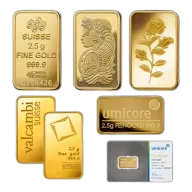
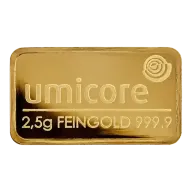
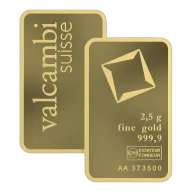
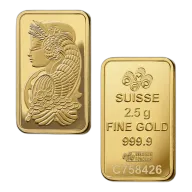



Prices are fetched automatically and may not reflect current merchant prices. Currency conversions and tax treatment are approximate. Rankings are based solely on price. We are not a dealer and accept no responsibility for transactions with listed merchants. Past performance is not indicative of future results. This site does not provide investment advice. Full disclaimer
About 2.5g Gold Bars
Who Buys 2.5g Gold Bars
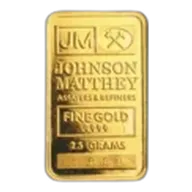
At 2.5 grams, or 0.0803 troy ounces, this is roughly one-twelfth of an ounce of gold and one of the most accessible gold bar denominations on the market. At 2026 prices a 2.5g bar represents a few hundred dollars, which opens physical gold ownership to budgets that a 1 oz bar excludes entirely. The weight is exclusively a gold format: no silver bars are produced at 2.5g, because silver's value density makes a bar that small impractical.
Three buyer profiles dominate. The first is the gift buyer: the sealed, credit-card-sized assay card, brand recognition (especially the PAMP Fortuna), and accessible price make 2.5g bars one of the most popular bullion gifts, and gram-denominated gold is a standard gifting size in Middle Eastern and Indian markets, particularly around festivals and weddings. The second is the small-budget accumulator building a position a few hundred dollars at a time. The third is the buyer deliberately holding small, portable units, since a dozen of these bars takes less space than a deck of cards.
Regionally the weight is most at home in German-speaking Europe, where 2.5g is the dominant fractional gold bar denomination, and it is standard across metric-system markets in Asia and the Middle East. In the US and Canada it is available but less common than 1/10 oz coins, the troy-market equivalent. Standard purity is .9999 fine, so the bars qualify as VAT-exempt investment gold in the UK and EU, and bars from LBMA-accredited refiners meet IRS requirements for precious metals IRA inclusion.
The Premium Cost of Going Small
Premiums on 2.5g gold bars are high in percentage terms: roughly 8-15% over spot depending on brand and dealer, against the 1-4% typical of 1 oz minted bars. A buyer pays perhaps 10% more per gram than on a 1 oz bar for the privilege of the smaller denomination. That is the unavoidable economics of fractional gold: fabrication, assay packaging, and distribution costs are close to fixed per bar, so on a small bar they are a large slice of the price.
The useful framing is where 2.5g sits on the fractional curve, because the curve is brutal below it. One-gram bars run 15-30% over spot and 0.5g bars 30-50%, so the 2.5g weight is where small gold starts to make financial sense; it offers much better premium efficiency than anything smaller while staying affordable. Within the weight, brand drives the spread: PAMP Fortuna bars command the highest premiums, while Valcambi and generic bars sit at the low end. Buyback for sealed assay-carded bars from major refiners is typically at or slightly below spot, which means the entry premium is the cost you should expect to write off.
One alternative worth knowing about is the Valcambi CombiBar: a 50g or 100g bar perforated into 2.5g segments that snap off individually. It combines bulk-bar pricing with small-denomination divisibility, and for an accumulator who wants 2.5g pieces without paying the per-bar premium twenty times over, it is the more efficient route. For pure accumulation, the verdict from the premium table is plain: larger bars win, and 2.5g earns its place on convenience, gifting, and accessibility rather than cost.
Major 2.5g Gold Bars
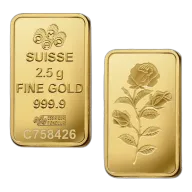
The PAMP Suisse Fortuna 2.5g is the single most recognisable small gold bar, carrying the Lady Fortuna design and the strongest secondary market demand of any fractional bar. It is the default choice for gifting, and that recognition is priced in: Fortuna bars sit at the top of the 2.5g premium range.
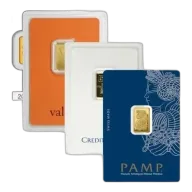
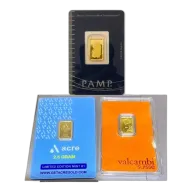
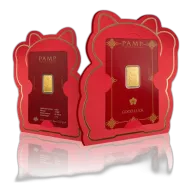
The value pick is Valcambi, the lower-premium Swiss option with a clean minted design in an assay card, and dealer listings bear this out, with the 2.5g Valcambi bar among the most widely stocked at this weight. Argor-Heraeus covers the weight in classic and Kinebar versions, the latter with holographic security in the bar surface. The Perth Mint 2.5g minted bar ships in CertiCard packaging and is popular in Australian and Asian markets, and Istanbul Gold Refinery bars serve Turkish and Middle Eastern buyers. Below the brand tier, generic 2.5g bars and a long tail of decorative issues fill out dealer listings at lower prices.
All of these are .9999 fine and sold sealed in assay cards: credit-card-sized packaging carrying the refiner's mark, serial number, weight, and purity certification. The card is integral to the product at this size, both as authentication and as the presentation that makes the bars work as gifts. The Valcambi CombiBar, available as 50g or 100g sheets of detachable 2.5g segments, rounds out the category for buyers who want the denomination without the per-bar premium.
Selling and Storing 2.5g Gold Bars
Liquidity is good for a fractional size. The 2.5g bar is the most common fractional gold bar denomination, sitting at the intersection of small enough to be affordable and large enough to be worth trading, and bars in original assay packaging sell easily to bullion dealers worldwide. PAMP Fortuna bars have the strongest secondary market of any fractional bar, followed by Valcambi, so the brand premium paid at purchase does buy something at exit: faster, cleaner resale.
The economics of selling are the weak point, not the saleability. With a low absolute value per bar, transaction costs such as shipping and insurance are proportionally heavy on a single-bar sale. These bars are best sold in quantity or in person; posting one insured 2.5g bar to a dealer can consume a painful share of its value. Buyback pricing for sealed assay-carded bars from major refiners typically lands at or slightly below spot.
The assay card is the asset to protect. Sealed packaging is what lets a dealer buy the bar without testing, so bars should stay in their cards, stored flat to avoid cracking the plastic. Storage is otherwise effortless: the card is credit-card sized, a dozen bars take up less space than a deck of cards, and gold needs no atmospheric precautions. The same form factor that makes storage trivial also makes the bars genuinely portable wealth, popular for cross-border travel within legal declaration limits. For accumulators who outgrow the denomination, the natural progression is up the bar scale toward 1 oz bars, where premiums fall sharply and each sale carries enough value to absorb its transaction costs.
2.5g Gold Bars: frequently asked questions
-
A 2.5g gold bar contains roughly 0.0804 troy oz of gold, so its metal value is approximately 0.0804 multiplied by $4,193.50. Retail prices sit above that to cover refining and dealer margin. We track listings from 69 dealers so you can compare the 152 offers currently available.
-
Investment-grade 2.5g gold bars are produced to .9999 fineness (24 carat). The purity is stamped on the bar itself and verified by an accompanying assay card.
-
Yes, particularly for resale. Bars from LBMA-accredited refiners carry broad global recognition and typically sell without buyer resistance. Products from less-known refiners may attract questions or a small liquidity discount. At the 2.5g size, dealer premiums can vary noticeably by brand, so comparing prices across refiners is worthwhile.
-
A minted 2.5g gold bar is very small, roughly comparable to a large postage stamp in area but considerably thinner. Exact dimensions vary between refiners. All 2.5g minted bars are compact enough to fit inside a standard assay card or blister pack.
-
Keep 2.5g bars in their original assay card or capsule to protect both the surface and the tamper-evidence seal, which supports resale value. For home storage, a fireproof safe bolted to a floor or wall is the practical minimum. For larger holdings, a professional bullion vault offers insurance and liquidity advantages that a home safe cannot match.